
Best Budget RMSc Red Dot Sights Compared by Fit

The Triton Nautilus2 suits most RMSc buyers because it mounts directly to compatible cuts and has integrated rear sights. Choose a different optic if you want an enclosed design, a larger dot, or multiple reticle options; an RMSc footprint is a mounting pattern, not a guarantee that every slide and screw set will fit.
We earn a commission if you buy through links on this page. As an Amazon Associate I earn from qualifying purchases. Products are compared on manufacturer specifications, not hands-on testing.
- Best overall: Triton Nautilus2 – Direct RMSc mounting and integrated rear sights distinguish it from the other options.
- Best for a simple dot: Monstrum Nitro – It pairs an RMSc footprint with a 3 MOA dot and motion activation.
- Best for reticle choice: ARORY RMSc Open Reflex – It offers a 2 MOA dot, 32 MOA circle, or circle-dot reticle.
- Best for an enclosed optic: OSIGHT SE Enclosed RMSc – Its enclosed design sets it apart from the open reflex options.
| Product | Best for | Reticle | Mounting | Weight | Shop |
|---|---|---|---|---|---|
| Triton Nautilus2 | Direct RMSc mounting | 3 MOA dot | RMSc direct mount | 0.1875 lb | Check Price on Amazon |
| Monstrum Nitro | Simple 3 MOA dot | 3 MOA dot | RMSc-compatible cuts | — | Check Price on Amazon |
| ARORY RMSc Open Reflex | Selectable reticles | 2 MOA, 32 MOA, circle-dot | RMSc; adapter options | 0.0644 lb | Check Price on Amazon |
| OSIGHT SE Enclosed RMSc | Enclosed emitter | 6 MOA dot | RMSc footprint | 0.0606 lb | Check Price on Amazon |
| CVLIFE Wolfprowl | Multiple base options | 3 MOA dot | RMSc; MOS adapter; Picatinny | 0.0750 lb | Check Price on Amazon |
RMSc Red Dot Sights Compared
Compare reticle, mounting approach, and design before choosing an optic for your slide.
Triton Nautilus2
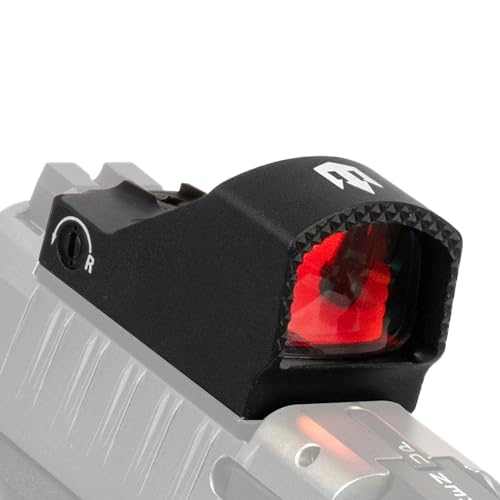
The Nautilus2 stands out for combining direct RMSc mounting with rear sights integrated into the optic housing. Its footprint also covers 407K and 507K patterns, and the maker names the 43X MOS, P365, and Hellcat as compatible examples. The 3 MOA dot gives buyers a single-dot reticle rather than multiple selectable shapes. The maker says it has Shake Awake and a 50,000-hour battery life. Choose it if built-in rear sights matter; buyers wanting an enclosed emitter or a larger dot should compare other designs.
Bottom line: Choose it if direct mounting and integrated rear sights are priorities.
Monstrum Nitro

The Nitro is a straightforward RMSc-compatible option with a 3 MOA dot and button-controlled illumination, rather than the integrated backup sights of the Nautilus2 or the selectable reticles of the ARORY. The maker says its Shake Awake mode shuts the dot off after one hour and turns it back on with movement. Multiple screw sets are included, and the compatibility includes Holosun K Series, 407K, 507K, and modified RMSc cuts. Its fit is limited to the specified pistol cuts, so buyers with another mounting platform should look elsewhere.
Bottom line: Pick it for an RMSc-compatible optic with one dot size and included screw sets.
ARORY RMSc Open Reflex

The ARORY offers the broadest reticle selection here: a 2 MOA dot, 32 MOA circle, or circle-dot combination. Its open reflex format also comes with a GL-MOS adapter plate and low Picatinny mount, unlike the direct-mount emphasis of some other options. The maker says it has 12 brightness settings, including two night-vision settings, and motion activation after sleep mode. Choose it when reticle choice or mounting flexibility matters. Buyers seeking an enclosed emitter should consider the OSIGHT SE instead, and installation requires checking slide cut, adapter needs, and screw length.
Bottom line: Choose it when selectable reticles and included mounting options are useful.
OSIGHT SE Enclosed RMSc

The OSIGHT SE is the enclosed-emitter choice, setting it apart from the open reflex formats in this group. It uses a 6 MOA dot, larger than the 2 or 3 MOA dots on several alternatives, and has a side-loading battery so battery replacement does not require removing the optic. The maker says it includes a motion sensor and an aspherical lens. This design suits buyers prioritizing an enclosed optic and a larger dot; the 6 MOA reticle is less suited to someone specifically seeking a smaller dot. Non-RMSc slides need a separate adapter plate.
Bottom line: Pick it for an enclosed design and a 6 MOA dot.
CVLIFE Wolfprowl

The Wolfprowl is the option with both an MOS adapter plate and a 21 mm Picatinny base included alongside RMSc compatibility. Its 3 MOA dot keeps the reticle simple, while a top-mounted battery can be changed without removing the sight. The maker says Motion Awake enters sleep mode after four minutes of inactivity and cites up to 50,000 hours of runtime. This is a useful fit when the included base options match the setup; buyers wanting multiple reticle shapes or an enclosed emitter should compare other designs.
Bottom line: Choose it when its included adapter or Picatinny base matches your mounting setup.
How to choose an RMSc red dot
Start with the slide cut and mounting hardware, then choose a reticle and optic design. RMSc describes a footprint pattern; it does not establish that every optic, slide, plate, or screw set will interchange. Some products also identify 407K/507K or modified RMSc compatibility, so match the maker’s compatibility notes to the exact slide. Dot size is measured in minutes of angle: 1 MOA spans about 1 inch at 100 yards, so a 6 MOA dot covers roughly 6 inches at that distance, compared with about 3 inches for a 3 MOA dot. A larger dot can be easier to see quickly, while a smaller dot covers less of a distant target. Choose based on the target distance and sight picture you need.
RMSc slide fit and mounting checks
RMSc compatibility alone is not enough to confirm a secure installation; verify the slide cut, any required adapter, and the correct screw length. This matters because the product options differ: some describe direct mounting, while others include adapter plates or list compatibility with modified cuts. Before installation, confirm the firearm is unloaded and keep ammunition away from the work area. Use the optic and firearm makers’ specified screw and torque requirements rather than guessing; over-tightening can damage threads or the optic, while loose hardware can shift under recoil. If the screw length or mounting method is uncertain, have a qualified gunsmith check the fit before firing.
Open and enclosed red dot designs
Open reflex and enclosed-emitter optics differ in how the emitter is housed: an open design leaves the emitter exposed, while an enclosed design places it inside the optic housing. That construction is a useful selection point if the optic may encounter debris or moisture, but it does not replace checking the specific product’s protection claims and care guidance. Reticles also vary: these options include single dots from 3 to 6 MOA and a model with a 2 MOA dot, 32 MOA circle, or both. A circle-dot reticle offers selectable shapes, while a single dot avoids switching among reticles. Match the enclosure and reticle to the environment and sight picture you prefer rather than treating either design as universally better.
Safe zeroing and routine checks
Zero a pistol optic only with the firearm pointed in a safe direction at an appropriate range, following the firearm and optic makers’ procedures. A practical decision rule is to confirm the dot’s point of impact at the distance you intend to use; a dot centered in the window does not by itself prove the optic is zeroed. Check that mounting screws remain secure after installation and inspect the optic for movement or damage before use. Battery access also affects upkeep: side- or top-loading designs allow battery changes without removing the sight, while other layouts may require removal. Keep the lens clean with materials suitable for coated optics, and do not use a damaged optic or loose mount until it has been checked.
Frequently Asked Questions
What does an RMSc footprint mean on a red dot?
RMSc identifies an optic mounting pattern used on compatible pistol cuts. Confirm the slide cut, adapter requirement, and screw length for the exact optic and firearm before installation.
Is a 3 MOA dot smaller than a 6 MOA dot?
Yes. At 100 yards, 3 MOA covers about 3 inches and 6 MOA about 6 inches; at shorter distances, the apparent coverage scales down proportionally.
Can I mount an RMSc optic without an adapter plate?
Only when the slide cut and optic are confirmed to match for direct mounting. Some slides require an adapter, and some optics include one while others do not.
How often should I check a pistol optic mount?
Inspect the mount before each use and after installation or battery work for loose screws, shifting, or damage. Use the specified torque for that optic and firearm rather than a generic value.
Does an enclosed pistol red dot need lens cleaning?
Yes. An enclosed housing does not keep the viewing lens free of fingerprints, dust, or residue; clean it with materials suitable for coated optics and inspect for damage before use.