
Best Cabinet Door Seal Strip Options Compared

NACONMLET White Cabinet Seal, 5 Rolls suits most cabinet doors because its adhesive-backed strip is specified for gaps from 2 to 9 mm and comes in five cut-to-fit rolls. Choose NACONMLET Gray Cabinet Seal instead for a gray finish and narrower 2–6 mm gaps; the other options are broader door-and-window seals rather than cabinet-focused strips.
We earn a commission if you buy through links on this page. As an Amazon Associate I earn from qualifying purchases. Products are compared on manufacturer specifications, not hands-on testing.
- Best overall: NACONMLET White Cabinet Seal, 5 Rolls – Its 2–9 mm fit range covers wider gaps than the gray cabinet strip, and five rolls can be cut to length.
- Best for gray cabinets: NACONMLET Gray Cabinet Seal – The gray tape targets modern cabinetry and is specified for 2–6 mm gaps.
- Best for mixed projects: Bantie D-Shaped Silicone Seal, 20 ft – Its flexible D-shaped strip is intended for cabinet, door and window frames with 1/8–1/4 inch gaps.
| Product | Best for | Gap range | Color | Total length | Shop |
|---|---|---|---|---|---|
| NACONMLET White Cabinet Seal, 5 Rolls | Wider cabinet gaps | 2–9 mm | White | 45.9 ft | Check Price on Amazon |
| NACONMLET Gray Cabinet Seal | Gray cabinet finishes | 2–6 mm | Gray | 45.9 ft | Check Price on Amazon |
| Bantie D-Shaped Silicone Seal, 20 ft | Mixed frame projects | 3.2–6.4 mm | Black | 20 ft | Check Price on Amazon |
| Brandzini Clear Silicone Weather Strip | Wide frame gaps | — | Clear | 33 ft | Check Price on Amazon |
Best cabinet door seal strips
Compare each strip by its gap fit, finish and roll length before choosing one for a cabinet seam.
NACONMLET White Cabinet Seal, 5 Rolls

NACONMLET White Cabinet Seal, 5 Rolls covers a broader stated cabinet-gap range than the gray version, accommodating 2–9 mm openings. The package contains five 1/2-inch-wide rolls, each 9.18 feet long, for a combined 45.9 feet; cut the strip to the needed run. The maker advises cleaning and drying the surface, warming the adhesive with a hair dryer for two minutes in winter, and leaving the door mostly undisturbed for 12 hours after application. The limitation is its white finish, which may stand out against dark cabinet interiors.
Bottom line: Pick this for a white cabinet with a measured 2–9 mm gap.
NACONMLET Gray Cabinet Seal
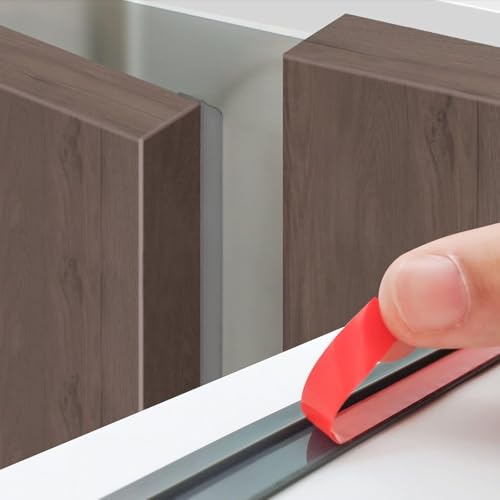
NACONMLET Gray Cabinet Seal is the color-matched choice for gray cabinetry, with a 2–6 mm gap range. It is self-adhesive weather stripping intended for wardrobes and aluminum window gaps, so it can suit a cabinet seam when its narrower fit range matches. The gray color is the main distinction from the white option, rather than a larger stated gap capacity. Measure the closed-door gap first: a seam wider than 6 mm falls outside the specified range, making this a poor fit for that opening.
Bottom line: Choose this when a gray finish and a 2–6 mm gap are the priorities.
Bantie D-Shaped Silicone Seal, 20 ft

Bantie D-Shaped Silicone Seal, 20 ft uses a flexible black D-shaped silicone profile, unlike the flatter cabinet-focused strips. The maker gives a recommended gap range of 1/8 to 1/4 inch and says the 20-foot roll can be trimmed for cabinet, door or window frames. That makes it a possible cabinet option when the seam matches the range, while also serving broader frame-sealing tasks. Its limitation for cabinet buyers is the wider, general-purpose profile and shorter roll compared with the two five-roll cabinet options.
Bottom line: Pick this for a measured 1/8–1/4 inch gap across mixed frame projects.
Brandzini Clear Silicone Weather Strip

Brandzini Clear Silicone Weather Strip is a clear, 35 mm-wide silicone weather strip designed for doors, windows and frames rather than specifically for cabinet seams. Its 33-foot total length across two packs may suit a buyer who needs a broad strip for several frame runs and wants a transparent finish. The product facts do not give a cabinet-gap range, so do not choose it by width alone; confirm the fit and clearance for the cabinet door before ordering. Its broad 35 mm width also makes it less discreet than a narrow cabinet seal.
Bottom line: Consider this only when a broad clear frame strip suits the cabinet design.
How to choose a cabinet door seal strip
Measure the closed-door gap before choosing adhesive weather stripping; the gap range is more important than roll length. A ruler or feeler gauge can help identify the widest point, since cabinet doors may sit unevenly along the edge. Pick a strip whose range includes that measurement, with a little compression when the door closes rather than forcing the door against an overfilled seal. For example, a gap from 7 to 9 mm fits the white option’s range but exceeds the gray option’s 6 mm limit. Also match strip color and profile to the cabinet edge: a bulky D-shape can be more visible than a narrow flat strip.
Adhesive seals need a clean, dry, smooth surface for contact. Remove dust and grease and let the surface dry fully before application; a textured or unfinished edge may hold adhesive less reliably than a smooth finished panel.
Cabinet seal gap fit and profile
Gap fit separates the cabinet strips: the white cabinet tape covers 2–9 mm, while the gray cabinet tape covers 2–6 mm. A wider opening is not automatically solved by pressing a thicker strip into it; too much compression can prevent the door from closing or pull the adhesive loose. The D-shaped general-purpose strip specifies 1/8–1/4 inch, approximately 3.2–6.4 mm, so it overlaps some cabinet gaps but not the full range of the white tape.
Use the largest gap measurement from the door’s full travel, not just one corner. If the gap varies materially from top to bottom, a single thickness may seal one area while obstructing another; adjust the door alignment or select a profile suited to the range.
| Measured gap | Candidate strip | Fit note |
|---|---|---|
| 2–6 mm | White or gray cabinet strip | Both stated ranges include it |
| Over 6 to 9 mm | White cabinet strip | Gray range ends at 6 mm |
| 1/8–1/4 in | Black D-shaped strip | General-purpose frame profile |
Installing adhesive cabinet weather stripping
Adhesive-backed strips bond best to clean, dry surfaces; grease, dust and moisture can weaken the initial contact. Measure each side, cut the strip with scissors, and apply it without stretching, since a stretched strip can pull back at the ends. Press along the run to seat the adhesive and keep the cabinet door from repeated opening and closing during the first 12 hours when using the white strip, as its maker advises.
Cold conditions can reduce adhesive tack. For the white strip, the maker recommends warming its adhesive with a hair dryer for two minutes in winter. Use gentle heat and avoid overheating nearby finishes or placing heat close to flammable materials.
Common cabinet seal strip fit mistakes
The most common mistake is choosing by total footage before checking the gap and profile. A 35 mm-wide clear strip may cover a broad frame surface but can be conspicuous on a cabinet edge, while a D-shaped strip designed for 1/8–1/4-inch gaps may be too compressible for a very narrow seam. Door clearance also matters: if added thickness keeps a cabinet door from latching or closing flush, remove the strip rather than forcing the hinge or latch.
Do not assume a seal strip makes a cabinet airtight or soundproof; these products are gap fillers, and the facts do not establish a performance rating. For kitchen cabinets near heat sources, keep adhesive and silicone within the maker’s application use and do not treat a door seal as a fire barrier.
Frequently Asked Questions
How do I measure a cabinet door gap accurately?
Measure the space between the closed door and cabinet frame at several points, including both ends and the center. Choose a strip whose range includes the largest measurement without preventing the door from closing.
Can I cut cabinet weather stripping to length?
Yes, the white cabinet strip and black D-shaped strip are described as cut-to-fit. Measure each run and cut cleanly with scissors so the ends meet without stretching the strip.
How long should adhesive seal strip set before use?
For the white cabinet strip, its maker advises avoiding frequent opening and closing for the first 12 hours. That gives the adhesive time to settle before the door repeatedly pulls against the strip.
Will a cabinet seal strip stop all dust?
A seal strip can reduce an open gap, but it should not be treated as an airtight barrier. A door that is misaligned or has gaps outside the strip’s fit range may still admit dust.
What should I do if the cabinet strip will not stick?
Clean and fully dry the mounting surface before applying adhesive-backed tape. In winter, the maker of the white cabinet strip recommends warming its adhesive with a hair dryer for two minutes.