
Best Car Battery Terminal: 5 Options Compared by Fit

SINGARO 4-Way Gold-A Terminals is the best car battery terminal for most people who need several cable connections, because its four ports accept 1–4 AWG cables and it fits SAE/JIS A posts. Choose a vehicle-specific replacement instead if your battery uses Nissan-style terminal assemblies or you only need a basic positive-and-negative pair.
Battery terminals clamp cable ends to battery posts; matching polarity, post type and cable size matters for a secure connection.
We earn a commission if you buy through links on this page. As an Amazon Associate I earn from qualifying purchases. Products are compared on manufacturer specifications, not hands-on testing.
- Best overall: SINGARO 4-Way Gold-A Terminals – Four cable ports per terminal accommodate multiple 1–4 AWG cable connections on SAE/JIS A posts.
- Best for Nissan fit: Nissan-Compatible Copper Terminal Pair – The pair is specified for a range of Nissan models and has red-positive and black-negative covers.
- Best for multiple cables: Four-Port Top-Post Terminal Set – Four ports and included felt washers suit setups with several cable connections.
| Product | Best for | Cable ports | Post fit | Shop |
|---|---|---|---|---|
| SINGARO 4-Way Gold-A Terminals | Multiple cables | 4 per terminal | SAE/JIS A | Check Price on Amazon |
| Nissan-Compatible Copper Terminal Pair | Nissan replacements | — | Nissan models | Check Price on Amazon |
| Four-Port Top-Post Terminal Set | Extra connections | 4 per terminal | Top post | Check Price on Amazon |
| Universal Top-Post Terminal Pair | Basic replacement | — | Top post | Check Price on Amazon |
| ACDelco Gold 3BA35 Terminal | Cable terminal | — | — | Check Price on Amazon |
Car Battery Terminals Compared
Compare cable connections and stated post compatibility before choosing a terminal pair or replacement.
SINGARO 4-Way Gold-A Terminals

Four cable ports per terminal set this pair apart for installations with several connections. SINGARO specifies tinned copper construction and compatibility with SAE/JIS A type A rear battery posts; the positive inner diameter is 17.5–19.1 mm and the negative is 15.9–17.5 mm. Its cable range is 1–4 AWG, with clamps for wire diameters of 5.2–7.4 mm. This pair suits cars, trucks, vans and RVs that use the matching post and cable sizes. The limitation is fit: confirm both post diameter and cable gauge before choosing it.
Bottom line: Choose this pair when you need four cable ports and your posts and cable gauges match.
Nissan-Compatible Copper Terminal Pair
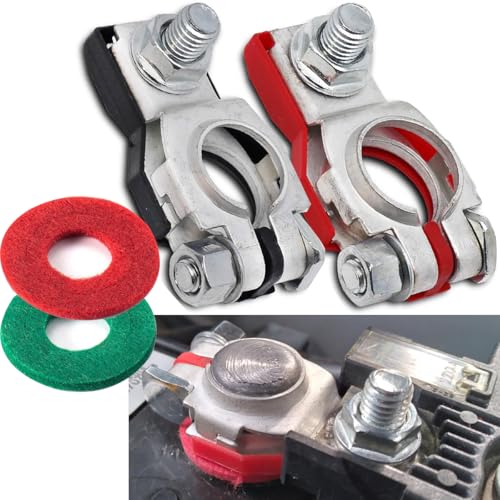
This pair is the vehicle-oriented choice, with red positive and black negative terminals and stated compatibility with a range of Nissan models from 1998 onward. The manufacturer identifies copper construction with a galvanized surface and plastic covers. The positive terminal is associated with part number 243407F000 and a 0.71-inch (18 mm) dimension; the name also includes 243407F001 for the negative side. It suits buyers replacing those Nissan-style assemblies rather than adding ports for extra wiring. Compatibility can vary by model and year, so verify that the part numbers match your vehicle before ordering.
Bottom line: Choose this pair when the Nissan application and terminal part numbers match your vehicle.
Four-Port Top-Post Terminal Set

Included felt washers distinguish this four-port top-post set from the other multi-cable option. The pair has color-coded positive and negative connectors and is intended for vehicles and small boats, including cars, trucks, RVs and camper setups. Four ports allow multiple cable connections, while the washers are supplied for the post area. This set suits buyers who want a general top-post replacement with several connection points. The maker does not give a cable gauge range or measured post diameter, so verify those dimensions against the battery and cable ends before buying.
Bottom line: Choose this set when you need four cable ports and have confirmed top-post compatibility.
Universal Top-Post Terminal Pair

Plastic bottom housings and separate red-positive and black-negative terminals make this pair a straightforward choice for a basic top-post replacement. The connectors include M8 nuts, and the positive terminal is identified with Nissan part number 243407F000 and a 0.71-inch (18 mm) measurement. The pair suits a buyer replacing matching terminal hardware without needing multiple cable ports. Its dimensions identify the positive side, but not a cable range or a full vehicle fit list. Confirm the negative terminal and post arrangement match your battery before installation.
Bottom line: Choose this pair for a basic replacement when its terminal dimensions and polarity match.
ACDelco Gold 3BA35 Terminal

The ACDelco Gold 3BA35 is identified as a battery cable terminal, rather than a clearly specified multi-port pair or vehicle-specific set. ACDelco says it is manufactured to meet expectations for fit, form and function. This option may suit a replacement where the 3BA35 part is already confirmed for the vehicle and cable assembly. It is less useful when selecting a universal terminal by dimensions alone.
Bottom line: Choose this terminal only when the 3BA35 part matches your cable and vehicle application.
How to choose a car battery terminal
Choose by post style, cable gauge and number of connections, in that order. SAE top posts are tapered, with the positive post larger than the negative; typical diameters are about 0.69 inch positive and 0.59 inch negative. JIS posts are smaller, so a terminal meant for SAE posts may not clamp securely on them. Cable gauge also matters: lower AWG numbers mean thicker wire, and a clamp must fit the conductor rather than just the insulation. Use this quick decision guide before comparing materials.
| Need | Choose |
|---|---|
| Several cable connections | A terminal with enough ports and a cable gauge range matching each wire |
| Replacement on a specific vehicle | A terminal matched to its application or part number |
| Basic top-post service | A positive-and-negative pair that matches the post diameters |
When a terminal’s post or cable range does not match your measured parts, do not force the fit; choose a compatible connection instead.
Top-post fit and cable sizing
Top-post terminals need to match both post taper and polarity; the positive post is usually wider than the negative, so reversing clamps can damage the connection. For cable size, AWG numbers run opposite to thickness: 1 AWG is larger than 4 AWG. As a measurable rule, if a cable falls outside the terminal maker’s gauge or diameter range, select another terminal rather than trimming strands to make it fit. Multiple-port clamps also need room for every lug to sit flat without crowding or crossing exposed metal.
Terminal materials and connection styles
Lead, copper and plated copper terminals are common; copper and tinned copper conduct electricity well, while plating can help limit surface corrosion. A four-port clamp is useful when separate accessories need connections at the battery, but unused ports do not improve a single-cable installation. Vehicle-specific terminal assemblies can simplify replacement when the original uses a molded cover or dedicated cable arrangement. Match an exact part number where available, since a universal-looking clamp may not match the cable end or post geometry. Felt washers can sit around the post to help manage corrosion residue, but they do not replace a tight, clean metal-to-metal terminal connection.
Safe battery terminal installation
Disconnect the negative cable first and reconnect it last; this reduces the chance that a tool touching the vehicle body will short the positive terminal. Remove jewelry and use an insulated wrench, keeping metal tools from bridging the posts. Lead-acid batteries can release flammable hydrogen gas, so keep sparks, flames and cigarettes away during service. Clean corrosion with a battery-terminal brush and avoid letting residue enter the battery vents. Tighten the terminal only to the vehicle or battery maker’s torque specification: overtightening can deform a post or clamp, while a loose terminal can heat under load. If the battery is swollen, leaking or damaged, leave service to a qualified technician.
Frequently Asked Questions
How can I tell positive from negative battery posts?
The positive post is generally larger, about 0.69 inch in diameter on a typical SAE top-post battery, versus about 0.59 inch for negative. Battery markings and red positive covers also identify polarity; never rely on cable color alone.
Can I use an SAE terminal on a JIS battery?
Not unless the terminal dimensions match the post. JIS posts are typically smaller than SAE posts, and a clamp that does not seat securely can loosen or overheat.
What order should I disconnect battery terminals?
Disconnect the negative terminal first and reconnect it last. Keeping the negative cable disconnected while working on positive reduces the chance of a tool shorting the positive post to the vehicle body.
How tight should a battery terminal clamp be?
Use the torque specification for the vehicle or battery, since clamp designs and posts differ. The connection should not rotate by hand, but overtightening can damage the post or terminal.
When should battery terminals be cleaned?
Clean visible corrosion when servicing the battery or when buildup interferes with a clean, tight connection. Use a terminal brush and keep corrosion residue out of battery vents; wear eye protection because battery electrolyte is corrosive.