
Best Car Cigarette Lighter Splitter: 5 Picks Compared

SUPERONE 180W 2-Socket Splitter suits most drivers because it combines two switched accessory sockets, up to 180W total output, USB charging and support for 12V and 24V vehicles. Choose JOYROOM 225W 2-Socket 7-in-1 Splitter if charging several phones or tablets at once matters more; choose a three-socket model if you need more accessory outlets.
A car cigarette lighter splitter turns one vehicle accessory socket into multiple power connections, but the vehicle circuit still limits the load. Add the wattage of every connected device and stay within both the splitter and vehicle limits.
We earn a commission if you buy through links on this page. As an Amazon Associate I earn from qualifying purchases. Products are compared on manufacturer specifications, not hands-on testing.
- Best overall: SUPERONE 180W 2-Socket Splitter – Two independently switched sockets, up to 180W total output and stated 12V/24V compatibility.
- Best for USB charging: JOYROOM 225W 2-Socket 7-in-1 Splitter – Five USB ports include two PD ports and three QC3.0 ports.
- Best for three sockets: LIHAN 127W 3-Socket Splitter – Adds three accessory sockets and four USB charging ports.
| Product | Best for | Accessory sockets | Socket output | USB ports | Shop |
|---|---|---|---|---|---|
| SUPERONE 180W 2-Socket Splitter | Switched dual outlets | 2 | 180W total | 1 USB-C PD 20W, 2 QC3.0 | Check Price on Amazon |
| JOYROOM 225W 2-Socket 7-in-1 Splitter | Multi-device USB | 2 | 225W total | 2 PD, 3 QC3.0 | Check Price on Amazon |
| LIHAN 127W 3-Socket Splitter | Three accessory sockets | 3 | 80W total sockets | 1 USB-C PD 30W, 1 QC3.0, 2 USB | Check Price on Amazon |
| JOYROOM 179W 3-Socket Splitter | Front and rear seats | 3 | 179W total | 1 USB-C PD 30W, 3 USB | Check Price on Amazon |
| 12V 2-Socket Splitter with 15A Fuse | Basic 12V split | 2 | 120W total | — | Check Price on Amazon |
Best car cigarette lighter splitters
Compare outlet count, power limits and USB charging features against the devices you plan to run.
SUPERONE 180W 2-Socket Splitter

SUPERONE 180W 2-Socket Splitter stands out for its two independent switches and stated compatibility with both 12V and 24V vehicles. The splitter provides up to 180W across its two accessory sockets and adds one 20W USB-C PD port plus two QC3.0 USB ports. A voltage display flashes when the reading falls below 12V, giving drivers a prompt to check the vehicle battery or electrical load. This layout fits drivers who want to control socket-powered accessories separately while charging USB devices. The display is a warning cue, not a substitute for checking the vehicle’s charging system or accessory circuit limit.
Bottom line: Choose this if separate socket switches and 12V/24V support matter.
JOYROOM 225W 2-Socket 7-in-1 Splitter
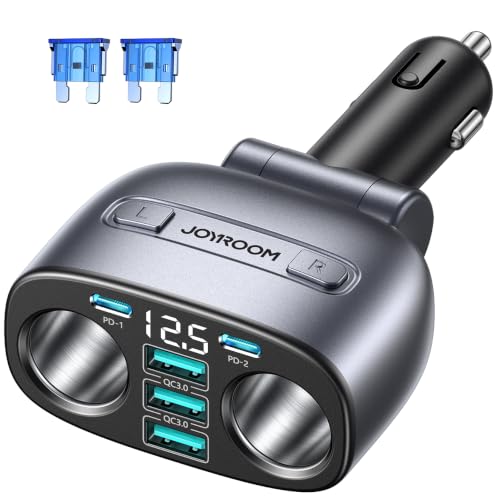
JOYROOM 225W 2-Socket 7-in-1 Splitter is the USB-heavy two-socket option, with five USB charging ports alongside its accessory outlets. The USB lineup includes 36W and 30W PD ports plus three QC3.0 ports rated at 30W each; the product says each fast-charge port runs at full speed individually. It is suited to a cabin where several passengers need phone or tablet charging while two socket devices remain connected. The 225W figure is total output, so it should not be treated as 225W available to each socket. Check device draw and vehicle circuit capacity before running multiple high-load accessories.
Bottom line: Pick this for several USB devices and two accessory sockets.
LIHAN 127W 3-Socket Splitter

LIHAN 127W 3-Socket Splitter adds three accessory sockets, which differentiates it from the two-socket splitters. It supports 12V and 24V vehicles and includes four USB ports: one USB-C PD port rated at 30W, one QC3.0 port and two standard USB ports. Its total output is 127W, with up to 80W for the three sockets. This configuration suits drivers who need several low-draw accessories and passenger charging in one setup. The combined socket limit is 80W, so it is a poor match for multiple high-wattage devices even though the headline total output is higher.
Bottom line: Choose this when three accessory outlets are more useful than higher socket wattage.
JOYROOM 179W 3-Socket Splitter

JOYROOM 179W 3-Socket Splitter separates itself with three accessory sockets and a 39.6-inch extension cable, making it useful when power needs to reach both front and rear seating areas. Its maker describes four charging ports, including PD30W USB-C, and up to seven connected devices across the sockets and charging ports. The product says it supports 12V/24V vehicles and has independent switches. This suits trucks, SUVs and RVs where rear-seat reach matters. The extension adds cable to manage in the cabin, and the total 179W limit still applies across connected devices rather than separately to each outlet.
Bottom line: Pick this when extended reach to rear passengers is the priority.
12V 2-Socket Splitter with 15A Fuse

12V 2-Socket Splitter with 15A Fuse is the simplest option here: a two-socket splitter for 12V devices, with a 120W maximum and a replaceable 15A fuse. Its 18AWG copper wire and PVC insulation are specified, with the sheath rated for heat resistance up to 105°C. That makes it a fit for two modest-load accessories when USB charging ports are not needed. Unlike the other options, it is described for 12V use, so do not assume it is suitable for a 24V system. A fuse protects against overcurrent, but it does not raise the vehicle socket’s own safe limit.
Bottom line: Choose this for two low-power 12V accessories without USB charging.
How to choose a car cigarette lighter splitter
Choose by the load and connections you need, not the largest headline wattage. A vehicle accessory socket is commonly protected at 10A or 15A; at 12V, those limits correspond to about 120W or 180W before allowing for voltage variation and circuit-specific restrictions. Check the vehicle manual or fuse panel for the actual socket rating, then add the wattage of every accessory that may run at once. If your combined load approaches the circuit’s limit, use fewer devices or a lower-draw setup. USB charging ports serve phones and tablets, while socket outlets are needed for plugs such as dash cams, coolers and inflators. Keep the splitter’s own stated maximum in view too: the vehicle circuit and adapter can have different limits, and the lower one governs.
Two sockets or three sockets
Choose two sockets for a smaller setup and three when the number of plugs is the constraint. More outlets do not increase the power available from the vehicle; they divide the same upstream circuit capacity among more devices. A typical 12V accessory circuit rated at 10A supports about 120W in theory, while a 15A circuit corresponds to 180W, but the vehicle’s actual rating decides. The 12V-only model is not interchangeable with a splitter explicitly rated for 12V/24V systems. Use this quick rule: if you need more than two plug-in accessories at once, start with a three-socket model, then reject any setup whose combined load exceeds the vehicle socket or splitter limit.
| Need | Choose | Reason |
|---|---|---|
| Two socket devices | Two-socket splitter | Enough outlets without extra sockets |
| Three socket devices | Three-socket splitter | Provides a third accessory outlet |
| Rear-seat reach | Extension-cable splitter | Places power farther from the dash |
USB charging and device compatibility
Match the charger protocol and wattage to the device, because a USB-C connector alone does not guarantee a particular charging speed. USB Power Delivery (PD) and Qualcomm Quick Charge (QC) are different fast-charging protocols; a device and port need compatible charging support to reach their faster modes. The wattage is a maximum for a port, not a promise that every connected phone will draw that amount. Multiple ports may also share available power, so read the device’s charging requirements and the adapter’s port ratings together. For ordinary accessory sockets, check plug fit and the accessory’s voltage requirements before connecting it. Do not force an oversized plug into a socket or use an adapter to connect a device rated for a different vehicle voltage.
Using a splitter without overloading the circuit
Keep the combined load under the lower of the vehicle socket rating and splitter rating. A 15A fuse is a current limit, not a general guarantee that every device combination is safe; replacing a blown fuse with a larger one can leave wiring unprotected. High-draw accessories such as heaters, vacuum cleaners and air compressors can consume much more power than a phone charger, so check each device label or manual before simultaneous use. If a plug, socket or cable becomes unusually hot, disconnect the load and stop using the setup until the cause is resolved. A low-voltage display can alert a driver to a falling battery reading, but it does not identify why voltage dropped or replace proper vehicle electrical diagnostics.
Frequently Asked Questions
How many watts can a 12V car socket supply?
A 10A socket corresponds to about 120W at 12V, while a 15A socket corresponds to about 180W. The vehicle’s fuse and manual determine the actual limit, so do not assume every socket supports 15A.
Can I use a 12V splitter in a 24V truck?
Only use a splitter explicitly rated for 24V in a 24V vehicle. A 12V-only model should not be treated as compatible, and connected accessories must also support the vehicle voltage.
Can a splitter power a car refrigerator and dash cam together?
It can if their combined draw stays below both the splitter limit and vehicle socket rating. Refrigerators may draw more during startup than their steady running figure, so allow for the device’s peak draw.
What does a flashing low-voltage display mean?
On the splitter with that feature, flashing begins when its reading is below 12V. A voltage reading can shift with engine state and electrical load, so investigate persistent low readings rather than relying on the display as a diagnosis.
Does a 15A fuse make every 12V splitter safe?
No; the fuse is an overcurrent protection component, not permission to exceed a socket or wiring limit. Do not replace it with a higher-rated fuse unless the manufacturer and vehicle specifications allow it.