
Best Debasto 3 0 Window Diesel Heater Fit Guide

For most buyers, BJADE’S Adjustable Window Vent Kit is the strongest fit because its adjustable panel reaches 39 inches and combines a 3-inch warm-air opening with separate 1-inch ports.
A diesel heater window vent routes ducting through a window opening. Keep combustion exhaust routed outdoors; never direct it into an occupied cabin, and use a working carbon monoxide alarm.
We earn a commission if you buy through links on this page. As an Amazon Associate I earn from qualifying purchases. Products are compared on manufacturer specifications, not hands-on testing.
- Best overall: BJADE’S Adjustable Window Vent Kit – The panel extends to 39 inches and has a 3-inch louvered vent plus two 1-inch ports.
- Best for car windows: Daisypower 3-Inch Car Window Vent Kit – Its adjustment range is 16.5 to 31.5 inches, with a clip-on groove and sealing strip.
- Best for insulated fit: LBG Products Insulated Window Panel – The cut-to-fit panel uses a three-layer foil-and-foam construction and accommodates a 3-inch pipe.
| Product | Best for | Maximum window width | Pipe compatibility | Panel or connector | Shop |
|---|---|---|---|---|---|
| BJADE’S Adjustable Window Vent Kit | Flexible venting | 39 in | 3 in and 1 in | Panel kit | Check Price on Amazon |
| Daisypower 3-Inch Car Window Vent Kit | Narrow vehicle windows | 31.5 in | 3 in | Panel kit | Check Price on Amazon |
| LBG Products Insulated Window Panel | Insulated panel fit | Up to 39 in | 3 in | Cut-to-fit panel | Check Price on Amazon |
| Forestchill Adjustable Window Vent Kit | Seasonal window use | 39 in | 3 in and 1 in | Panel kit | Check Price on Amazon |
3-Inch Diesel Heater Window Vent Kits
Compare the window fit, duct openings and construction before choosing a vent panel or hose connector.
BJADE’S Adjustable Window Vent Kit

BJADE’S Adjustable Window Vent Kit offers the most clearly defined port arrangement among these adjustable panels: a louvered opening for a 3-inch warm-air hose and two 1-inch holes that can serve as exhaust or fresh-air passages. The panel extends to 39 inches and is intended for horizontal or vertical sliding windows. Gaskets are included, and unused ports can be sealed. This suits buyers who need several routing options in one insert. Its maximum width is 39 inches, so measure the usable window opening before choosing it for a wider window.
Bottom line: Choose this when you need multiple duct-port options in a sliding-window panel.
Daisypower 3-Inch Car Window Vent Kit

Daisypower 3-Inch Car Window Vent Kit is the vehicle-specific choice for a narrower opening: its adjustment range runs from 16.5 to 31.5 inches, below the 39-inch maximum of the larger panels. A bottom groove clips onto the glass, and a sealing strip closes the gap around the insert. The 3-inch outlet is intended to deliver heater air into a car, van, RV or truck cabin. Pick it when the measured window width falls within its range. It is less suitable for windows wider than 31.5 inches or for buyers who need extra 1-inch ports.
Bottom line: Choose this for a vehicle window measuring 16.5 to 31.5 inches wide.
LBG Products Insulated Window Panel
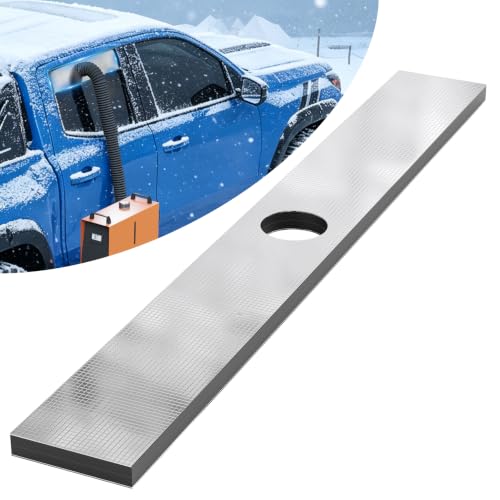
LBG Products Insulated Window Panel differs through its three-layer aluminum-foil, elastomeric-foam and aluminum-foil construction, rather than a set of multiple pre-cut ports. The vehicle panel accepts a 3-inch pipe and can be cut to fit, with a maximum length of 39 inches. The maker says it is designed for 5kW to 8kW heaters and offers sealing and insulation. This suits buyers prioritizing a customizable panel for an SUV, pickup or motorhome. Cutting is irreversible, so measure the window and mark the final panel dimensions before trimming.
Bottom line: Choose this when a cut-to-fit insulated panel suits your vehicle window.
Forestchill Adjustable Window Vent Kit

Forestchill Adjustable Window Vent Kit is a temporary-use panel option that avoids drilling a wall, with three pre-cut holes for 3-inch hose and 1-inch pipes. Three sealing plates fit windows up to 39 inches, and the design is intended for vertical or horizontal sliding and hung windows. The maker describes indoor exhaust ventilation or outdoor warm-air delivery as possible arrangements; confirm the intended duct routing for your heater before installation, and keep combustion exhaust outdoors. This panel suits seasonal setups. Its material is incomplete, so buyers focused on panel composition should compare that aspect before choosing.
Bottom line: Choose this for a removable panel when its window range and ports fit.
How to choose a diesel heater window vent
Start with the window opening and the duct route, not the heater’s power rating. Measure the usable sash width where the panel will sit; a 39-inch maximum panel cannot seal an opening wider than that. Then match the opening to the heater’s duct: 3-inch and 75 mm are the same nominal hose size, while a 1-inch port is a separate passage. Decide whether you need a complete panel, extra small ports, or only a hose connector. For example, choose a 16.5-to-31.5-inch insert if that range covers the measured window; choose a connector only if a panel is already in place. Leave enough room for the sash and seals to close without pinching the duct.
Diesel heater window vent safety
Combustion exhaust must discharge outside, away from doors, windows and air intakes; warm air delivered into the cabin travels through a separate duct. Diesel heaters burn fuel and can produce carbon monoxide, an odorless gas, so install a working CO alarm inside the occupied space and follow the heater maker’s exhaust-routing and clearance instructions. Do not treat a louver or a window seal as an exhaust safety device. Keep exhaust tubing and hot components clear of curtains, bedding and other combustible materials. Before running the heater, check that the exhaust joint is secure and that the window insert cannot shift or leave a gap that redirects fumes indoors.
Window vent sizes and fit
These panels span different vehicle-window widths: some reach 39 inches, while the car-specific insert tops out at 31.5 inches and starts at 16.5 inches. Measure the actual opening between the sash edges, not the outside frame, and account for the panel’s bottom groove or sealing strip if present. A panel that is too short can leave a draft path; one that is too long may interfere with the sash. For cut-to-fit foam panels, mark the opening carefully before trimming because material removed cannot be restored. Confirm that the hose can pass through without kinking and that the window can hold the insert firmly when closed.
Panel kits versus hose adapters
A panel kit fills and seals part of the window while providing openings for ducting; an adapter joins a hose to a mounting point but does not supply an adjustable sealing panel. The distinction matters if you expect a complete window solution: a connector alone will not cover the gap around a partially open vehicle window. Compare the installation by need rather than treating every 3-inch-compatible part as interchangeable.
| Need | Suitable type | Check before fitting |
|---|---|---|
| More than one duct passage | Panel with 3-inch and 1-inch ports | Port use and unused-hole seals |
| Vehicle opening up to 31.5 inches | Car-specific panel | Minimum width of 16.5 inches |
| Existing panel, hose interface only | 75 mm connector | Matching hose and secure mounting |
| Custom insulation fit | Cut-to-fit layered panel | Measure before trimming |
Frequently Asked Questions
Is 75 mm the same as a 3-inch heater hose?
Yes, 75 mm is the nominal metric size used for a 3-inch heater hose. Check the hose and connector dimensions before assembly because nominal sizing does not guarantee every coupling has the same fit.
Can a diesel heater exhaust point into the cabin?
No. Combustion exhaust must be routed outdoors and kept clear of openings that could let fumes re-enter; the cabin’s warm-air duct is a separate path. Use a working carbon monoxide alarm wherever the heater operates near occupied space.
How wide should a window vent panel be?
Measure the sash opening where the insert will sit, then choose a panel whose adjustment range includes that measurement. One car-specific kit covers 16.5 to 31.5 inches, while other panels here extend to 39 inches.
Can I use a hose adapter without a window panel?
Use it only when a separate insert already closes the rest of the window opening.
Should I cut an insulated window vent panel?
Cut only after measuring the usable window opening and marking the final dimensions, since trimming cannot be reversed. Leave room for the hose opening and the panel’s seal so the insert remains supported.