
Best Digital Salt Water Pool Tester: 5 Models Compared

ORAPXI 5-in-1 Pool Salt and pH Meter is the best digital salt water pool tester for most pool owners because it combines salinity and pH readings in one meter. Choose eSeasonGear SALT-3050 instead if you want a pool-focused salt and temperature tester; its use excludes marine tanks and food.
Salt testers measure dissolved salt, usually displaying results as parts per million (ppm) or parts per thousand (ppt). The right target depends on your salt chlorine generator, so compare readings with its recommended range before adding salt.
We earn a commission if you buy through links on this page. As an Amazon Associate I earn from qualifying purchases. Products are compared on manufacturer specifications, not hands-on testing.
- Best overall: ORAPXI 5-in-1 Pool Salt and pH Meter – Combines a 0–9,990 ppm salt range with pH measurement.
- Best for pool-only checks: eSeasonGear SALT-3050 – Designed for saltwater pools and koi ponds, with a 0–9,999 ppm range.
- Best for multiple water uses: Hofun 5-in-1 Salinity and pH Meter – Offers salinity readings in ppm, ppt and percent for several water applications.
| Product | Best for | Salt range | Other readings | Intended use | Shop |
|---|---|---|---|---|---|
| ORAPXI 5-in-1 Pool Salt and pH Meter | Salt and pH | 0–9,990 ppm; 10–100 ppt | pH, TDS, EC, temperature | Pools, hot tubs, swim spas | Check Price on Amazon |
| eSeasonGear SALT-3050 | Pool-only salinity | 0–9,999 ppm; 0.0–1.0% | Temperature | Salt pools, koi ponds | Check Price on Amazon |
| Hofun 5-in-1 Salinity and pH Meter | Multiple water uses | 0–9,999 ppm; 10–200 ppt; 0.01–25% | pH, EC, TDS, temperature | Pools, aquariums, spas, hydroponics | Check Price on Amazon |
| T TESTRUST 5-in-1 Pool Salt Tester | Multi-unit readings | 0–9,999 ppm; 10–200 ppt; 0.01–25% | pH, TDS, EC, temperature | Pools, aquariums, hot tubs | Check Price on Amazon |
| Smart Pool 7-in-1 Tester with App | Connected tracking | — | pH, ORP, EC, TDS, SG, temperature | Pools, hot tubs, aquariums | Check Price on Amazon |
Digital salt water pool testers compared
Compare each meter’s range and extra measurements with your pool’s testing needs and salt system target.
ORAPXI 5-in-1 Pool Salt and pH Meter

ORAPXI 5-in-1 Pool Salt and pH Meter pairs a pool-oriented salt range with a pH range of 0.00–14.00, making it the most versatile choice here for routine salt and pH checks. It also measures TDS, EC and temperature, and its maker recommends pool pH of 7.2–7.8. That combination suits owners who want more than a salinity reading from one meter. The salt range tops out at 9,990 ppm, so check that it covers your system’s target before relying on it; a meter with a higher stated ceiling may be a better fit for an unusually high target.
Bottom line: Pick this if you want salinity and pH readings in one pool-focused meter.
eSeasonGear SALT-3050

eSeasonGear SALT-3050 is the clearest fit for buyers who want a salt-focused meter rather than a multi-parameter water tester. It measures 0–9,999 ppm or 0.0–1.0% salinity and has a 32–130°F temperature range; the maker says it is precalibrated at 3,000 ppm sodium chloride and 77°F. Its applications are saltwater pools and koi ponds only, so choose another meter for marine tanks or food testing. The narrow purpose is a limitation if you also need pH readings, but it avoids paying attention to measurements outside the pool salt task.
Bottom line: Choose this for pool salt and temperature checks without extra water measurements.
Hofun 5-in-1 Salinity and pH Meter
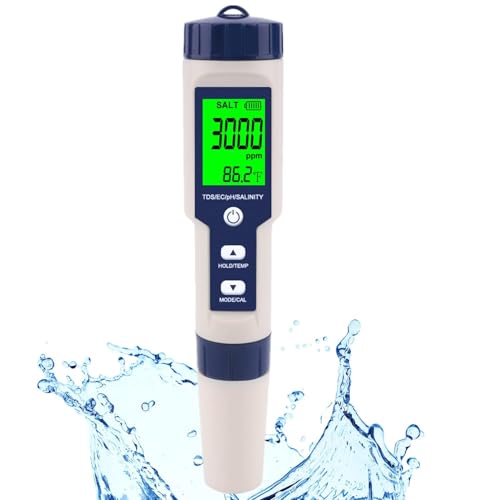
Hofun 5-in-1 Salinity and pH Meter stands out for its three salinity display formats: ppm, ppt and percent. Its maker gives a 0–9,999 ppm range for pool salt and a 10–200 ppt range for seawater, and says the display switches to ppt above 9,999 ppm. The meter also measures pH, temperature, EC and TDS, which suits households testing more than pool water. The broad use cases are helpful, but a pool owner who only needs salt concentration may prefer a meter with a more narrowly defined pool purpose; check that the selected display and range match your salt system’s target.
Bottom line: Choose this if you need several salinity units or test water beyond the pool.
T TESTRUST 5-in-1 Pool Salt Tester

T TESTRUST 5-in-1 Pool Salt Tester provides the same three salinity formats—ppm, ppt and percent—that make multi-unit meters useful when comparing pool and other water readings. The maker gives a 0–9,999 ppm pool range and a 10–200 ppt seawater range; it also measures pH, TDS, EC and temperature. That mix suits someone who tests both a pool and an aquarium or hot tub. The wide application list does not make every setting interchangeable: for a salt pool, use the pool range and compare it with your chlorinator’s target rather than using the seawater range as a pool goal.
Bottom line: Pick this if you want several salinity units alongside pH and water-quality readings.
Smart Pool 7-in-1 Tester with App

Smart Pool 7-in-1 Tester with App is the connected option in this group: its maker says the tester pairs with iOS and Android devices over Bluetooth and can save readings, show charts and export reports. It measures pH, ORP, EC, TDS, salinity, specific gravity and temperature, which may suit owners who want a broader record of water measurements. App tracking is useful only if you want to maintain a digital history rather than make occasional salt checks.
Bottom line: Choose this if app-based measurement history matters and its salt range suits your system.
How to choose a digital salt water pool tester
Start with the salt range and the target printed for your chlorine generator, not with the number of extra functions. Many saltwater pool systems operate around 2,700–3,400 ppm, but acceptable ranges vary by generator, so use the model’s target as the decision rule. A meter with a 0–9,999 ppm range covers that common band; check the ceiling if your system calls for a higher concentration. Next, decide whether pH matters: pool water is commonly managed around pH 7.2–7.8, but a salt meter that does not measure pH cannot replace a separate pH check. Temperature, TDS and EC can be useful additions, but they are not substitutes for the salt system’s specified salinity range.
How to read ppm and ppt salt results
Pool meters commonly show salt in parts per million (ppm), while some also display parts per thousand (ppt) or percent. One ppt equals 1,000 ppm, so 3,000 ppm is 3 ppt; percent is a different scale, with 1% equal to 10,000 ppm. Use one unit when comparing a reading with your chlorinator’s target, and convert before making a decision. For example, a 3,200 ppm result is 3.2 ppt. A display that automatically switches units can prevent a number from appearing to jump when it crosses a meter’s ppm ceiling, but confirm which unit is on screen before adding salt. Salt concentration describes dissolved salt, not chlorine concentration.
How to take a pool salt reading
Take a sample from well-mixed pool water rather than right beside a salt cell, return jet or recent salt addition. Circulate the water after adding salt before retesting; a concentrated patch can give a misleading local result. Rinse the probe with clean water between samples and avoid touching the sensing surface, since residue can affect later measurements. Temperature can affect conductivity-based salinity readings, so allow the meter and sample to stabilize and use temperature compensation if the device provides it. Follow any immersion marks on the meter body, and do not assume a waterproof rating means the probe can be submerged indefinitely. If a reading conflicts sharply with the generator display, repeat the sample before changing chemistry.
Salt tester formats compared
Choose the display format that matches the target you need to check; the table gives common equivalents useful for pool decisions.
| Display | Equivalent | Useful for |
|---|---|---|
| ppm | 3,000 ppm = 3 ppt | Most pool generator targets |
| ppt | 1 ppt = 1,000 ppm | Readings above a ppm display ceiling |
| Percent | 1% = 10,000 ppm | Comparing meters that use percent |
Different units do not indicate different salt chemistry; they scale the same concentration. A salt meter may also report EC or TDS, but those measurements are not direct replacements for a pool generator’s salt target unless the instrument specifically converts them to salinity. Keep the chlorinator’s target and the meter’s displayed unit together when recording results. Do not add salt based solely on a number without checking the unit and confirming the sample was taken after circulation.
Frequently Asked Questions
How often should I test salt in a pool?
Check salt at least monthly during the swimming season and after adding water or salt. Test sooner if the chlorinator reports a low-salt condition, since dilution from rain or refilling can change concentration.
What salt level should a saltwater pool have?
Many salt chlorine generators work around 2,700–3,400 ppm, but the correct target is the range for the specific generator. Use that target as the decision point rather than assuming all salt pools share one ideal level.
Can a digital salt tester measure chlorine?
A salinity meter measures dissolved salt, not free chlorine. Check chlorine separately with a pool test kit; salt chlorine generators convert salt into chlorine, but the salt reading does not show the chlorine residual.
How long should I wait after adding pool salt to test?
Run the pool circulation system for about 24 hours after adding salt before relying on a new reading. Testing before the salt has dispersed can produce a locally high result near the addition point.
Why do pool salt readings differ between meters?
Different calibration, temperature compensation and sampling conditions can cause readings to diverge. Compare meters using the same well-mixed sample at similar temperature, and check whether both readings use ppm, ppt or percent.