
Best Digital Scale 0.01 Gram Accuracy: 5 Picks

Bonvoisin Lab Scale 600 g is the best choice for most people because its 600 g capacity, 0.01 g accuracy and 0.5 g minimum start weight balance fine readings with a useful weighing range. Choose Digital Pocket Gram Scale 200 g instead for a compact pocket scale capped at 200 g, or a 5,000 g model when heavier loads matter more than portability.
We earn a commission if you buy through links on this page. As an Amazon Associate I earn from qualifying purchases. Products are compared on manufacturer specifications, not hands-on testing.
- Best overall: Bonvoisin Lab Scale 600 g – It combines 0.01 g accuracy with 600 g capacity and a 0.5 g minimum start weight.
- Best for portability: Digital Pocket Gram Scale 200 g – Its 200 g capacity and compact 5.2-by-2.99-inch footprint suit small loads on the go.
- Best for food prep: MEIYA 1,000 g USB Scale – It offers 1,000 g capacity, USB charging, tare and nine units for kitchen weighing.
- Best for heavy loads: Bonvoisin Lab Scale 5,000 g – Its 5,000 g capacity and 180-by-140 mm pan provide a much larger weighing range.
| Product | Best for | Capacity | Minimum start weight | Notable features | Shop |
|---|---|---|---|---|---|
| Bonvoisin Lab Scale 600 g | Lab and jewelry | 600 g | 0.5 g | 6 units, tare, counting | Check Price on Amazon |
| Digital Pocket Gram Scale 200 g | Portable weighing | 200 g | — | Tare, 100 g calibration weight | Check Price on Amazon |
| MEIYA 1,000 g USB Scale | Kitchen weighing | 1,000 g | 0.3 g | Tare, USB charging, 9 units | Check Price on Amazon |
| Bonvoisin Lab Scale 5,000 g | Large lab loads | 5,000 g | — | 180 × 140 mm pan, external calibration | Check Price on Amazon |
| RUISHAN Lab Scale 5,000 g | Inventory counting | 5,000 g | — | Piece counting, 170 × 170 mm pan | Check Price on Amazon |
Digital scales with 0.01 gram accuracy
Match the scale’s capacity and minimum start weight to the items you plan to weigh; the same 0.01 g increment does not mean every model suits the same load.
Bonvoisin Lab Scale 600 g

Bonvoisin Lab Scale 600 g stands out for balancing a useful 600 g range with a 0.5 g minimum start weight, which suits jewelry and small-component work when a pocket scale’s 200 g ceiling is restrictive. It reads in grams, ounces, carats, pennyweight, tola and grains, and includes tare and piece counting. Power can come from an AC adapter or batteries, with adjustable auto-off. The trade-off is a larger benchtop footprint than a pocket model, so it is less convenient to carry around.
Bottom line: Choose it for small-item work that needs more capacity than a pocket scale.
Digital Pocket Gram Scale 200 g

Digital Pocket Gram Scale 200 g is the compact option, measuring 5.2 by 2.99 by 0.79 inches and weighing up to 200 g in 0.01 g increments. It comes with a 100 g calibration weight and uses a MODE-key calibration sequence; tare supports weighing an item inside a container. This scale fits jewelry or other small objects when portability matters more than a broad range. Its firm 200 g ceiling makes it the wrong choice for heavier batches, even if the display still shows hundredths of a gram.
Bottom line: Pick it for portable weighing when every load stays below 200 g.
MEIYA 1,000 g USB Scale

MEIYA 1,000 g USB Scale is oriented toward kitchen and food weighing, with a 1,000 g capacity, USB charging and two trays. Its working range starts at 0.3 g, and the feature set includes tare and nine measurement units. That combination offers more room for recipe ingredients than a pocket scale and is useful when switching units during food prep. The limitation is a 1 kg maximum, so it does not match the two larger lab balances for heavier batches or bench work.
Bottom line: Choose it for food portions and recipes within its 1 kg range.
Bonvoisin Lab Scale 5,000 g
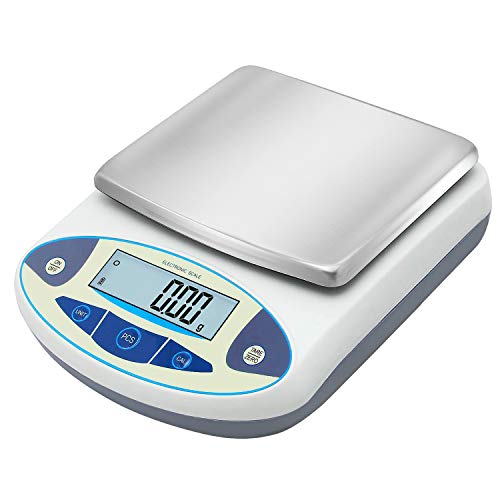
Bonvoisin Lab Scale 5,000 g has the broadest capacity here at 5,000 g, paired with a 180-by-140 mm stainless-steel pan for larger samples or multiple small items. The model offers eight selectable ranges between 200 g and 5,000 g, adjustable feet, a level bubble, overload alarm and external calibration. Its strength is accommodating heavier loads without giving up 0.01 g increments. It is a 4.4 lb bench balance rather than a pocket tool, and the size description says calibration weights are not included.
Bottom line: Pick it when a large pan and loads up to 5,000 g are priorities.
RUISHAN Lab Scale 5,000 g

RUISHAN Lab Scale 5,000 g pairs a 5,000 g maximum with a 170-by-170 mm stainless-steel pan, making it the other high-capacity bench option. Its built-in counting function can total multiple pieces, a useful distinction for inventory tasks involving coins, screws or similar items. The larger pan also gives more room than a pocket platform.
Bottom line: Choose it for high-capacity weighing with piece counting.
How to choose a 0.01 g digital scale
Start with the load’s total weight, then check the model’s minimum start weight as well as its capacity. A 0.01 g display increment means readings change in hundredths of a gram; it does not mean the scale can weigh anything from 0.01 g or remain accurate across its whole range. In this group, stated capacities span 200 g to 5,000 g, while the two listed minimums are 0.3 g and 0.5 g. If your loads routinely exceed 1,000 g, narrow your choices to the 5,000 g balances; if you weigh under 200 g and carry the scale, prioritize the pocket model. Keep the load centered and use a level, stable surface to reduce avoidable reading variation.
Capacity and minimum load are different
Capacity is the maximum load; minimum start weight is the lower threshold at which a model begins registering a load. Those limits answer different questions, so a high-capacity balance is not automatically the best choice for tiny objects. For example, the 600 g model gives a 0.5 g minimum start weight, while the 1,000 g kitchen model begins at 0.3 g; the 5,000 g models do not provide a minimum in the specifications. For a required load below 0.5 g, choose only a model with a lower starting threshold, and confirm the working range before ordering if that cutoff is essential. Also leave room below the maximum for the container, since tare zeroes the container’s displayed weight but does not expand the scale’s capacity.
Scale types compared by typical use
Scale format helps determine which features are practical: pocket models favor portability, kitchen scales emphasize recipe convenience, and lab balances trade compactness for capacity and controls. These categories overlap, but the useful decision is whether your work needs travel, food handling, or a broad bench range. Every option here resolves to 0.01 g, so choose by load and work pattern rather than treating that increment as a complete measure of suitability.
| Need | Practical choice | Reason |
|---|---|---|
| Carry small loads | 200 g pocket scale | Compact body and modest capacity |
| Weigh recipe ingredients | 1,000 g kitchen scale | USB charging, trays and tare |
| Handle heavier bench loads | 5,000 g lab balance | Higher maximum capacity and larger pan |
For pieces counted in quantity rather than by individual weight, a counting function is useful, but set it up with a representative sample and consistent pieces to avoid propagating a sample error.
Calibration and safe weighing habits
Calibration checks a scale against a known weight; use the calibration mass and procedure specified for that model, on a firm surface away from drafts and vibration. The pocket model includes a 100 g calibration weight, while the 5,000 g Bonvoisin model offers external calibration and does not include calibration weights. Keep a balance dry and avoid placing loads beyond its maximum, since overloads can damage the sensing mechanism. Let the display settle before recording a value, and use a tare container that leaves enough remaining capacity for the sample. Calibration is not a substitute for checking suitability: a scale with 0.01 g increments can still have a minimum start weight above the sample you intend to weigh.
Frequently Asked Questions
Does 0.01 g accuracy mean a 0.01 g minimum load?
No; a 0.01 g increment is the displayed step size, not necessarily the minimum load. The minimum starts in this group are 0.3 g and 0.5 g, so check that threshold for very small samples.
How much weight can a 0.01 g scale hold?
Capacity varies by model, from 200 g for the pocket scale to 5,000 g for two lab balances here. Include the container’s weight when checking whether a load will fit under the maximum.
Why does my digital scale reading keep changing?
Air movement, vibration, an uneven surface and a load placed off-center can shift fine readings. Set the scale on a level, stable bench away from fans and let the display settle before recording.
How often should a precision scale be calibrated?
A common lab practice is to verify a balance before a critical measurement and after moving it, then calibrate if the check fails. The right interval depends on use and required traceability; use known calibration masses appropriate to the scale’s procedure.
Can I weigh food on a lab gram scale?
Yes, if the food and container stay within the scale’s capacity and its platform can be kept clean. Kitchen scales may be more convenient for routine recipes because trays and charging are included on the 1,000 g model.