
Best Electric Tomato Strainer: 4 Models Compared

VEVOR 370W Large-Hopper Strainer suits most people who want a high-volume electric tomato strainer, with a claimed processing rate of 200 pounds per hour and a large-hopper. Choose VEVOR 800W Max Multi-Screen Strainer instead if interchangeable screens for different textures matter more than throughput.
An electric tomato strainer separates pulp from skins and seeds as it mills soft produce; for smaller batches or frequent texture changes, compare rated output and included screens before choosing.
We earn a commission if you buy through links on this page. As an Amazon Associate I earn from qualifying purchases. Products are compared on manufacturer specifications, not hands-on testing.
- Best overall: VEVOR 370W Large-Hopper Strainer – Its claimed 200-pound-per-hour rate and large-hopper support high-volume batches.
- Best for texture options: VEVOR 800W Max Multi-Screen Strainer – Four screens with 1 mm, 1.5 mm, 3 mm, and 6 mm openings offer distinct texture choices.
- Best for safety features: COSTWAY 450W Tomato Strainer – Its feature set includes a motor guard, anti-slip feet, waterproof insulated switch, and pusher.
| Product | Best for | Claimed output | Motor power | Shop |
|---|---|---|---|---|
| VEVOR 370W Large-Hopper Strainer | Large batches | 200 lb/h | 370 W | Check Price on Amazon |
| VEVOR 800W Max Multi-Screen Strainer | Texture variety | 88 lb/h | 300 W rated; 800 W max | Check Price on Amazon |
| COSTWAY 450W Tomato Strainer | Safety features | 200–350 lb/h | 450 W | Check Price on Amazon |
| ETC-1C 450W Tomato Strainer | Stainless construction | 200–350 lb/h | 450 W | Check Price on Amazon |
Electric Tomato Strainers Compared
Compare claimed throughput, motor specifications, and included screen options to match the machine to your batch size and preferred sauce texture.
VEVOR 370W Large-Hopper Strainer

VEVOR 370W Large-Hopper Strainer distinguishes itself with a large-hopper and a claimed 200-pound-per-hour processing rate, making it a fit for harvest batches where fewer refills matter. The 370-watt motor drives a stainless steel filter screen that separates peels and seeds in one pass. Cutting tomatoes into small pieces first can help reduce clogging. Its 21.74-pound weight and 19.29-inch length call for a sturdy counter with room to stage produce and catch sauce. The screen setup is not a texture-changing set, so buyers who want several sauce consistencies should consider a model with multiple screens.
Bottom line: Choose it for larger batches when a large-hopper and claimed 200 lb/h output are priorities.
VEVOR 800W Max Multi-Screen Strainer

VEVOR 800W Max Multi-Screen Strainer stands apart with four interchangeable screens—1 mm, 1.5 mm, 3 mm, and 6 mm—plus a claimed output of 88 pounds per hour. Its motor is rated at 300 watts, with 800 watts maximum; the maker says the DC motor provides steady output, high torque, and low noise. The range of openings is useful when one machine needs to handle finer tomato sauce as well as thicker salsa or puree. Its lower claimed throughput than the 200-to-350-pound-per-hour options makes it a less suitable choice for buyers processing the largest harvest batches.
Bottom line: Pick it when multiple screen sizes matter more than maximum batch throughput.
COSTWAY 450W Tomato Strainer
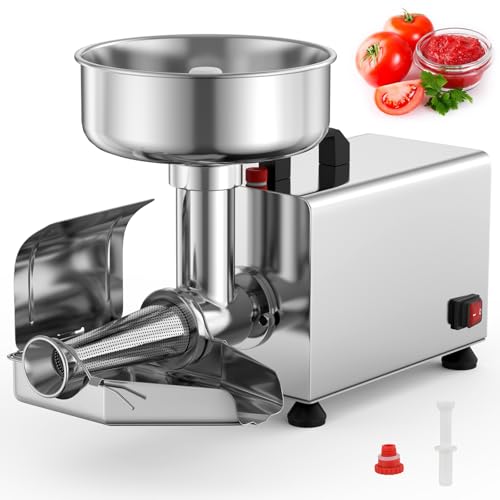
COSTWAY 450W Tomato Strainer is differentiated by its safety-oriented features: a fully enclosed motor guard, anti-slip feet, waterproof insulated switch, and feeding pusher. Its 450-watt full-copper motor and 8.5-inch feed chute pair with a claimed rate of 200–350 pounds per hour, suiting substantial tomato or berry batches. The machine measures 20.5 inches long, 11 inches wide, and 13 inches high, so allow space for the unit and collection vessels. The output range is broad rather than a single figure; buyers who need a predictable rate for planning should treat the claim as a range, not a guaranteed pace.
Bottom line: Choose it for its named safety features and broad claimed output range.
ETC-1C 450W Tomato Strainer

ETC-1C 450W Tomato Strainer specifies 304 stainless steel for all food-contact components, a useful differentiator for buyers prioritizing material clarity. The 450-watt pure-copper motor is paired with an 8.5-inch feed chute and a claimed output of 200–350 pounds per hour. It is intended for tomatoes, berries, sauce, jam, and juice, including larger canning preparations. At 20.87 inches long and 20.94 pounds, it needs a stable work surface with clearance for feeding and collection. Buyers seeking different textures from dedicated screens should favor a model whose screen sizes are explicitly included.
Bottom line: Pick it when 304 stainless food-contact parts are the deciding specification.
How to Choose an Electric Tomato Strainer
Start with the amount of produce you process and the texture options you need. These models claim rates from 88 to 350 pounds per hour, so use the lower end of a range when estimating time rather than assuming the maximum. A rough planning rule: for batches above 100 pounds, prioritize a model claiming at least 200 pounds per hour and a larger feed area; smaller batches can put more weight on screen selection and storage. Motor wattage alone does not establish throughput: one model lists 800 watts maximum but 300 watts rated and claims 88 pounds per hour. Compare rated power, claimed output, and included parts together.
Screen Sizes and Sauce Texture
Screen openings control what passes through and how much coarse material remains behind. A 1 mm opening is finer than a 6 mm opening, while intermediate 1.5 mm and 3 mm sizes provide steps between them. The four-screen model here is the only one with those specific options identified, which suits cooks who switch among tomato sauce, puree, and coarser preparations. Do not assume a screen opening alone determines final texture: produce ripeness, feed size, and how quickly ingredients are pushed through also affect the result. For less clogging, cut tomatoes into small pieces before feeding them, as the maker recommends for the large-hopper model.
Batch Setup, Stability, and Safe Feeding
Plan the work area before processing: machines in this group are roughly 18 to 21 inches long, and larger units weigh about 21 to 22 pounds. A stable counter and enough space for a receiving bowl reduce awkward handling during continuous feeding. Keep hands away from moving feed components and use a pusher rather than fingers; disconnect power before clearing a jam or cleaning. The COSTWAY model identifies a motor guard, anti-slip feet, and waterproof insulated switch, but these features do not replace safe handling around powered machinery. Tomato pieces should be sized for the feed opening, and the collection container should be positioned before switching the motor on.
Electric Strainer Output Compared
Use the output claims as a first-pass way to sort machines by intended batch scale, not as a promise of the rate in every kitchen. Feed preparation, tomato condition, and pauses for clearing or changing containers can affect real throughput. The table shows the practical distinction among the models.
| Claimed output | Models | Best match |
|---|---|---|
| 88 lb/h | VEVOR 800W Max Multi-Screen Strainer | Screen variety |
| 200 lb/h | VEVOR 370W Large-Hopper Strainer | Large-hopper batches |
| 200–350 lb/h | COSTWAY 450W Tomato Strainer, ETC-1C 450W Tomato Strainer | High-volume processing |
When estimating a canning session, leave time for washing produce, trimming, and transferring finished sauce; the machine’s processing claim covers milling rather than the whole preservation workflow.
Frequently Asked Questions
Should tomatoes be cooked before using an electric strainer?
Many tomato mills can process raw or softened tomatoes, but the products here do not specify a cooking requirement. For easier feeding, cut fruit into small pieces; softening tomatoes first is a common kitchen step when they are firm or difficult to feed.
What size tomato pieces reduce strainer clogging?
Small pieces are recommended for the large-hopper VEVOR model to help reduce clogging. Cut around the feed opening and avoid forcing oversized pieces into a powered mill.
How do screen openings affect tomato sauce?
Smaller openings generally produce a finer pass-through than larger openings; 1 mm is finer than 6 mm. Screen size is only one factor, since tomato softness and feed pace also influence texture.
How much counter space should an electric strainer have?
Allow roughly 21 inches of length for the larger machines in this group, plus room beside the feed chute and beneath the outlet for a collection vessel. A stable surface matters because several models weigh about 21 to 22 pounds.
Can an electric tomato strainer process berries too?
The maker describes these machines for soft fruits such as strawberries or blueberries as well as tomatoes. Remove stems and prepare fruit so it feeds freely, and use a suitable screen when texture options are available.