
Best Epoxy for Golf Club Heads: 3 Cure Times Compared

Brampton PRO-FIX Long Cure suits most club builders because its 20-minute work life gives more time to assemble a full set before the epoxy begins to set. Choose Brampton PRO-FIX Quick Cure or Brampton PRO-FIX Rapid Cure instead when faster curing matters more than longer assembly time.
Golf club epoxy bonds the shaft to the head, so match its working time to how many clubs you can assemble promptly.
We earn a commission if you buy through links on this page. As an Amazon Associate I earn from qualifying purchases. Products are compared on manufacturer specifications, not hands-on testing.
- Best overall: Brampton PRO-FIX Long Cure – A 20-minute work life supports assembling a full set in one session.
- Best for quick batch repairs: Brampton PRO-FIX Quick Cure – Its 5-minute work life allows up to 3 clubs per mix, and the maker says it fully cures in 1 hour.
- Best for a single-club repair: Brampton PRO-FIX Rapid Cure – A 3-minute work life is sized for one club, and the maker says it is ready in 30 minutes.
| Product | Best for | Work life | Cure time | Package size | Shop |
|---|---|---|---|---|---|
| Brampton PRO-FIX Long Cure | Full-set assembly | 20 minutes | — | 0.85 oz | Check Price on Amazon |
| Brampton PRO-FIX Quick Cure | Small repair batches | 5 minutes | 60 minutes | 4 oz | Check Price on Amazon |
| Brampton PRO-FIX Rapid Cure | One-club repair | 3 minutes | 30 minutes | 0.85 oz | Check Price on Amazon |
Golf Club Head Epoxy Compared
Match the epoxy’s work life and cure schedule to the number of clubheads you plan to bond.
Brampton PRO-FIX Long Cure

The 20-minute work life sets this epoxy apart for assembling several clubs in one session. Brampton says the formula is engineered for high-impact golf use and swing speeds over 130 mph; the 0.85-ounce clear package is intended for shafts and heads across drivers, putters, and irons. That longer window suits builders who want time to align a full set before the bond begins to set. The tradeoff is a slower process than quick- or rapid-cure options, so it is less suitable when a fast return to play is the priority.
Bottom line: Choose this when you need a longer assembly window for multiple clubs.
Brampton PRO-FIX Quick Cure

The 4-ounce kit and 5-minute work life make this the batch-repair choice: Brampton says one mix can bond up to three clubs and fully cures in 1 hour. The maker says it works with steel, titanium, graphite, wood, and plastics, and is engineered to resist high impact at swing speeds exceeding 125 mph. Its working window is shorter than the long-cure formula, so careful preparation and having the heads ready before mixing matter. It suits repairs where a fast cure is more useful than extended alignment time.
Bottom line: Pick this for a small batch when a one-hour cure is useful.
Brampton PRO-FIX Rapid Cure
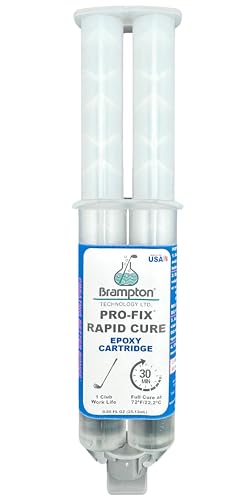
The 3-minute work life makes this the most focused option for repairing one club at a time. Brampton says it is ready in 30 minutes and engineered for golf shaft and head impact at swing speeds up to 120 mph; the 0.85-ounce package is aimed at a single-club repair. This short window favors a prepared workspace, with the shaft and head ready for assembly before mixing. Its limited working time is the drawback for set building or anyone who needs extra time to align multiple heads.
Bottom line: Choose this for a single repair when the 30-minute stated turnaround fits your schedule.
How to Choose Golf Club Epoxy
Choose golf club epoxy by the number of heads you can assemble within its work life, not cure time alone. The work life is the usable period after the two parts are mixed; cure time is the later point when the bond is ready for use. A 3-minute window suits one prepared club, while a 20-minute window leaves more time for a set. For batch work, pick a formula whose clubs-per-mix capacity covers your task. Have components, mixing surface, and alignment plan ready first, because epoxy begins curing after mixing.
Epoxy joints rely on clean, well-fitted surfaces. Remove old adhesive and residue, and abrade the bonding surfaces lightly where appropriate; avoid contaminating prepared surfaces with oil or dust. Mix the two components thoroughly in the ratio supplied with the product, since an uneven blend can leave weak or uncured areas.
Work Life and Cure Time for Club Repairs
Work life and cure time describe different parts of a repair: a short work life means less assembly time, while a shorter cure time means the club reaches the maker’s ready point sooner. Do not treat a quick cure as permission to rush surface preparation or alignment. A practical rule is to reserve quick-cure products for a single club or a small prepared batch, and use a longer work life when aligning several heads. Temperature can change epoxy behavior; cooler conditions commonly slow curing and warmth can speed it, so avoid extremes and follow the product’s mixing and curing directions.
| Repair need | Useful work life | What to prioritize |
|---|---|---|
| One club, fast turnaround | About 3 minutes | Prepare parts before mixing |
| Small batch | About 5 minutes | Confirm clubs per mix |
| Several clubs, more alignment time | About 20 minutes | Allow a longer assembly window |
Preparing a Shaft and Clubhead Bond
Clubhead bonding depends on a sound fit between the shaft tip and hosel, so remove old epoxy and keep the mating surfaces free of debris. A shaft should seat to its intended depth without force; if the fit is loose, damaged, or mismatched, epoxy alone is not a reliable fix. Different shaft materials and head constructions can require different prep, so verify compatibility for the specific combination before bonding. For graphite shafts, avoid aggressive sanding that can cut into the fibers, and use protective equipment when handling uncured epoxy. Keep uncured resin off skin and out of eyes, and ventilate the work area.
Avoid swinging a club before the maker’s cure period has passed. The joint takes load at impact, and early use can compromise the bond even if it feels firm by hand.
Frequently Asked Questions
How long should golf club epoxy cure before use?
The cure period depends on the formula: the quick-cure option here gives a 1-hour ready time, while the rapid-cure option gives 30 minutes. Longer-cure formulas need their own stated cure schedule, so do not assume work life equals cure time.
Can golf club epoxy bond graphite shafts?
Some golf epoxies are formulated for graphite as well as metal shafts; the quick-cure option here names graphite among compatible materials. Use a careful prep method because cutting graphite fibers can weaken the shaft.
How much epoxy should I mix for one golf club?
Mix only enough for the repair you can complete inside the product’s work life. A 3-minute formula is aimed at one club, while a 5-minute formula here is described for up to three clubs per mix.
Why does old golf club epoxy need to be removed?
Old adhesive can prevent the shaft and hosel from making a clean, close-fitting bond. Remove residue and dust before assembly, and stop if the shaft or hosel is damaged or does not fit securely.
Does temperature affect golf epoxy curing?
Yes, temperature can change how quickly epoxy sets: colder conditions generally slow curing and warmer conditions can speed it. Keep the work area within the product’s directions and allow the full cure period before putting the club under impact.