
Best Exhaust Repair Putty: 5 Options Compared

For most exhaust-joint repairs, Walker 35958 Exhaust Putty is the strongest fit because it is designed to seal elevated-temperature joints, including out-of-round connections. Choose a high-temperature paste instead if you need a temperature rating or are patching a hole; exhaust putty is not a substitute for replacing badly corroded or structurally damaged pipe.
We earn a commission if you buy through links on this page. As an Amazon Associate I earn from qualifying purchases. Products are compared on manufacturer specifications, not hands-on testing.
- Best overall: Walker 35958 Exhaust Putty – Made for elevated-temperature joints, including out-of-round muffler and pipe connections.
- Best for stated heat rating: NASCA High Temp Exhaust Sealant, 5.3 oz – The maker rates this 5.3-ounce paste for temperatures up to 2,012°F.
- Best for larger quantity: MPD Muffler Cement Putty, 16 oz – The 16-ounce package is the largest amount among these options.
| Product | Best for | Intended repair | Package size | Stated maximum temperature | Shop |
|---|---|---|---|---|---|
| Walker 35958 Exhaust Putty | Exhaust joints | Joints | Stock size | — | Check Price on Amazon |
| NASCA High Temp Exhaust Sealant, 5.3 oz | Heat-rated patches | Cracks, holes, leaks | 5.3 oz | 2,012°F | Check Price on Amazon |
| LOCBONDSO Exhaust Repair Kit, 5.3 oz | Multi-area repairs | Joints, holes, leaks | 5.3 fl oz | 2,012°F | Check Price on Amazon |
| Wynn’s Exhaust Repair Putty | General exhaust seals | Exhaust-system damage | — | — | Check Price on Amazon |
| MPD Muffler Cement Putty, 16 oz | Larger projects | Cracks, holes, seams | 16 oz | — | Check Price on Amazon |
Exhaust Repair Putty Compared
Match the compound to the repair location, then compare package size and any temperature rating.
Walker 35958 Exhaust Putty

Walker 35958 stands out for exhaust joints, especially out-of-round muffler and pipe connections. The maker says the compound seals joints exposed to elevated temperatures and sets up in minutes. Its universal-fit description does not establish vehicle-specific compatibility, so confirm the dimensions and fit for your vehicle before buying. This is the clearest match when the repair is at a connection rather than a hole in a pipe or muffler wall. The package is identified as stock size, without a usable volume measurement here, so it is harder to compare by quantity.
Bottom line: Pick it for a joint repair, particularly an out-of-round connection.
NASCA High Temp Exhaust Sealant, 5.3 oz

NASCA is distinguished by a maximum temperature: the maker rates this 5.3-ounce paste for up to 2,012°F. Its non-slumping formula is intended to stay where applied, and the maker says it can seal cracks, holes and leaks in automotive exhaust components. That makes it a sensible choice when a temperature figure matters for a patch-style repair. The package information does not provide a curing schedule, so buyers should use the directions on the product for cure time and any required heat cycle rather than assuming a quick set means the repair is ready for driving.
Bottom line: Choose it when you want a heat rating for a patch repair.
LOCBONDSO Exhaust Repair Kit, 5.3 oz

LOCBONDSO specifically names joints as well as holes and leaks, giving it broader stated repair coverage than a compound focused on joints alone. The maker rates the 5.3-fluid-ounce, non-slumping grey sealant for temperatures up to 2,012°F and says it sets quickly. It is a practical fit if one compound needs to cover several exhaust-system locations. The advertised temperature is a maker claim, not a guarantee that every repair location or damaged component is suitable; severe corrosion or a pipe weakened through its wall still calls for replacement rather than a surface seal.
Bottom line: Pick it when the repair may involve more than one exhaust area.
Wynn’s Exhaust Repair Putty

Wynn’s is the only option here explicitly described as waterproof, which may matter for an exterior repair exposed to road spray. The maker claims a permanent seal and says the grey putty is suitable for all exhaust systems. Choose it only when that broad compatibility claim suits your repair and the missing heat rating is not a deciding factor; for high-heat areas where a rated limit matters, choose a compound with a maximum temperature.
Bottom line: Choose it when water resistance is the priority and a heat rating is not essential.
MPD Muffler Cement Putty, 16 oz
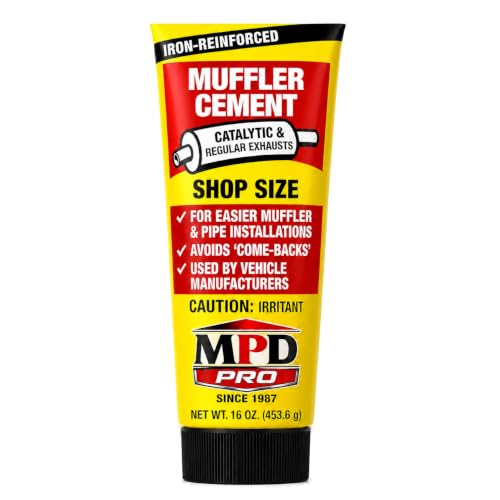
MPD offers the largest quantity here at 16 ounces, making it the practical option for a repair that needs more compound than a 5.3-ounce container. The maker says the paste seals cracks, holes and seams on mufflers and tailpipes, dries to a hard finish and resists vibration and thermal cycling. It also names catalytic converters among possible uses.
Bottom line: Pick it for a job where the larger 16-ounce quantity is useful.
How to choose exhaust repair putty
Choose exhaust repair putty by matching the compound to the damaged area: joint compounds target connections, while patch-style pastes name cracks, holes or seams. A product with a maximum temperature gives a useful comparison point, but the rating alone does not establish suitability for every point in an exhaust system. Compare the rating with the maker’s application directions and the location being repaired. For small repairs, a 5.3-ounce package may be easier to handle; for a larger repair, the 16-ounce size provides more material. If the metal is perforated over a broad area, loose, or structurally weakened, replace the affected section rather than relying on putty to restore its strength.
Where exhaust putty fits in a repair
Exhaust putty is a sealing compound, not a replacement for sound pipe or a mechanical joint. A joint compound can address a gap at a connection, while patch compounds are marketed for cracks, holes or seams. Decide by location first: a connection that is out of round calls for a product specifically suited to joints; a hole in a wall calls for a paste whose directions cover patching. A repair covering more than one location may favor a product that names both joints and holes. Putty cannot rebuild missing metal, and a leak near a flange, flex section or hanger may involve a damaged part that needs replacement rather than surface compound.
Preparing an exhaust repair safely
Work only on a fully cool exhaust system: exhaust components can become hot enough to cause burns, and a running engine produces carbon monoxide, which can be fatal in an enclosed space. Prepare the surface by removing loose rust and debris and leaving it clean; contamination can interfere with adhesion. The required dryness, application thickness and cure process differ by compound, so use the specific product directions rather than assuming one cure method fits all putties. Do not start or run a vehicle in a closed garage to cure a repair. If a leak persists after the instructed cure, or the pipe is loose or badly corroded, stop relying on the putty and have the exhaust section repaired or replaced.
When to patch and when to replace exhaust pipe
Use putty for a limited sealing job on otherwise sound metal, not as a structural fix. A small, localized crack or seam is a more plausible candidate than a hole surrounded by flaking rust or a section that moves under light pressure. A useful decision rule is to replace the section if corrosion has opened multiple holes or the metal flexes or crumbles; compound cannot restore the original wall thickness. Check nearby hangers and connections as well, because movement or misalignment can stress a fresh seal. For leaks that are difficult to locate or close to the engine, a qualified mechanic can identify whether the source is the pipe, a gasket or another exhaust component.
Frequently Asked Questions
Can exhaust putty seal a hole in a muffler?
Some exhaust pastes are marketed for holes and cracks, but the metal around the hole must remain sound. If rust has thinned or crumbled the surrounding muffler wall, replace the damaged section instead of treating putty as structural repair.
How hot does exhaust repair putty need to withstand?
There is no single temperature rating for every compound; compare the product’s maximum with its application directions.
Does exhaust putty need to cure before driving?
Yes, allow the compound to complete its product-specific cure before driving. Cure methods and times differ, so use the package directions and never run an engine in an enclosed garage to speed the process.
Can exhaust putty repair a leaking pipe joint?
Some compounds are specifically made for joints, and one option here targets out-of-round connections. A loose, badly misaligned or corroded joint may need mechanical repair or part replacement rather than a surface seal.
Is exhaust putty safe to apply on a hot pipe?
No; work only after the exhaust is fully cool to avoid burns. Exhaust parts can remain hot after the engine is shut off, so do not judge readiness by engine noise or appearance alone.