
Best Finger Guard for Cutting: 4 Kitchen Sets Compared

For most cooks, SLXDEX Adjustable Stainless Steel Guard is the best finger guard for cutting because its open ring adjusts to fit, while its 6.5 cm length gives a clear size reference. Choose Romooa 11-Piece Finger Guard Set instead if you want multiple guard styles and extra slicing tools; a finger guard is a barrier, not a substitute for careful knife technique.
We earn a commission if you buy through links on this page. As an Amazon Associate I earn from qualifying purchases. Products are compared on manufacturer specifications, not hands-on testing.
- Best overall: SLXDEX Adjustable Stainless Steel Guard – The open-ring design adjusts, and the guard measures 6.5 cm long.
- Best for tool variety: Romooa 11-Piece Finger Guard Set – The 11-piece set combines several guard styles with slicing accessories.
- Best for multiple guard styles: CHENGU 9-Piece Finger Guard Set – The nine-piece set includes single- and two-finger guards plus an onion holder.
| Product | Best for | Pieces | Material | Design | Shop |
|---|---|---|---|---|---|
| SLXDEX Adjustable Stainless Steel Guard | Adjustable ring fit | 2 | Stainless steel | Open ring; 6.5 cm | Check Price on Amazon |
| Romooa 11-Piece Finger Guard Set | Mixed kitchen tools | 11 | Stainless steel guards | Single- and double-finger guards; mixed tools | Check Price on Amazon |
| 304 Stainless Steel Finger Guards | 304 steel pair | 2 | 304 stainless steel | Adjustable finger sleeves | Check Price on Amazon |
| CHENGU 9-Piece Finger Guard Set | Two guard styles | 9 | Stainless steel guards | Single- and double-finger guards | Check Price on Amazon |
Finger guards for cutting
Compare guard styles and set contents to find an option that matches your prep routine and finger fit.
SLXDEX Adjustable Stainless Steel Guard
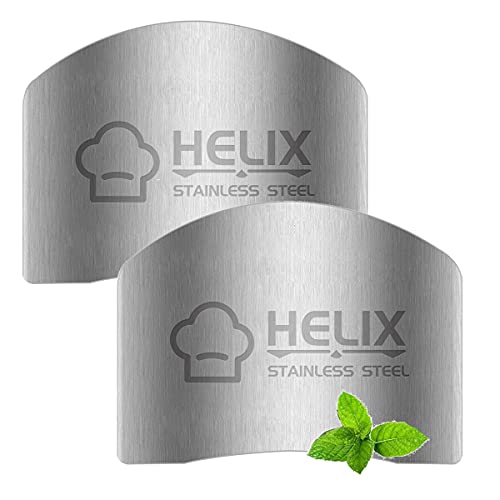
The open-ring adjustment is the distinguishing feature of this two-piece set, making it a useful choice when a fixed finger opening may not fit comfortably. Each guard is stainless steel, and the size is 6.5 cm long. The maker says the smooth-edged, corrosion-resistant material is intended to protect fingers while slicing and chopping.
An adjustable ring still needs to sit securely without pinching or sliding toward the blade. The 6.5 cm length is the only dimension, so buyers with unusually small or large fingers should confirm fit before ordering.
Bottom line: Choose this set if adjustable fit matters more than having several guard styles.
Romooa 11-Piece Finger Guard Set

The broadest assortment here is this 11-piece set, which includes four stainless steel guards in single- and double-finger styles, two thumb guards, finger cots, and three slicing accessories. That mix can suit a kitchen where different tasks call for different hand positions rather than one ring guard alone.
The maker says the guards keep fingers away from knives during slicing and dicing. The set’s guard dimensions and specific material for the non-metal components are not included in the specifications, so check sizing and materials if either is essential to your choice.
Bottom line: Pick this set if you want multiple guard styles and companion slicing tools.
304 Stainless Steel Finger Guards
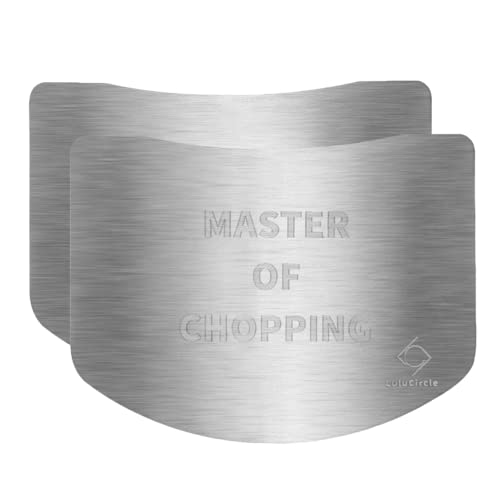
This two-piece pair specifies grade 304 stainless steel, unlike the other simple pair, which identifies stainless steel without a grade. Its adjustable finger-sleeve design is intended to fit a range of finger sizes, so it may suit cooks who prefer a metal guard with a named steel grade.
The maker describes 304 steel as corrosion resistant and says no extra care is needed. The dimensions—4.0 by 3.0 by 2.0—do not identify a unit or measurement orientation, so they are not enough to judge finger fit; confirm the fit before ordering if sizing is a concern.
Bottom line: Choose this pair if you prioritize a 304 steel grade.
CHENGU 9-Piece Finger Guard Set
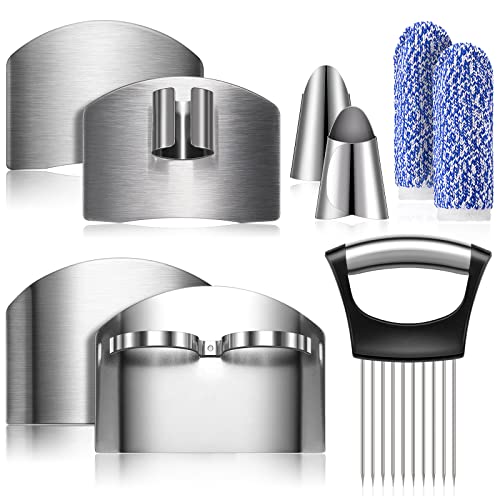
The nine-piece CHENGU set focuses on guard variety, with both single-finger and two-finger protectors plus an onion holder. The two-finger guard measures about 2.99 by 2.17 inches, while the single-finger version is about 2.48 by 2.17 inches, making this the clearest option here for comparing guard dimensions.
The set is described as lightweight, and the maker says its slicing guide helps keep fingers away from the knife. Its pieces are not all specified as stainless steel individually, so buyers seeking a particular material for every accessory should verify that before choosing.
Bottom line: Pick this set if you want single- and double-finger styles with dimensions.
How to choose a finger guard for cutting
Choose by fit and hand position first: a guard that shifts during a cut can distract you or expose the fingertip. Metal ring and sleeve guards put a barrier between some fingers and the blade, while fabric finger cots cover fingertips and may feel more flexible; neither style makes careless cutting safe. A guard should sit securely without restricting a natural grip or forcing the hand toward the blade.
For repeated prep, consider whether one adjustable guard is enough or whether different foods and grips call for distinct guard styles. Set count alone does not tell you how many usable guards are included, since a multi-piece set may include holders or slicing tools. Match product dimensions to the finger or hand position you intend to protect, and avoid using a loose guard.
Finger guard fit and sizing
Measure the finger area that the guard will cover and compare it with the product’s dimensions; length alone does not establish a comfortable fit. For an adjustable ring, make a small adjustment at a time and check that the opening stays secure without pinching. A sleeve or finger cot should cover the intended area without bunching or sliding during a grip.
Metal finger guards and fabric cots are not interchangeable: a ring or plate shields a specific side of the hand, while a cot covers a fingertip. Choose the style based on where your fingers sit as you guide food. If a dimension lacks a unit or is not tied to a specific piece, confirm the measurement before ordering rather than guessing from the package count.
Safe knife technique with a finger guard
A finger guard is a backup barrier, not a replacement for a stable cutting board, a controlled knife and a curled guiding hand. Keep fingertips tucked behind the knuckles and move the guiding hand gradually as the food gets smaller; pause to reposition rather than reaching around the blade. A sharp knife that moves predictably is easier to control than one that slips from excess force.
Do not assume a metal guard or fabric cot is cut-proof: no protective accessory should be placed in the blade’s path or used to justify faster chopping. Keep the food flat-side down when its shape allows, work at a pace that preserves control, and stop if the guard shifts. Clean and dry reusable guards after food prep according to their material and construction.
Frequently Asked Questions
Does a finger guard replace the claw grip?
No, a finger guard is an added barrier and does not replace tucking fingertips behind the knuckles. Keep the guiding hand curled and move it back as the food gets smaller.
How should a finger guard fit my hand?
A guard should stay in place without pinching or limiting your grip. Compare its dimensions with the finger or hand position you plan to protect, and do not use a guard that slides during prep.
Are fabric finger cots the same as metal guards?
No, a finger cot covers a fingertip, while a metal ring or plate shields a more specific area of the hand. Choose the form that fits your grip and intended coverage; neither should be treated as cut-proof.
Can I use a finger guard with a mandoline?
Use a mandoline’s intended hand guard or food holder rather than relying on a separate finger guard. Keep hands away from the exposed blade, and stop before the remaining food becomes too small to hold securely.