
Best Fishing Water Temp Gauge: 3 Options Compared

The AQUANEAT 2-pack is the best fit for most people who need an actual water temperature reading, because its probe is submerged in the water and its range spans -58°F to 158°F. Choose another model if you need a cordless outside-tank display or a vehicle coolant gauge instead.
We earn a commission if you buy through links on this page. As an Amazon Associate I earn from qualifying purchases. Products are compared on manufacturer specifications, not hands-on testing.
- Best overall: AQUANEAT Digital Aquarium Thermometer, 2-Pack – Its probe measures water directly across a -58°F to 158°F range.
- Best for probe sensing: DaToo Aquarium Thermometer with Probe – A stainless-steel probe has an error limit of ±1°C.
- Best for cordless viewing: QZQ Wireless Touch Aquarium Thermometer, 2-Pack – Its wireless touch design avoids a wire in the aquarium.
| Product | Best for | Measurement method | Temperature range | Pack count | Shop |
|---|---|---|---|---|---|
| AQUANEAT Digital Aquarium Thermometer, 2-Pack | Direct water readings | Submerged probe | -58°F to 158°F | 2 thermometers | Check Price on Amazon |
| DaToo Aquarium Thermometer with Probe | Stainless probe | Stainless-steel probe | -58°F to 158°F | 1 thermometer | Check Price on Amazon |
| QZQ Wireless Touch Aquarium Thermometer, 2-Pack | Cordless tank display | Wireless touch sensor | — | 2 thermometers | Check Price on Amazon |
Fishing Water Temperature Gauges
Choose by whether you need a direct water probe, an outside-tank sensor, or a vehicle coolant gauge.
AQUANEAT Digital Aquarium Thermometer, 2-Pack

The AQUANEAT two-pack is the only option here with two thermometers and a clearly stated submerged-probe setup. Each unit has a suction-cup probe for water and a large LCD display; only the probe goes underwater, not the display unit. The range is -58°F to 158°F, with accuracy of ±1°C, making it a practical match for checking water directly across varied conditions. It suits anglers monitoring a tank or livewell where a wired probe is acceptable. The cord and separate display may be less convenient than a cordless outside-tank sensor.
Bottom line: Pick this if you want two direct-reading probe thermometers for tank or livewell checks.
DaToo Aquarium Thermometer with Probe

The DaToo stands out for its stainless-steel sensing probe and stated ±1°C measurement error. Its range, -58°F to 158°F, matches the broad span of the AQUANEAT, but this is a single thermometer rather than a two-pack. The LCD display and suction cup are suited to aquarium, reptile, or terrarium monitoring where a probe can sit in the water. The specifications do not spell out a separate display-to-probe cable arrangement, so choose it for its sensor specification rather than assuming a particular setup. As with other tank thermometers, the device itself should stay out of the water.
Bottom line: Choose this for a single thermometer with a stainless-steel sensing probe.
QZQ Wireless Touch Aquarium Thermometer, 2-Pack
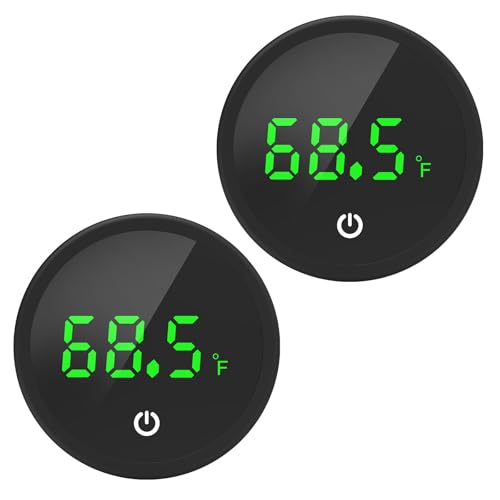
The QZQ two-pack differs from direct-probe models by using a wireless touch design, avoiding a wire inside the aquarium. It has an LED display, touch wake-up, and instant Celsius/Fahrenheit switching; the maker says the display responds in 3 seconds and the accuracy is ±1°F. The battery compartment is designed for replacement through a circular buckle on the back. This suits a tank where a clean, wire-free interior matters more than a submerged probe.
Bottom line: Pick this for cordless tank monitoring and Celsius/Fahrenheit switching.
How to choose a fishing water temperature gauge
Choose a gauge based on where the sensor measures: in the water, through the tank wall, or in an engine cooling system. Aquarium probe thermometers measure with a sensor placed in the water, while stick-on induction models read through the tank wall and are not equivalent to a fishing thermometer placed directly in open water. Vehicle gauges monitor engine coolant and require installation, so they do not measure lake or river temperature. For direct water checks, choose a probe model with a range covering the conditions you expect; the AQUANEAT and DaToo span -58°F to 158°F. A range is not a promise of marine durability, so confirm the intended environment before using aquarium gear outdoors.
Probe, wall-sensing, and coolant gauge types
A submerged probe gives a direct water measurement, while an outside-tank sensor avoids placing a wire in the aquarium. A vehicle gauge reads coolant through an installed sensor and belongs to a different job. Use this comparison to match the sensing method to the measurement location.
| Type | Sensor placement | Best use |
|---|---|---|
| Submerged probe | In the water | Direct tank or livewell checks |
| Wireless induction | Outside aquarium wall | Wire-free aquarium monitoring |
| Mechanical vehicle gauge | Engine coolant fitting | Vehicle coolant temperature |
For a livewell or open-water reading, prioritize a probe that is explicitly meant to be submerged; a tank-wall sensor cannot be transferred to open water because it senses through the tank wall.
Using a water temperature reading while fishing
Water temperature can change quickly with depth, shade, current, and recent weather, so take readings at the depth and location relevant to the fishing area. A surface reading is not a substitute for a deeper reading when the water is stratified; compare more than one depth if the gauge and sampling setup allow it. Let the sensor settle in the water before recording a value, and keep the display unit dry when the probe is the only submersible part. Aquarium thermometers are built for tank monitoring, not necessarily for repeated casting, boat use, or immersion of the display. Verify that the sensor and cable can tolerate your intended fishing environment before relying on them on the water.
Reading accuracy, range, and safe placement
Check both the temperature range and the error before using a gauge to compare locations. Celsius and Fahrenheit differ by 1.8 degrees per degree, so do not compare readings without confirming the units. Keep non-submersible display bodies above water, and do not immerse a vehicle gauge or its electrical components. A gauge outside its operating range can no longer provide a meaningful measurement; choose a model whose range includes the temperatures you expect to encounter.
Frequently Asked Questions
Can an aquarium thermometer measure lake temperature?
A submerged-probe aquarium thermometer can measure water directly if its probe is intended for immersion, but aquarium designs are not necessarily built for outdoor fishing conditions. Keep the display dry if only the probe is submersible.
Where should I place a water temperature probe?
Place the probe at the depth you want to compare and keep it away from direct contact with the boat, tank wall, or bottom. For meaningful comparisons, use the same depth and allow the reading to settle before noting it.
How do I compare Celsius and Fahrenheit readings?
Convert before comparing because each Celsius degree equals 1.8 Fahrenheit degrees. For example, 10°C equals 50°F, so verify the display unit before recording readings.
Can I use a car temperature gauge for fishing water?
No; a vehicle temperature gauge measures engine coolant through an installed sensor rather than open water. Its mounting and 12-volt vehicle power requirements make it a different instrument.
Does a wireless aquarium thermometer need a probe cable?
The QZQ model uses a wireless touch design and is described as avoiding a wire in the tank. Check that its specified sensing method and temperature range suit your measurement before choosing it.