
Best Waterproof Floor Tile Stickers Compared by Coverage

40-Pack 12-Inch Dark Grey Marble Tiles suits most people because its 40 12-by-12-inch tiles cover 40 square feet in a familiar square-tile format. Choose 20-Pack 12-Inch Taupe Marble Tiles if removable flooring matters more, or ZRJT 118-Inch Grey Flooring Roll if you want long strips with fewer seams.
Peel-and-stick floor tiles are adhesive-backed surface coverings, not a replacement for correcting a damp, unstable or badly uneven subfloor.
We earn a commission if you buy through links on this page. As an Amazon Associate I earn from qualifying purchases. Products are compared on manufacturer specifications, not hands-on testing.
- Best overall: 40-Pack 12-Inch Dark Grey Marble Tiles – Its 40 one-square-foot tiles cover 40 square feet, more area than the other tile pack.
- Best for removability: 20-Pack 12-Inch Taupe Marble Tiles – The maker says the adhesive-backed tiles can be removed without damaging the underlying surface.
- Best for fewer seams: ZRJT 118-Inch Grey Flooring Roll – Each long strip measures 118 inches and covers about 9.6 square feet.
| Product | Best for | Format | Coverage | Thickness | Shop |
|---|---|---|---|---|---|
| 40-Pack 12-Inch Dark Grey Marble Tiles | Larger tile projects | 12 × 12 in tiles | 40 sq ft | 1.27 mm PVC layer | Check Price on Amazon |
| 20-Pack 12-Inch Taupe Marble Tiles | Removable floor updates | 12 × 12 in tiles | 20 sq ft | 1.2 mm | Check Price on Amazon |
| ZRJT 118-Inch Grey Flooring Roll | Fewer floor seams | 11.8 × 118 in roll | 9.6 sq ft | 0.635 mm | Check Price on Amazon |
Waterproof Floor Tile Stickers
Compare the tile packs and flooring roll by coverage, format and the project needs each serves.
40-Pack 12-Inch Dark Grey Marble Tiles
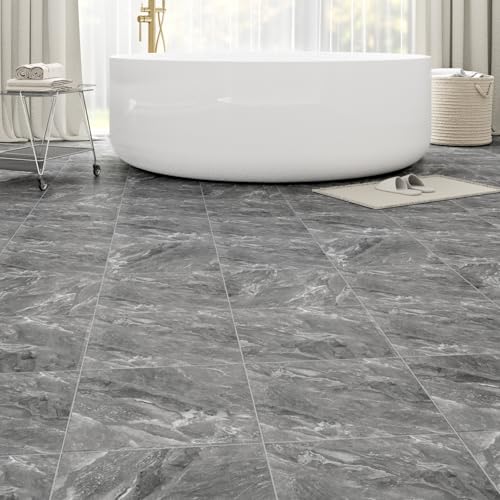
The 40-tile pack covers the most floor area among the square-tile options here: each 12-by-12-inch tile covers 1 square foot. The dark grey marble-look vinyl has a PVC layer measuring 1.27 millimeters thick. The maker says the surface resists wear and stains and that its adhesive holds up when exposed to water. That makes this pack a practical fit for a larger room or an RV floor where a square layout works. The limitation is the tile format: a 12-inch grid creates more seams than a continuous roll.
Bottom line: Choose this pack when you want square tiles and need to cover up to 40 square feet.
20-Pack 12-Inch Taupe Marble Tiles

The standout here is the maker’s removable-adhesive claim: the 20 taupe marble-look vinyl tiles are said to come off without damaging the surface beneath. Each 12-by-12-inch tile covers 1 square foot, for a total of 20 square feet, and measures 1.2 millimeters thick. The maker also describes the surface as waterproof, wear-resistant and non-slip. Consider this pack for a smaller room or a temporary update, but measure first: it covers half the area of 40-Pack 12-Inch Dark Grey Marble Tiles, so a larger project needs more than one pack.
Bottom line: Pick this pack for a smaller floor where removable adhesive is a priority.
ZRJT 118-Inch Grey Flooring Roll

The 118-inch roll is the only long-strip format here, so it can reduce the number of seams across a narrow run compared with separate square tiles. Each 11.8-inch-wide strip is 0.635 millimeter thick and covers about 9.6 square feet. Its grey wood-grain finish is described by the maker as scratch-resistant and waterproof. The roll can suit a hallway, RV or other narrow area, but its coverage is much smaller than 40-Pack 12-Inch Dark Grey Marble Tiles’s 40-square-foot pack; plan the layout and seams before cutting.
Bottom line: Choose the roll for a narrow run where long strips can reduce visible seams.
How to Choose Waterproof Floor Tile Stickers
Start with floor area and format: a 12-by-12-inch tile covers 1 square foot, while a roll’s coverage depends on its width and length. Measure the room’s longest and widest points, multiply them for a basic square-foot estimate, then add material for cuts and layout; a simple rectangular room typically needs less extra than one with alcoves or many corners. Choose square tiles when a grid suits the room, and long strips when fewer seams across a narrow run matter more. Adhesive-backed coverings work best as surface updates, not as a fix for a soft, loose or damp floor. A measurable rule: if a floor has raised seams or uneven spots, correct them before applying thin stickers, rather than expecting the covering to level the floor.
Prepare the Floor Before Sticking Tiles
Clean, smooth and fully dry surfaces give peel-and-stick flooring the best chance of adhering evenly. Remove grit, grease and residue; even small particles can telegraph through thin coverings or create a weak spot. Existing flooring should be firmly attached, with no loose edges, lifted seams or flaking finish. Avoid applying stickers over damp surfaces or trapping moisture beneath a waterproof layer, since water can compromise adhesion or remain hidden. Check that the floor is compatible with adhesive-backed vinyl, especially if it is freshly painted, sealed or textured. Dry-fit a row before peeling the backing and keep cuts away from high-traffic edges where lifting would matter most.
Plan Tile Coverage and Seams
Plan the layout before removing any adhesive backing: a 12-inch tile grid and an 11.8-inch-wide roll create different seam patterns. Mark a straight reference line across the room and dry-lay the first row, so small wall-angle differences do not force a visibly narrow strip at the far side. Keep cuts consistent at doorways and around fixed obstacles, and avoid placing a seam exactly where a chair leg or threshold will repeatedly catch it. A roll reduces seams along its length but still has edges and end joints. Measure each separate floor zone rather than assuming a connected hallway and room form one simple rectangle.
| Project need | Format to consider | Reason |
|---|---|---|
| Broad, square-tile layout | 12-by-12-inch tiles | Each tile covers 1 square foot |
| Temporary surface update | Removable-adhesive tiles | Useful when removal is a priority |
| Narrow run with fewer seams | Long roll strips | Longer sections mean fewer crosswise joints |
Common Floor Sticker Mistakes
The most common mistake is treating a waterproof surface claim as permission to cover any floor condition. A waterproof covering does not repair a leak, stabilize loose flooring or guarantee that water cannot enter at edges and seams. Another mistake is skipping a dry layout: misaligned first rows can make every later joint look crooked. Do not stretch or force a strip around a corner; cut cleanly to fit instead. Consider door clearance too: a new surface layer can interfere with a tight door swing. If a door barely clears the existing floor, check the added layer’s thickness against that clearance before committing.
Frequently Asked Questions
How many floor tile stickers cover 40 square feet?
Forty 12-by-12-inch tiles cover 40 square feet because each tile covers 1 square foot. Add extra material when the room has many corners or cuts.
Can peel-and-stick tiles go over existing flooring?
They can adhere to some existing floors if the surface is smooth, clean, dry and firmly attached. Do not cover loose, damp, rough or raised flooring and expect the stickers to correct it.
Should I use floor stickers in a shower?
No; a waterproof-surface claim does not establish that a sticker floor is suitable for a shower or constantly wet area. Water can reach edges and seams, and floor traction when wet matters.
How do I reduce visible seams in a sticker floor?
Choose long strips for a narrow run and dry-lay the layout before peeling the backing. A long roll still has edge and end joints, so align those away from prominent or heavily trafficked spots.
Can waterproof floor stickers hide uneven flooring?
They are not a substitute for leveling a floor. Correct raised seams, soft areas and loose material first; a thin covering can show underlying bumps and may not adhere evenly.