
Best Glitter for Snow Globes: 3 Types Compared

For most snow globes, LEOBRO 1 mm White Glitter is the clearest starting point because its 1 mm white glitter is sized for a fine, snowy look. Choose Renfio Matte White Hexagon Glitter for larger matte hexagons or Hungdao Artificial Snow Twinkles for a fluffy, dry scene rather than a water-filled swirl.
Glitter for snow globes is a suspended decorative material, and particle size and shape affect how it looks as it settles. Check how each material behaves in your globe’s liquid before sealing it.
We earn a commission if you buy through links on this page. As an Amazon Associate I earn from qualifying purchases. Products are compared on manufacturer specifications, not hands-on testing.
- Best overall: LEOBRO 1 mm White Glitter – The 1 mm clear-white polyester glitter is a fine, snow-like option and is explicitly suited to snow balls.
- Best for matte flakes: Renfio Matte White Hexagon Glitter – White matte hexagon sequins create a larger, more defined flake effect.
- Best for dry scenes: Hungdao Artificial Snow Twinkles – The lightweight PVC artificial snow is intended for snow globes and holiday village decoration.
| Product | Best for | Material or shape | Color or effect | Pack amount | Shop |
|---|---|---|---|---|---|
| LEOBRO 1 mm White Glitter | Fine white flakes | Polyester glitter | Clear white, 1 mm | 150 g | Check Price on Amazon |
| Renfio Matte White Hexagon Glitter | Visible matte flakes | Hexagon sequins | Matte white, iridescent shine | 50 g | Check Price on Amazon |
| Hungdao Artificial Snow Twinkles | Dry snow scenes | PVC plastic flakes | White, fluffy and iridescent | 110 g | Check Price on Amazon |
Glitter for Snow Globes
Match the material and particle style to whether you want a water-filled swirl or a dry decorative scene.
LEOBRO 1 mm White Glitter

LEOBRO 1 mm White Glitter is the fine-flake choice here: its 1 mm clear-white polyester pieces are intended to give crafts a snow-like sparkle. The 150 g amount can serve multiple small projects, and the maker specifically names snow balls and Christmas ornaments among its uses. Choose it when you want many small white particles rather than prominent sequins or fluffy filler. One limitation is that the maker does not establish how quickly the glitter settles or whether it remains suspended in a particular liquid, so check its movement in a sample before sealing a water-filled globe.
Bottom line: Pick this for a fine white effect when you can test the settling behavior first.
Renfio Matte White Hexagon Glitter
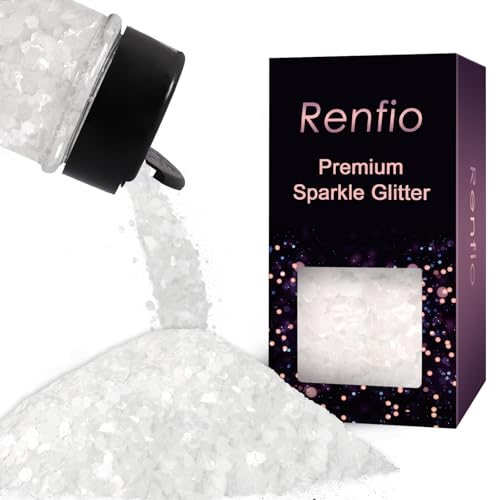
Renfio Matte White Hexagon Glitter stands apart with larger hexagon-shaped flakes and a matte white finish that still has an iridescent shine. The 50 g jar suits projects where the flakes should read as distinct shapes instead of a fine suspended snow. The maker explicitly identifies snowglobe tumblers as a use, making this a relevant option for a decorative globe-style vessel. Its chunky shape is the tradeoff: it will create a different visual density from fine particles, and the maker does not establish its behavior in a water-filled globe. Test the appearance and movement before permanently closing the vessel.
Bottom line: Choose this when distinct white hexagons matter more than a fine flurry.
Hungdao Artificial Snow Twinkles

Hungdao Artificial Snow Twinkles is artificial snow rather than conventional loose glitter: the package combines two bags of plastic snow with ten small bags of colorful debris, totaling 110 g. The maker names snow globes and holiday villages as intended decorative uses, so it fits a dry scene where light, fluffy filler provides the snowy look. The mixed contents offer more than one decorative texture, but this is not the fine white glitter choice for a clear water swirl. Keep the material contained and test its scale in the globe before arranging the scene, since the fields do not give individual flake dimensions.
Bottom line: Pick this for a dry holiday scene with fluffy artificial snow and colorful accents.
How to Choose Glitter for Snow Globes
Choose particle style first: fine glitter gives a denser, subtler field, while chunky shapes create visible individual flakes. In these options, the measurable distinction is 1 mm pieces for LEOBRO 1 mm White Glitter versus hexagon sequins for Renfio Matte White Hexagon Glitter; Hungdao Artificial Snow Twinkles is lightweight artificial snow for dry decoration. For a water-filled globe, put a small amount of the candidate material in a sample container with the intended liquid and observe whether it clumps, floats, or settles at a pace you like. Do this before final assembly because material shape and liquid viscosity both affect movement. If the project is a dry scene, prioritize the scale and texture of the flakes instead of suspension.
Glitter Size and Movement in Water
Smaller particles generally produce a finer-looking cloud, while larger flakes are easier to distinguish as they fall; the exact settling speed also depends on particle shape and the liquid. A globe liquid made more viscous will slow particle movement, but too much thickener can make the contents sluggish or uneven. Distilled water is commonly chosen for water globes because it contains fewer dissolved minerals than tap water. Test the actual combination in a small sealed sample rather than assuming that craft glitter will behave the same in every liquid. Check for clumping and persistent surface floating, and adjust the quantity or material before sealing the finished globe.
Water-Filled Globes Versus Dry Snow Scenes
Water-filled globes need decorative particles that look appealing while suspended and settling; dry scenes can use fluffy filler that would not create the same effect in liquid. Use this guide to match the material to the construction style.
| Project style | Material direction | Decision point |
|---|---|---|
| Fine water swirl | Small glitter particles | Test settling in the intended liquid |
| Bold water swirl | Chunky sequins | Check scale and movement in a sample |
| Dry holiday scene | Fluffy artificial snow | Check scale against the scene |
Keep dry filler out of a liquid globe unless you have confirmed its behavior in a sample. The material type, not just its white color, determines whether it suits the construction.
Sealing and Handling a Snow Globe
Seal a water-filled globe only after checking that the chosen liquid and particles move as intended in a sample. A secure closure matters because leaks can damage nearby surfaces, and decorative contents should never be treated as drinkable. Small craft particles and loose flakes are also a choking risk for young children, so keep open materials and unfinished globes out of their reach. Avoid overfilling the vessel; leave the space required by its closure and assembly design rather than forcing liquid into the seam. For a dry scene, secure lightweight filler so it does not spill when the globe is moved, and keep the outside clean before closing the assembly.
Frequently Asked Questions
Can regular craft glitter go in a water globe?
Some craft glitter may work, but its movement depends on particle shape and the liquid. Test a small sample first and check for clumping, surface floating, and how quickly the particles settle.
Should I use distilled water in a snow globe?
Distilled water is a common choice because it has fewer dissolved minerals than tap water. The finished liquid’s clarity and particle movement still depend on the other materials used.
How do I make glitter fall more slowly?
A more viscous liquid can slow falling particles, while excessive thickener can make a globe sluggish or uneven. Test small changes in a sample before assembling the globe.
Can artificial snow go inside a water globe?
Artificial snow intended for dry decoration may not behave like suspended glitter in liquid. Test a small amount in the exact liquid before using it in a sealed globe.