
Best Glue for Elastic Bracelets: 5 Options Compared

INSOIA 20g Bracelet Glue suits most bracelet makers because its maker says it sets in 10–45 seconds and fully cures in 12–24 hours. Choose another option if you want an included cord-and-needle kit, multiple bottles, or an alternate applicator.
Elastic-bracelet glue is a small-application adhesive used to secure the tied knot; it should not replace sound knotting or repair a worn elastic cord.
We earn a commission if you buy through links on this page. As an Amazon Associate I earn from qualifying purchases. Products are compared on manufacturer specifications, not hands-on testing.
- Best overall: INSOIA 20g Bracelet Glue – Its maker gives a 10–45-second set time and a 12–24-hour full cure.
- Best for a cord kit: ZUAWAE Glue and Cord Kit – Includes elastic string and two beading needles alongside two glue bottles.
- Best for larger quantity: Meuvcol 100g Jewelry Glue – A 100-gram bottle comes with six precision tips.
| Product | Best for | Package | Applicator | Set or dry time | Shop |
|---|---|---|---|---|---|
| INSOIA 20g Bracelet Glue | Fast setting | 20 g | 4 precision tips | 10–45 sec set | Check Price on Amazon |
| 2-Pack Brush-Head Jewelry Glue | Brush application | 2 bottles | Built-in brush | 5–10 min dry | Check Price on Amazon |
| ZUAWAE Glue and Cord Kit | Starter supplies | 2 × 10 g | Brush head | — | Check Price on Amazon |
| 3-Pack Brush-Head Bracelet Glue | Multiple bottles | 3 bottles | Built-in brush | 5–10 min dry | Check Price on Amazon |
| Meuvcol 100g Jewelry Glue | Larger bottle | 100 g | 6 precision tips | 5–10 sec dry | Check Price on Amazon |
Glue for Elastic Bracelets
Compare the applicator, package contents, and stated setting time against the kind of bracelet repair you plan to make.
INSOIA 20g Bracelet Glue
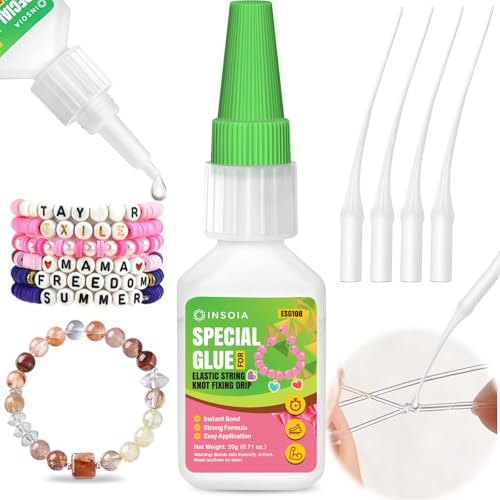
INSOIA 20g Bracelet Glue is the option with the shortest initial set window among products with a specific time: its maker says 10–45 seconds, with full cure in 12–24 hours. The 20-gram clear bottle includes four precision tips, and the maker describes the adhesive as waterproof and fast-setting. It is intended for elastic-string knots as well as beads and jewelry components, so it suits small repair work and broader craft use. A limitation is the longer full-cure window; avoid stretching or wearing the bracelet until the adhesive has cured.
Bottom line: Pick this if a short initial set time matters and you can allow the full cure.
2-Pack Brush-Head Jewelry Glue
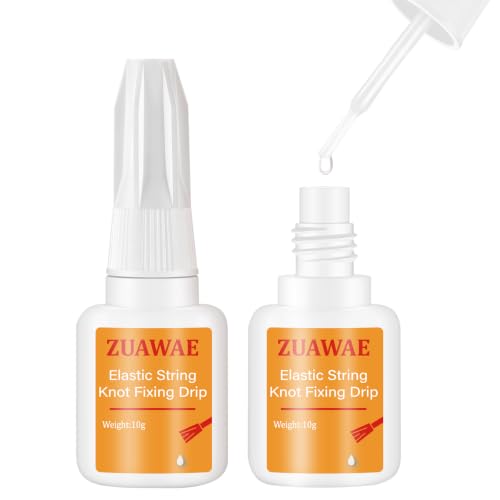
2-Pack Brush-Head Jewelry Glue uses a built-in brush head rather than separate precision tips, making it a fit for buyers who prefer brushing a thin coating onto a knot. The maker recommends clean surfaces and gives a 5–10-minute drying time. Its uses include elastic string, beads, rhinestones, and other jewelry work. The package is a two-piece set, but bottle volume is not available, so it is harder to compare the total adhesive amount with measured-size options. Choose it when brush application and a drying window matter more than a quantified bottle size.
Bottom line: Choose this for brush-style application and a 5–10-minute dry time.
ZUAWAE Glue and Cord Kit

ZUAWAE Glue and Cord Kit stands apart by bundling bracelet-making materials: two 10-gram glue bottles, one roll of 0.8 mm elastic string, and two beading needles. The brush-head bottles are intended for pinpoint knot application, while the included cord can support making or restringing bracelets. It is a practical match when the cord and needles are useful additions rather than supplies you already have.
Bottom line: Pick this when you need cord and beading needles along with glue.
3-Pack Brush-Head Bracelet Glue

3-Pack Brush-Head Bracelet Glue provides three bottles with built-in brush heads, giving it the largest bottle count among the brush-application choices. The maker describes the glue for elastic-string knots and jewelry crafts, and recommends applying a thin layer to clean surfaces; the drying time is 5–10 minutes. This set fits makers who want several small applicators available for separate projects or work areas, but it is not the clearest choice if total quantity is the priority.
Bottom line: Choose this if keeping several brush-head bottles on hand is useful.
Meuvcol 100g Jewelry Glue

Meuvcol 100g Jewelry Glue has the largest single-container quantity, at 100 grams, and includes six precision tips for placing adhesive near a small bracelet knot. The maker says the glue is waterproof and gives a 5–10-second drying time. Its intended uses include stretch-cord knots, beads, charms, and rhinestones. A larger container may be more adhesive than occasional bracelet repairs require, and no full-cure time is available in the product text. Choose it for repeated jewelry projects where a larger quantity and multiple tips are more useful than a compact bottle.
Bottom line: Pick this for frequent projects that benefit from a 100-gram bottle.
How to choose glue for elastic bracelets
Choose by applicator control, cure schedule, and how much glue you expect to use. A narrow tip or brush can help place a small amount on the knot; excess adhesive can spread onto beads or string and leave a visible spot. A fast initial set does not mean the adhesive is fully cured: the product with a cure schedule gives 10–45 seconds to set but 12–24 hours for full cure. For occasional repairs, a smaller container may be easier to use up than a large one. For repeated projects, compare measured grams rather than package count when the bottle sizes are known.
Bracelet glue reinforces a correctly tied knot; it does not restore elastic that has lost stretch or frayed. If the cord is visibly worn or slack, restring the bracelet before sealing its knot.
How to apply glue to an elastic bracelet knot
Apply a small amount directly to a clean, tied knot, keeping adhesive off the visible bead surfaces. Product makers recommend a thin layer, and some advise waiting 5–10 minutes for drying; another maker gives a separate full-cure window of 12–24 hours. Keep the bracelet relaxed while the adhesive sets so the knot is not pulled apart prematurely. Where the product gives a full-cure time, wait for that period before wearing or stretching the bracelet.
Work with good ventilation and keep glue away from eyes and skin; follow the package safety directions if adhesive contacts either. Keep adhesives out of children’s reach, especially during bead crafts, and do not assume a glue is safe for skin because it is sold for jewelry.
Elastic cord thickness and bracelet fit
Elastic cord commonly comes in diameters around 0.5–1.0 mm, with 0.8 mm a frequent bead-bracelet size; bead-hole diameter determines what can pass through. Check that the cord fits the smallest bead hole before restringing, and leave enough stretch to tie a secure knot without forcing a bead onto the cord. A kit containing 0.8 mm string is therefore most relevant when its beads have holes that accept that diameter. Thicker cord can improve support for larger-hole beads, but it will not fit every bead.
Measure wrist circumference with a flexible tape and add roughly 0.5–1 inch for a comfortable bracelet, adjusting for bead size and preferred snugness. Do not use glue to compensate for a knot that slips or cord that is too short; correct the cord length and knot first.
Glue package types compared
Package format changes how the adhesive is dispensed and what supplies come with it; it does not by itself establish bond strength. Use this guide to match the package to the task, and compare a measured weight when one is supplied.
| Package type | Useful when | Trade-off |
|---|---|---|
| Precision-tip bottle | Placing glue on a small knot | Requires careful aim |
| Brush-head bottle | Coating a knot in a thin layer | May be less pinpoint |
| Glue and cord kit | Starting or restringing a project | Included cord must match bead holes |
| Large container | Repeated craft use | More glue than occasional repairs need |
Choose a precision tip for controlled placement, a brush for spreading a thin coating, or a kit when its cord and needles are useful. Regardless of package, keep glue off the bracelet’s visible surfaces and allow the appropriate cure time before wear.
Frequently Asked Questions
How long should bracelet glue cure before wearing?
Wait for the product’s full-cure time when one is given; one option specifies 12–24 hours even though its initial set is 10–45 seconds. A dry time of 5–10 minutes is not automatically a full-cure time.
Can glue fix stretched-out elastic bracelet cord?
No; glue can secure a knot but cannot restore elastic that has become slack or frayed. Restring a bracelet when the cord no longer returns to its original length or shows wear.
What elastic cord diameter fits clay beads?
Cord around 0.5–1.0 mm is common for bead bracelets, but the bead hole controls fit. Test the cord through the smallest hole before stringing the whole bracelet.
How much extra length should a stretch bracelet have?
A common starting allowance is about 0.5–1 inch beyond wrist circumference. Bead size and whether you prefer a snug or loose fit can change that allowance.
Should I use glue instead of tying a knot?
No; tie a secure knot first, then use a small amount of glue to reinforce it. Adhesive does not make worn cord or a slipping knot mechanically sound.