
Best Glue for Jewelry Repair: 5 Options Compared

For general jewelry repairs, Aleene’s Jewelry & Metal Glue, 0.7 fl oz is the most direct fit because it is made for jewelry and metal and its name specifies clear adhesive. Choose a different option if you want a larger tube, multiple small tubes, or a B-7000-style precision applicator.
Jewelry glue bonds small components; it is not a substitute for a mechanical repair when a clasp, chain, or setting must bear load.
We earn a commission if you buy through links on this page. As an Amazon Associate I earn from qualifying purchases. Products are compared on manufacturer specifications, not hands-on testing.
- Best overall: Aleene’s Jewelry & Metal Glue, 0.7 fl oz – Designed for jewelry and metal, with a clear adhesive in a 0.7 fl oz tube.
- Best for small portions: Aleene’s Jewelry & Metal Glue, 3-pack – Three 0.1 fl oz tubes provide separate small amounts for occasional repairs.
- Best for precision application: FITTDYHE B-7000 Jewelry Glue, 50 ml – The product features describe a fine tip and a 50 ml tube.
| Product | Best for | Package amount | Applicator | Shop |
|---|---|---|---|---|
| Aleene’s Jewelry & Metal Glue, 0.7 fl oz | Metal and jewelry | 0.7 fl oz | — | Check Price on Amazon |
| Aleene’s Jewelry & Metal Glue, 3-pack | Occasional repairs | 0.1 fl oz each | — | Check Price on Amazon |
| FITTDYHE B-7000 Jewelry Glue, 50 ml | Fine placement | 50 ml | Precision tip | Check Price on Amazon |
| B-7000 Jewelry Glue, 4 × 15 ml | Multiple small jobs | 4 × 15 ml | Precision tip | Check Price on Amazon |
| Cerca de Jewelry Glue, 2 oz | Larger supply | 2 oz | Controlled drops | Check Price on Amazon |
Best glue for jewelry repair
Compare the adhesive purpose and package format before choosing glue for a particular jewelry fix.
Aleene’s Jewelry & Metal Glue, 0.7 fl oz

Aleene’s Jewelry & Metal Glue, 0.7 fl oz is the most directly jewelry-focused choice here: its name specifies jewelry and metal, while the other options emphasize craft uses or B-7000 adhesive. The 0.7 fl oz tube is a single-container option for repairs involving jewelry, metal, glass, gems, or beads, as named on the package. Its clear finish is useful when visible adhesive would distract from a piece.
Bottom line: Choose this for a clear adhesive explicitly intended for jewelry and metal.
Aleene’s Jewelry & Metal Glue, 3-pack

Aleene’s Jewelry & Metal Glue, 3-pack stands apart by dividing the adhesive into three 0.1 fl oz packages, a format suited to small jobs or keeping portions separate. The product features describe a no-drip, no-run formula, a permanent bond, and a clear, waterproof finish; those are maker claims, not a guarantee for every material combination. Its small amount per tube is a practical limitation for repeated or larger repairs, where a larger container may be more suitable. Check that the joint can be bonded rather than relying on glue to replace a broken load-bearing clasp or setting.
Bottom line: Pick this when several small tubes suit occasional, controlled repair work.
FITTDYHE B-7000 Jewelry Glue, 50 ml

FITTDYHE B-7000 Jewelry Glue, 50 ml offers a 50 ml tube and a fine precision tip, distinguishing it from the other products whose features do not identify an applicator. The maker describes the adhesive as transparent, waterproof, and elastic, and says the cap is designed to resist clogging. Those properties may suit craft-style jewelry fixes where a small drop and some flexibility are useful.
Bottom line: Choose this when a precision tip and 50 ml supply fit your repair needs.
B-7000 Jewelry Glue, 4 × 15 ml
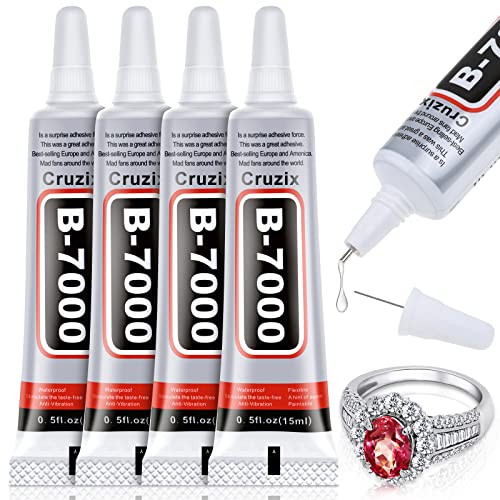
B-7000 Jewelry Glue, 4 × 15 ml provides four 15 ml tubes rather than one larger container, which can be convenient when separate portions suit different craft jobs. The product features describe a precision needle tip and a pin in the cap, plus a clear, flexible adhesive for jewelry and bead work. The maker also claims a waterproof bond. This option is less suited to someone who specifically wants an adhesive whose name identifies it as jewelry-and-metal glue; Aleene’s Jewelry & Metal Glue, 0.7 fl oz makes that intended use clearer. For any bonded joint, confirm that the chosen surfaces are compatible before applying adhesive.
Bottom line: Pick this for a multi-tube format and fine placement on craft jewelry.
Cerca de Jewelry Glue, 2 oz

Cerca de Jewelry Glue, 2 oz offers a 2 oz supply, more than the other single-container options, and its product features describe controlled small drops for precise application. The maker describes it as clear, waterproof, and elastic, and names materials including gems, pearls, metal, and rhinestones. That broad material range is useful for mixed-material craft repairs, but it does not mean every surface pairing will bond reliably. A larger container can also be more adhesive than a single minor repair needs, so match the amount to planned use and follow the package directions for handling and cure time.
Bottom line: Choose this when you need a larger clear adhesive supply for varied jewelry materials.
How to choose jewelry repair glue
Choose by the joint material and whether it must flex, not by the word “strong” alone. Jewelry adhesives commonly work by forming a thin bond between prepared surfaces; grease, polish, and dust can interfere, so clean and dry both sides first. Metal-to-metal, stone-to-metal, and fabric-to-metal are different pairings, and an adhesive that works for one may not suit another. For a tiny stone under 4 mm, favor a precision tip or apply a pinhead-sized drop with a disposable pick to limit squeeze-out. If the repair carries body weight or secures a valuable stone, use a jeweler’s mechanical repair rather than treating glue as a substitute for a setting or clasp.
Allow the joint to reach the package’s cure time before wearing it; handling strength and full cure are not always the same.
Match adhesive to jewelry materials
Surface pairing determines whether glue is a sensible repair: smooth metal, porous fabric, glass, and gemstones do not present the same bonding surface. Use the material list and directions on the chosen package, and test a hidden area when appearance matters. A clear adhesive can still leave a visible bead, so less is usually easier to control than excess that squeezes beyond the joint. Do not glue across a moving hinge or clasp; those parts need free movement and mechanical function.
This table gives a practical starting point, not a guarantee that every material combination will bond.
| Repair need | Useful feature | Choice approach |
|---|---|---|
| Tiny stone or bead | Fine applicator | Use a precision tip or small placement tool |
| Visible joint | Clear adhesive | Use a minimal amount and prevent squeeze-out |
| Broken clasp or setting | Mechanical support | Seek repair beyond an adhesive-only fix |
Applying glue without a messy bond
Use a small amount, align the pieces once, and keep adhesive away from the visible face of a stone. A fine tip can help place a drop, but a pin or toothpick can meter glue from a wider opening. Work on a protected, level surface and keep the bonded parts steady during the package’s cure period. Avoid wearing the jewelry while the bond cures; movement can shift the parts and skin contact with uncured adhesive should be avoided.
Adhesives can irritate skin or eyes, so avoid direct contact, work with ventilation, and keep tubes away from children and pets. If glue reaches skin or eyes, follow the package safety directions rather than pulling bonded skin apart.
Common mistakes with jewelry glue
Too much glue is a common mistake: excess can obscure a stone edge, spread onto a finish, or leave a visible ridge after curing. Another is choosing by water resistance alone; water resistance does not establish suitability for every surface or repeated flexing. Do not use glue to replace a missing prong, stretched chain link, or failed clasp, because those repairs depend on mechanical structure. Finally, do not assume a bond is ready as soon as it feels firm. Respect the cure time on the package, and keep the repair dry and undisturbed until that time has passed.
Frequently Asked Questions
How long should jewelry glue cure before wearing?
Wait for the full cure time printed on the adhesive package before wearing the piece. A bond that feels firm to the touch may not have reached its full cure.
Can jewelry glue repair a broken necklace clasp?
Glue is not a reliable substitute for a clasp’s mechanical connection, especially when the joint is pulled during wear. Replace or mechanically repair a broken clasp rather than relying on adhesive alone.
How do I keep clear glue off a gemstone?
Use a precision tip or transfer a pinhead-sized drop with a disposable pick, then join the pieces without pressing out excess. Protect the visible stone surface and let the bond cure without movement.
Is waterproof jewelry glue safe to wear in water?
Waterproof is a maker’s adhesive claim, not proof that a repaired piece can withstand soaking, heat, or repeated movement. Let the glue fully cure and avoid water exposure if the package directions do not authorize it.
Should I glue a loose stone back into a setting?
Glue may not secure a stone in a setting designed to hold it with prongs or a bezel. If the stone is loose because the setting has shifted or a prong is damaged, have the setting repaired mechanically.