
Best Glue for Melamine: 5 Options Compared

Titebond Melamine Glue 16 oz suits most melamine projects because its fast initial tack and longer open time help hold parts while leaving room to align them. Choose RooClear Melamine Glue 16 oz if its 20-minute assembly time fits your workflow, or a larger package when project volume matters more than handling a small container.
Melamine glue is an adhesive intended to join melamine-faced panels and related materials; the panel surface should be clean and properly prepared for bonding.
We earn a commission if you buy through links on this page. As an Amazon Associate I earn from qualifying purchases. Products are compared on manufacturer specifications, not hands-on testing.
- Best overall: Titebond Melamine Glue 16 oz – Its fast initial tack is paired with longer open time for alignment.
- Best for timed assembly: RooClear Melamine Glue 16 oz – The assembly time is 20 minutes.
- Best for larger runs: Titebond Melamine Glue 1-gallon 2-pack – The package contains two 1-gallon containers.
| Product | Best for | Package size | Shop |
|---|---|---|---|
| Titebond Melamine Glue 16 oz | Small assemblies | 16 oz | Check Price on Amazon |
| Titebond Melamine Glue 1 gallon | Frequent assembly | 1 gal | Check Price on Amazon |
| RooClear Melamine Glue 16 oz | Timed assemblies | 16 oz | Check Price on Amazon |
| Titebond Melamine Glue 1-gallon 2-pack | Batch production | 2 × 1 gal | Check Price on Amazon |
| Titebond Melamine Glue 16 oz 12-pack | Repeat small jobs | 12 × 16 oz | Check Price on Amazon |
Best Glue for Melamine
Compare the package sizes and working characteristics to match the adhesive to your assembly pace and project volume.
Titebond Melamine Glue 16 oz
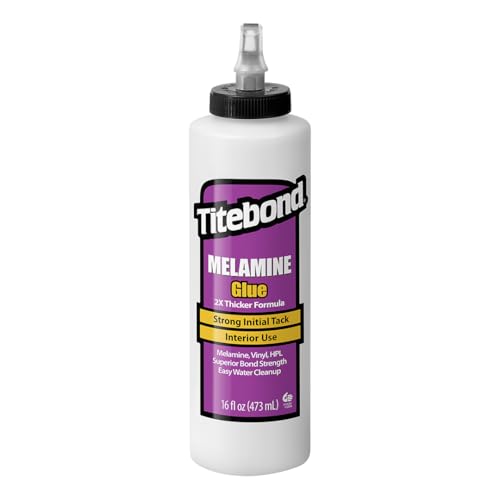
For a small or occasional build, this 16-ounce size gives the same melamine-bonding focus as larger Titebond packages without committing to a gallon. The maker says it bonds melamine, wood, MDF, particleboard, vinyl-coated surfaces, HPL and metals; fast initial tack and longer open time support alignment during assembly. Its thicker, drip-resistant consistency can help with controlled placement, and the water-based formula cleans up with water and dries clear. The main limitation is volume: a 16-ounce container is less suited to repeated production work than gallon formats.
Bottom line: Choose this for smaller builds where alignment time and a compact package matter.
Titebond Melamine Glue 1 gallon

The single-gallon format is the practical distinction here for projects that use more adhesive than a small container can supply. The maker says this water-based, nonflammable formula bonds melamine, vinyl-coated products, HPL, wood, MDF and particleboard, with fast initial tack and longer open time for positioning. A thick consistency helps control runs, and the adhesive dries clear and cleans up with water. Its size is the tradeoff: occasional repairs may not need a gallon, so a smaller package may be easier to manage.
Bottom line: Pick this for recurring work that calls for a gallon-sized supply.
RooClear Melamine Glue 16 oz

RooClear is the option with a 20-minute assembly time and 4-hour setting time, making those timing figures central to planning a build. Its 16-ounce size is aimed at smaller jobs, and the maker says the adhesive dries clear and becomes impermeable to water when dry. That water property is a difference from products described primarily by water cleanup; it does not by itself establish suitability for outdoor exposure or constant immersion. Buyers choosing it should confirm that its assembly and setting times work with their clamping and alignment sequence.
Bottom line: Choose this when its 20-minute assembly window suits the job.
Titebond Melamine Glue 1-gallon 2-pack
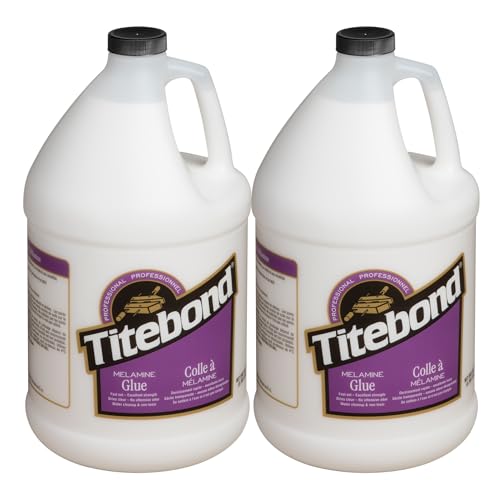
This two-gallon total package is the largest supply option here, suited to batch work or multiple assemblies rather than a single occasional repair. The maker says the formula bonds melamine, wood, MDF, particleboard, vinyl-coated surfaces, HPL and metals, with fast initial tack, longer open time and a thicker consistency for controlled application. It is water-based, low-odor, cleans up with water and dries clear. The obvious limitation is committing to two containers; choose a smaller format when storage or consumption is uncertain.
Bottom line: Select this for ongoing work where the two-gallon quantity is useful.
Titebond Melamine Glue 16 oz 12-pack

This 12-pack totals 192 ounces, packaged as twelve individual 16-ounce containers rather than one bulk jug. That format can suit repeat jobs where separate containers are more convenient than opening a gallon at a time. The maker says the adhesive bonds melamine, wood, MDF, particleboard, vinyl-coated surfaces, HPL and metals; it has fast initial tack, longer open time, drip resistance, water cleanup and a clear finish. The limitation is the number of containers: a single project may be better served by one small bottle or a gallon.
Bottom line: Choose this for repeated smaller assemblies that benefit from separate containers.
How to choose melamine glue
Choose melamine adhesive by matching the bonded materials, the assembly window and the amount you will use. Melamine-faced panels have a hard resin surface, while their cut edges expose a more absorbent particleboard or MDF core; joining a face to an edge is different from joining two porous wood surfaces. The products here identify melamine plus several related materials, but their working times differ: one gives a 20-minute assembly time and a 4-hour setting time, while other options describe fast tack and longer open time without a numeric window. If precise alignment requires more than 20 minutes, favor a formula with an explicitly longer open time, then confirm the actual handling schedule before assembly.
Package size and project scale
Package quantity is the clearest distinction among these choices: they range from 16 ounces to two 1-gallon containers. A useful decision rule is to choose a single 16-ounce container for a small, one-off project; choose a gallon for recurring work; and consider the two-gallon or twelve-container formats only when multiple assemblies justify storing more adhesive. The 12-pack and two-gallon option have the same total volume, but divide it differently: twelve 16-ounce bottles versus two gallon containers. Container format affects how you stage a job, not the adhesive’s bond strength. Avoid estimating coverage without the joint dimensions and application method.
Bonding melamine surfaces
Melamine’s finished face is less absorbent than bare wood, so cleanliness and contact area matter when making a joint. Remove dust and grease, dry-fit the pieces, and make sure the faces meet evenly before applying adhesive; gaps and contamination can undermine a bond regardless of package size. For edge-to-face joints, keep the cut edge square and provide enough clamping or assembly pressure to maintain contact while the adhesive sets. A clear-drying formula can reduce visible residue on a finished surface, but excess adhesive should still be controlled at the joint. These products are aimed at interior woodworking and assembly; the product facts do not establish exterior durability for the Titebond options.
Working time, cleanup and safe handling
Open time and setting time describe different parts of assembly: open time is the interval available to position parts, while setting time is the period before the bond reaches a firmer state. Only RooClear gives a numeric assembly and setting time here, so plan its clamp sequence around 20 minutes and 4 hours respectively. Water-based formulas that clean up with water should be wiped before they dry, since dried adhesive is harder to remove. Keep adhesive off skin and out of eyes, ventilate the work area, and keep containers closed when not in use; water-based does not mean suitable for ingestion or contact with food. Do not load a glued joint until its specified cure requirements are met.
Frequently Asked Questions
Can melamine glue bond a melamine edge to its face?
It can be used for melamine-to-melamine assemblies, but the face and cut edge behave differently: the face is resin-coated and the edge is exposed core. Clean both surfaces, dry-fit them, and clamp the joint so they remain in close contact while setting.
How long should I clamp a melamine glue joint?
RooClear gives a 20-minute assembly time and a 4-hour setting time, but those figures do not state a universal clamp-release rule. For products without a numeric time, use the adhesive maker’s full cure guidance before removing clamps or loading the joint.
Does clear-drying melamine glue leave a visible line?
A clear-drying formula is less conspicuous than a white one, but dried squeeze-out can still affect the finish. Apply a controlled bead and remove excess while it is still workable.
Can I use melamine glue outdoors or in water?
Do not assume that a melamine adhesive is suitable for outdoor exposure or immersion. RooClear is described as impermeable to water when dry, but that claim alone does not define weather or continuous-immersion performance.
How do I prepare melamine before gluing?
Start with clean, dry surfaces and a dry fit that leaves no visible gaps. Remove dust and grease, align the pieces before applying adhesive, and clamp evenly to maintain contact through the set.