
Best Grout Cleaning Machine: 3 Stand-Up Picks

Grout Groovy! Stand-Up Cleaner Bundle is the best grout cleaning machine for most people because its 20-foot cord and included brush wheels, hand brush and microfiber cloth cover more cleaning tasks. Choose Grout Groovy! Compact Stand-Up Cleaner or Grout Groovy! Lightweight Stand-Up Cleaner if you want a simpler stand-up cleaner rather than a bundle, and choose a floor machine only if you need broader floor-care functions.
We earn a commission if you buy through links on this page. As an Amazon Associate I earn from qualifying purchases. Products are compared on manufacturer specifications, not hands-on testing.
- Best overall: Grout Groovy! Stand-Up Cleaner Bundle – A 20-foot cord and three brush wheels, plus a hand brush and microfiber cloth, make it the most complete grout-focused package.
- Best for small spaces: Grout Groovy! Compact Stand-Up Cleaner – Its compact stand-up design is aimed at maneuvering in tight bathrooms, kitchens and RVs.
- Best for simple operation: Grout Groovy! Lightweight Stand-Up Cleaner – The stand-up design targets routine grout cleaning on ceramic and porcelain tile without a bundle of extra tools.
| Product | Best for | Weight | Shop |
|---|---|---|---|
| Grout Groovy! Stand-Up Cleaner Bundle | Complete kit | 4 lb | Check Price on Amazon |
| Grout Groovy! Compact Stand-Up Cleaner | Tight spaces | 5.2 lb | Check Price on Amazon |
| Grout Groovy! Lightweight Stand-Up Cleaner | Basic cleaning | 5.6 lb | Check Price on Amazon |
Best grout cleaning machines
Compare the grout-focused stand-up tools by reach, included accessories and the kind of tile-cleaning job you have.
Grout Groovy! Stand-Up Cleaner Bundle
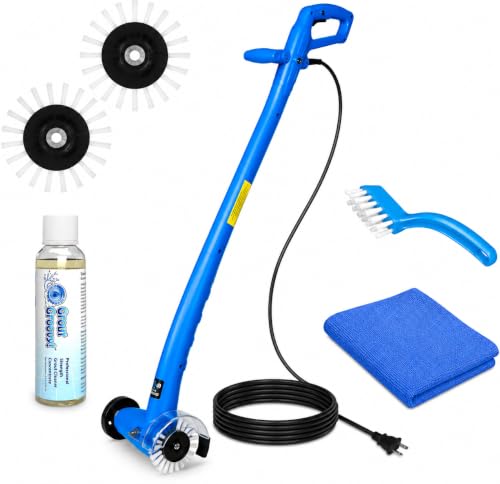
Grout Groovy! Stand-Up Cleaner Bundle stands apart with its accessory bundle: three brush wheels, a grout hand brush and a microfiber cloth come with the stand-up electric cleaner. Its 4-pound weight and 20-foot cord give a concrete sense of its portability and reach. The maker says each nylon wheel can clean up to 500 square feet when used properly and says the wheels are safe for porcelain and ceramic tile. This bundle suits a household that wants powered grout cleaning plus a hand tool for corners. Its brush-wheel approach is specific to grout lines, not a general floor-buffer replacement.
Bottom line: Choose this if you want the most complete set of grout-cleaning tools and an extended cord.
Grout Groovy! Compact Stand-Up Cleaner

Grout Groovy! Compact Stand-Up Cleaner is the lightest compact stand-up cleaner, aimed at small bathrooms, kitchens and RVs rather than broad floor work. Its 46-inch length and slim profile are intended to ease maneuvering in confined rooms. The maker says it cleans dirt, grime and stains from grout lines and is suitable for ceramic and porcelain tile. This option fits quick home cleanups where a dedicated grout tool matters more than an accessory kit. Its weight is 5.2 pounds, so the 4-pound bundle is lighter if carrying weight is the priority.
Bottom line: Pick this for a compact stand-up tool in a small tiled room or RV.
Grout Groovy! Lightweight Stand-Up Cleaner

Grout Groovy! Lightweight Stand-Up Cleaner keeps the focus on an upright format for kitchen and bathroom grout, with a comfortable grip intended for longer cleaning sessions. At 5.6 pounds, it is the heaviest of the three listed Grout Groovy! units, though still a stand-up home tool. The maker says it deep-cleans grout on ceramic, porcelain and other hard tile surfaces, and describes its approach as chemical-free. This suits buyers who want a straightforward powered tool rather than bundled accessories. Those wanting supplied wheels, a hand brush and cloth should choose the bundle instead.
Bottom line: Choose this for a straightforward upright cleaner when accessories are not the priority.
How to choose a grout cleaning machine
Choose a grout-focused scrubber when the work is mainly narrow grout lines; choose a floor buffer when the job also includes broad-area stripping, polishing or carpet cleaning. Brush width and access matter more than motor claims for tight joints: a narrow brush can track a grout line, while a wider pad contacts more tile face. Nylon is a common nonmetallic brush material for routine tile scrubbing; avoid steel brushes, which can scratch glaze and damage softer grout. For ordinary home tile, start with water or a tile-compatible cleaner and light pressure, then increase effort only if the grout and tile tolerate it. Sealed, natural-stone, epoxy or colored grout may need cleaner-specific care, so check compatibility before applying chemicals.
Brushes and grout-line fit
Match the brush shape to the joint: a narrow wheel or pointed brush concentrates contact in grout lines, while a broad pad is better suited to open tile surfaces. Common residential grout joints are often around 1/8 to 1/4 inch wide, but older floors and handmade tile can have wider or uneven joints. Keep the brush centered over the joint and test a small hidden area first; excess pressure can chip grout edges or abrade a tile finish. Stiffness also matters: softer nylon suits routine buildup, while a firmer brush may help with stubborn soil but needs extra caution on glazed tile. A machine is not a substitute for repairing missing or cracked grout.
Using a grout cleaner without damaging tile
Work in small sections and keep the brush moving rather than holding it in one place; concentrated abrasion can wear grout or scratch tile. Sweep or vacuum loose grit before scrubbing, since sand and hard particles can act like abrasives under a rotating brush. Test any cleaner in an inconspicuous spot, especially on natural stone, colored grout or a recently sealed surface. Do not mix household cleaners: combining bleach with ammonia or acids can release dangerous gases. Ventilate the room, wear gloves if the cleaner label calls for them, and keep the cord and plug away from standing water. Rinse residue from the tile and grout when the cleaner instructions require it.
Grout scrubber types compared
Dedicated electric grout scrubbers emphasize narrow brush contact and an upright handle, while orbital floor machines use a larger rotating pad for broader floor work. A handheld grout brush offers the most control at edges and corners but requires more effort from the user. Choose by surface area and task, not by the word “commercial” or “powerful”: large machines can be awkward in a small bathroom, while a narrow grout wheel can be slow on a full-room floor. The table gives a practical starting point; finish choice, joint width and room layout can change the best fit.
| Cleaning need | Tool type | Reason |
|---|---|---|
| Grout lines in a small room | Stand-up grout scrubber | Narrow brush contact and upright handling |
| Broad floor polishing or stripping | Orbital floor machine | Larger pad covers open floor area |
| Edges, corners or spot work | Hand grout brush | Direct control in confined areas |
Frequently Asked Questions
Can an electric grout cleaner damage tile?
Yes, an abrasive or metal brush can scratch tile glaze, and concentrated pressure can wear grout. Use a nylon brush, keep it moving, and test a hidden area first.
Should I use bleach in a grout cleaning machine?
Only use a cleaner if its label permits use on your tile and grout and with the machine’s brush system. Never mix bleach with ammonia or acidic cleaners because toxic gases can form.
How wide should a grout cleaning brush be?
A brush should fit within the grout joint without repeatedly rubbing the tile edges; many residential joints are about 1/8 to 1/4 inch wide. Test irregular or wider joints gently before cleaning the whole floor.
Do grout cleaning machines work on natural stone?
Natural stone can scratch or etch more easily than ceramic or porcelain, and acidic cleaners can etch some stone. Use only a stone-compatible brush and cleaner, testing a hidden spot first.
How often should tile grout be cleaned?
Clean grout when soil becomes visible rather than on a fixed schedule; high-traffic kitchens and entryways generally need attention sooner than low-use rooms. Sweep regularly to remove grit that can scratch tile during scrubbing.