
Best Handheld Welding Gun: 3 Portable Arc Welders Compared

The Protmex handheld welder suits most home users because its 20–120A range and compatibility with 3/32- to 1/8-inch rods give more electrode flexibility than the 3/32-inch options. Choose 110V 20–120A Stick Welder Kit instead if you want a gun-style stick welder bundled with a mask and ground clamp.
A handheld welding gun is a compact manual stick welder that holds a consumable electrode at the gun end; it is not a MIG wire-feed gun. Match the amperage to the electrode and metal thickness, and use appropriate eye, skin, and ventilation protection.
We earn a commission if you buy through links on this page. As an Amazon Associate I earn from qualifying purchases. Products are compared on manufacturer specifications, not hands-on testing.
- Best overall: Protmex 110V Handheld Welder – Its 20–120A output and 3/32- to 1/8-inch rod fit cover a broader electrode range.
- Best for included gear: 110V 20–120A Stick Welder Kit – It includes a welding mask, ground clamp, and five rods.
| Product | Best for | Electrode compatibility | Shop |
|---|---|---|---|
| Protmex 110V Handheld Welder | Broader rod range | 3/32–1/8 in. | Check Price on Amazon |
| Saker 110V Portable Welder | 3/32-inch rods | 3/32 in. | Check Price on Amazon |
| 110V 20–120A Stick Welder Kit | Starter accessory kit | — | Check Price on Amazon |
Handheld Welding Guns
Compare these portable arc welders by power input, adjustable output, and electrode fit before choosing one for a repair task.
Protmex 110V Handheld Welder

The Protmex accommodates 3/32- to 1/8-inch rods, giving it a wider stated electrode range than the 3/32-inch-only models here. Its 110V inverter has a five-position current knob covering 20–120A, and the package includes 20 rods. The maker says current compensation helps maintain output through voltage fluctuations, which may matter when using a long extension cord. This is a fit for home users who already know their electrode size and need a compact stick-welding format. The maker does not identify a mask or ground clamp, so buyers who need those accessories should confirm package contents before ordering.
Bottom line: Choose this for the broadest rod compatibility among these handheld models.
Saker 110V Portable Welder
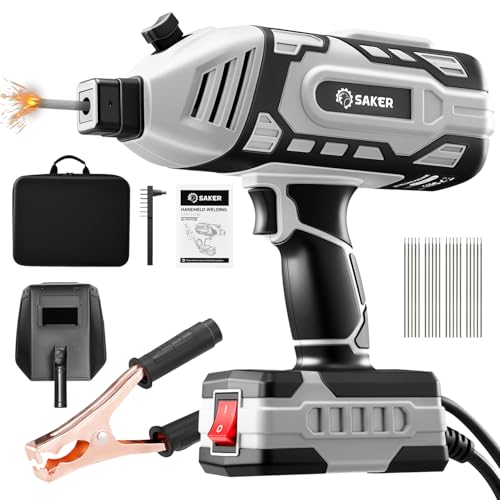
The Saker is specified for 3/32-inch rods, a narrower match than the 3/32- to 1/8-inch range of Protmex 110V Handheld Welder. It uses a 110V IGBT inverter and a five-speed control for 20–120A output. The maker says the inverter supports arc stability and consistent current, while the adjustable output is intended to help control spatter. A 20-rod bundle is identified, making this a straightforward choice when the job and electrode selection are already set around 3/32-inch rods.
Bottom line: Pick this when your planned work uses 3/32-inch electrodes and no broader rod fit is needed.
110V 20–120A Stick Welder Kit

The included mask and ground clamp distinguish this model from the other two; the package also contains five rods. Its gun-style body combines the inverter and electrode holder, with a handle button and top-mounted current control. Five settings span 20–120A, and the product is described as an MMA stick welder. The body size is about 9.84 × 3.94 × 9.84 inches, useful when planning storage or portability.
Bottom line: Choose this if the included mask and ground clamp are priorities and you can verify rod fit.
How to choose a handheld welding gun
Choose a handheld stick welder by matching its electrode size and amperage range to the metal and joint, not by portability alone. Stick welding uses a consumable coated rod that carries current and provides shielding as it melts; the operator controls arc length and travel speed by hand. A common starting rule is roughly 1 amp per 0.001 inch of electrode diameter, then adjust within the electrode maker’s range and for joint position and metal thickness. A 3/32-inch rod is commonly run around 70–120A, while a 1/8-inch rod often needs roughly 90–150A; confirm the rod’s own operating range. For these 20–120A units, 1/8-inch rods may be limited to the lower end of their usable range.
Input power matters too: 110V machines draw substantial current, so use a properly rated outlet and extension cord rather than a light household cord. Longer or undersized cords can cause voltage drop and unstable arcs.
Rod size and amperage fit
Rod diameter and amperage must suit each other; a larger electrode generally needs more current and can deposit more metal per pass. Choose a 3/32-inch rod for lighter repairs or thinner material, and consider 1/8-inch rods for thicker stock when the machine and circuit can support the required setting. The maker identifies broader rod compatibility for Protmex 110V Handheld Welder, while Saker 110V Portable Welder is designated for 3/32-inch rods; 110V 20–120A Stick Welder Kit requires a fit check before choosing electrodes.
Use the electrode package’s current range as the controlling reference, since coating type, polarity, position, and joint design change the usable setting. A good starting condition is a short, steady arc—about the electrode core diameter—rather than holding the rod far from the work. Too much current can cause excessive spatter or burn-through; too little can make the rod stick or produce poor fusion.
Handheld stick welders compared with other welders
Handheld arc units are compact stick welders, not wire-feed MIG guns or TIG torches. Stick equipment feeds a coated electrode by hand and is often practical for outdoor repairs where wind makes gas-shielded processes difficult. MIG welding feeds wire continuously and usually needs shielding gas or flux-core wire; TIG uses a separate nonconsumable tungsten electrode and often a separate filler rod. The process choice determines consumables, setup, and the skill needed for clean results.
This table gives a process-level starting point; exact material thickness depends on machine output, electrode or wire choice, joint preparation, and operator technique.
| Process | Consumable | Typical use |
|---|---|---|
| Stick / MMA | Coated rod | Repair work, outdoor use |
| MIG | Continuous wire | Longer seams, faster feeding |
| TIG | Tungsten electrode; optional filler | Controlled, precise welds |
Safety and setup for portable arc welding
Arc welding produces intense ultraviolet and infrared radiation, hot spatter, fumes, and electric-shock hazards. Wear a properly rated welding helmet, gloves, nonflammable long sleeves, and closed shoes; a handheld welder’s package accessories do not replace protective clothing or suitable ventilation. Keep combustibles at least 35 feet from hot work when practical, or shield and monitor them, and never weld near flammable vapors or containers that held fuel.
Clamp the work lead to clean metal close to the joint, remove paint or rust at the weld area, and keep the electrode holder and cables dry and undamaged. Use a dedicated, correctly protected circuit sized for the machine’s input, and avoid coiling an extension cord under load because heat can build up.
Frequently Asked Questions
Can a handheld welding gun weld 1/8-inch steel?
A handheld stick welder may weld 1/8-inch steel if the rod, current, and joint are appropriate. A 3/32-inch electrode commonly runs around 70–120A, while 1/8-inch electrodes typically need higher current; these models top out at 120A, so check the electrode maker’s range and the welder’s duty cycle.
What rods fit a handheld stick welder?
Rod fit is model-specific: some machines accept 3/32-inch electrodes, while Protmex 110V Handheld Welder is specified for 3/32- to 1/8-inch rods. Match the rod type and diameter to the machine’s holder and current range, then use the electrode package’s polarity and amperage guidance.
Do 110V welders need a special outlet?
A 110V welder needs an outlet and branch circuit rated for its input current, which can be higher than a typical light-duty appliance load. Check the machine’s nameplate and circuit rating, and avoid an undersized or long extension cord because voltage drop can destabilize the arc.
Is stick welding safe to use indoors?
Stick welding indoors requires effective fume ventilation and fire control, since welding fumes and UV arc radiation can injure people. Keep the work area clear of combustibles, wear a welding helmet and protective clothing, and do not weld coatings or metals unless their hazards are controlled.
How should I set amperage for a welding rod?
Start within the electrode manufacturer’s current range; a common rough guide is about 1 amp per 0.001 inch of rod diameter. Joint position, coating, polarity, material thickness, and machine behavior change the setting, so practice on scrap of similar thickness before welding a critical joint.