
Best Handheld Welding Machine: 4 Models Compared

For most DIY jobs, SOARFLY 110V Handheld ARC Welder is the best handheld welding machine here because it accepts electrodes from 1/16 to 1/8 inch and has five current levels. Choose another model if its specified controls or accessories better suit your work; all four are 110V stick welders, which use a consumable electrode to make the weld.
Before choosing, confirm the machine’s duty cycle and input-current requirements against the work duration and the circuit you plan to use.
We earn a commission if you buy through links on this page. As an Amazon Associate I earn from qualifying purchases. Products are compared on manufacturer specifications, not hands-on testing.
- Best overall: SOARFLY 110V Handheld ARC Welder – The 1/16–1/8-inch electrode range covers more sizes than the other products specify.
- Best for voltage fluctuations: Protmex 110V Handheld Welder – Its maker describes automatic current compensation for voltage fluctuations from long extension cords.
- Best for compact controls: 110V Handheld MMA Stick Welder – Its gun-style body puts the welding button and adjustment knob within reach.
| Product | Best for | Output range | Electrode range | Controls | Shop |
|---|---|---|---|---|---|
| SOARFLY 110V Handheld ARC Welder | Broad rod range | 120A | 1/16–1/8 in. | LED display; 5 levels | Check Price on Amazon |
| Protmex 110V Handheld Welder | Long-cord use | 20–120A | 3/32–1/8 in. | 5-position knob | Check Price on Amazon |
| Saker 110V Portable Welder | 3/32-inch rods | 20–120A | 3/32 in. | 5-speed knob | Check Price on Amazon |
| 110V Handheld MMA Stick Welder | Gun-style controls | 20–120A | — | 5 current levels | Check Price on Amazon |
Handheld Welding Machines
Compare the specified output, electrode compatibility and controls before matching a stick welder to your repair work.
SOARFLY 110V Handheld ARC Welder

SOARFLY 110V Handheld ARC Welder distinguishes itself with the widest electrode range: 1/16 to 1/8 inch, including E6013, E6011, E6010, E7018 and E308 rods. The maker says its IGBT inverter has hot start and anti-stick functions, and the machine includes auto-darkening welding glasses. That combination suits a DIYer who wants one machine for varied stick electrodes.
Bottom line: Pick this if electrode-size flexibility is your priority.
Protmex 110V Handheld Welder

Protmex 110V Handheld Welder is the only option whose maker specifically claims automatic current compensation during voltage fluctuations from long extension cords. Its 20–120A output has five knob positions, and the rod range is 3/32 to 1/8 inch; the maker says it is intended for carbon steel, stainless steel and iron. This makes it a candidate for repair work where the power run may be long. Its rod range does not include 1/16-inch electrodes, so choose another machine if those smaller rods are part of your work.
Bottom line: Choose this when the maker’s voltage-compensation claim matters.
Saker 110V Portable Welder
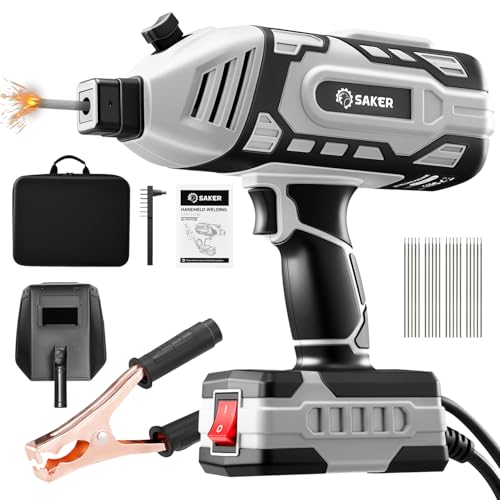
Saker 110V Portable Welder pairs a 20–120A output range with a five-speed current knob and is specified for 3/32-inch rods. The maker says its IGBT inverter supports arc stability and current consistency, and identifies carbon steel and iron as suitable materials. The included quantity is 20 rods, useful if you want electrodes with the machine. This is a narrower stated electrode fit than the machines specifying a range of sizes, so it is best suited to buyers whose repair tasks already call for 3/32-inch rods.
Bottom line: Pick this for work centered on 3/32-inch electrodes.
110V Handheld MMA Stick Welder

110V Handheld MMA Stick Welder stands out for its integrated gun-style body, with the electrode holder, handle-mounted welding button and top adjustment knob in one unit. Its output is 20–120A across five settings, and its approximate dimensions are 9.84 × 3.94 × 9.84 inches. The package includes a ground clamp, welding mask and five rods.
Bottom line: Choose this if integrated gun-style controls are the deciding factor.
How to choose a handheld stick welder
Match the electrode size and recommended amperage to the metal thickness and weld position before comparing extra features. Stick electrodes commonly come in 1/16-, 3/32- and 1/8-inch diameters; larger electrodes generally need more current and suit thicker material. A machine’s output rating does not tell you how long it can weld continuously: duty cycle is the share of a 10-minute period it can operate at a specified output. Verify both its duty-cycle rating and input-current requirement for your intended task. For short household repairs, favor a compatible electrode and a current range that includes its recommended setting; do not assume a 120A maximum means a standard outlet can supply full output.
| Need | What to compare |
|---|---|
| Small-diameter rods | Explicit compatibility with 1/16-inch electrodes |
| Common repair rods | 3/32-inch fit and a matching recommended amperage |
| Thicker stock | 1/8-inch rod fit, duty cycle and input requirements |
Electrode fit and current settings
Electrode diameter is a practical starting point, but the electrode type and metal thickness also affect the correct amperage. E6013 is commonly used for general-purpose welding, while E7018 is a low-hydrogen electrode that requires dry storage and handling; consult the electrode manufacturer’s amperage range rather than relying on a welder’s maximum. The four machines differ in which rod sizes they explicitly identify, so match the rod you plan to use instead of treating all stick welders as interchangeable. If the fit does not name your electrode size, confirm compatibility before buying. Keep the work clamp attached to clean, bare metal near the weld to maintain a reliable electrical path.
Power, duty cycle and extension cords
A 110V label describes input voltage, not the amperage a machine can draw from a household circuit. Compare the welder’s input-current and plug requirements with the circuit rating, and avoid sharing a circuit with other high-draw equipment. Long or undersized extension cords can cause voltage drop; use a cord gauge and length allowed by the welder maker, since a current-compensation feature is not a substitute for safe wiring. Duty cycle is typically expressed as a percentage over 10 minutes: for example, 20% means two minutes of welding followed by eight minutes of cooling at the output. Check the rating at the amperage you expect to use, because the allowable welding time can change with output.
Welding safety for handheld machines
Stick welding produces intense ultraviolet and infrared light, hot metal, sparks and fumes. Use a welding helmet with the correct shade for the process and current; OSHA’s published guidance gives shade 10 as a starting point for shielded metal arc welding up to 160A, with higher current requiring darker shades. Wear flame-resistant clothing, gloves and safety footwear, and keep bystanders behind a welding screen. Remove combustible materials from the work area and keep a suitable fire extinguisher nearby. Weld only with ventilation appropriate to the material and coating, and never weld containers that may have held flammable substances. An included mask or glasses should not be assumed to replace correctly rated eye and face protection.
Frequently Asked Questions
What electrode size is easiest for small repairs?
A 3/32-inch electrode is a common general-purpose size for small repair work, but the correct choice depends on metal thickness and electrode type. Check the rod maker’s amperage range and confirm the welder supports that diameter.
Can a 110V welder run from an extension cord?
It may, but cord length and wire gauge affect voltage drop and heating. Follow the welder maker’s cord guidance, and do not use a damaged or coiled cord under load.
How long can I weld before taking a break?
Use the duty-cycle rating for the amperage you are running; a 20% rating over 10 minutes means two minutes of welding and eight minutes of cooling. A higher output setting may have a shorter permitted weld time.
Do stick welders need shielding gas?
Ordinary stick welding uses a flux-coated electrode rather than a separate shielding-gas cylinder. The electrode’s flux creates shielding during welding, but the correct rod still depends on the metal and job.
What protection should I wear for arc welding?
Use a welding helmet with an appropriate shade, plus flame-resistant clothing and welding gloves. OSHA guidance starts at shade 10 for shielded metal arc welding up to 160A; protect bystanders with a welding screen as well.