
Best Heating Pad to Use in Car: 3 Travel Picks

The best heating pad to use in a car for most people is 12V Car Heating Pad, 24 x 12 in, because its included 12V charger powers a 24-by-12-inch pad with three heat settings. Choose WillingHeart 12V Shoulder Wrap instead for a snap-on shoulder wrap, or comfheat 5,000mAh Cordless Heating Pad if you need cordless warmth and can work within its battery run time.
A car heating pad uses vehicle power or a rechargeable battery to provide localized warmth; these options differ in fit, coverage, and how long they can run away from an outlet.
We earn a commission if you buy through links on this page. As an Amazon Associate I earn from qualifying purchases. Products are compared on manufacturer specifications, not hands-on testing.
- Best overall: 12V Car Heating Pad, 24 x 12 in – Includes a 12–24V car charger and offers three heat levels.
- Best for shoulder coverage: WillingHeart 12V Shoulder Wrap – The neckline snap helps hold the wrap in place, with four heat and timer settings.
- Best for cordless use: comfheat 5,000mAh Cordless Heating Pad – A rechargeable 5,000mAh battery provides warmth without a power cord.
| Product | Best for | Power source | Heat settings | Dimensions | Shop |
|---|---|---|---|---|---|
| 12V Car Heating Pad, 24 x 12 in | General car use | 12–24V car charger | 3 levels, 113–131°F | 24 x 12 in | Check Price on Amazon |
| WillingHeart 12V Shoulder Wrap | Neck and shoulders | 12V car power | 4 levels, 102.2–140°F | 24.02 x 17.72 in | Check Price on Amazon |
| comfheat 5,000mAh Cordless Heating Pad | Cord-free warmth | 5,000mAh rechargeable battery | 3 levels; up to 3.5 hours | 12 x 16 in | Check Price on Amazon |
Heating Pads to Use in a Car
Compare power requirements, shape, and controls to match a pad to your trip and preferred coverage.
12V Car Heating Pad, 24 x 12 in

12V Car Heating Pad, 24 x 12 in is the most direct fit for car use among these options: its included charger fits a standard cigarette-lighter socket, and the 24-by-12-inch shape covers a focused area. It has three settings—113°F, 122°F, and 131°F—and a 120-minute auto shut-off. The pad is corded, not battery-powered, and draws 30W on high; it can also run from a USB-C PD source rated at least 30W. That power requirement matters if you planned to use an ordinary phone charger or basic power bank, which will not power it.
Bottom line: Pick this for plug-in warmth and a compact rectangular pad.
WillingHeart 12V Shoulder Wrap
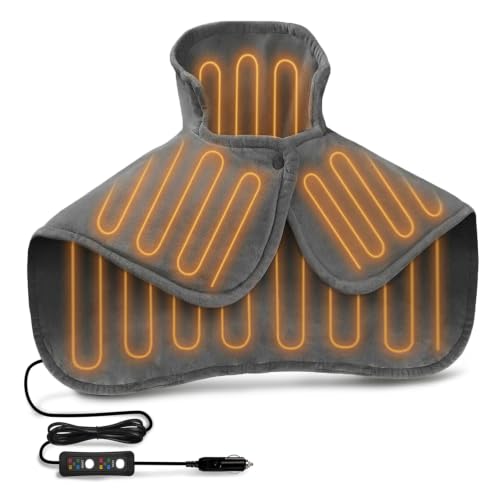
WillingHeart 12V Shoulder Wrap differs from a flat pad with its shoulder wrap shape and neckline snap, which helps keep it in place while driving. The 12V design offers four heat levels from 102.2°F to 140°F, four timers from two to eight hours, and an 85-inch cord. The wrap can also be used over the legs or stomach for targeted warmth. Its collar must not be folded while in use, and its shoulder-focused shape is less suitable than a flat pad when you want coverage across a broader area.
Bottom line: Choose this for a secured shoulder wrap and selectable timers.
comfheat 5,000mAh Cordless Heating Pad

comfheat 5,000mAh Cordless Heating Pad is the cordless alternative, powered by a 5,000mAh rechargeable battery rather than a car socket. Its 12-by-16-inch pad is filled with clay beads and weighs 1.7 pounds, giving it a weighted feel that differs from the lighter plug-in options. The manufacturer gives run times of up to about 3.5 hours on low, 2.5 on medium, and 1.6 on high, with three heat settings and auto-off. Because battery life drops as the setting rises, it is a weaker match for long trips when warmth is needed continuously.
Bottom line: Pick this when avoiding a cord matters more than extended high-heat use.
How to choose a car heating pad
Start with the power source and how you plan to sit: a 12V corded pad plugs into a vehicle socket, while a rechargeable pad works independently until its battery runs down. For a trip longer than 1.6 hours at high heat, favor a vehicle-powered option over a battery model whose high-setting run time is about 1.6 hours. Next, match the shape to the target area: a shoulder wrap can stay positioned around the neck, while a rectangle is easier to place over a lap or back. Keep cords clear of the driver’s feet, pedals, steering controls, and airbags; never position a pad where it can interfere with safe vehicle operation.
Power sources and heat settings
Car-socket heating pads use a 12V accessory outlet, but the socket’s rating and the pad’s draw determine compatibility; check the vehicle manual if the outlet’s limit is unclear. A 30W pad needs a source capable of supplying 30W, so a USB-C PD power source must meet that minimum and a basic 5V phone charger will not suffice for 12V Car Heating Pad, 24 x 12 in. Battery-powered pads trade continuous vehicle power for limited run time, and high settings generally exhaust charge faster than low settings. If you need warmth for multiple hours away from a socket, plan around the specific model’s high-setting duration rather than its low-setting maximum.
Choosing the right coverage and fit
Pad dimensions indicate the area available for coverage, not a guarantee that the pad will fit every seat or body position. A 24-by-12-inch rectangle suits targeted warmth, while a 24.02-by-17.72-inch wrap has more width and a neckline snap for shoulder placement. Before buying, measure the space where the pad will sit and check that no cord or fabric will cross a seat belt, controls, or airbag zone. For warmth concentrated at the neck and shoulders, favor a wrap; for a lap or back placement, choose a flat pad. Do not fold a heated wrap whose instructions prohibit folding during use.
Safe use during a drive
Heat accessories can distract a driver, and loose fabric or cords can obstruct pedals or controls; drivers should set up the pad before moving and stop using it if it interferes with driving. A passenger can manage the controller more safely than a driver, but the pad still needs to stay clear of airbags and seat belts. Keep heating elements flat, avoid placing a hot pad against bare skin for extended periods, and use a lower setting if warmth feels uncomfortable. Auto shut-off timers add a cutoff but do not replace supervision or safe placement; never leave a powered pad running unattended in a parked vehicle.
Frequently Asked Questions
Can I plug a heating pad into a car outlet?
Yes, if the pad is designed for vehicle power and its plug matches the car’s 12V accessory socket. Confirm the vehicle outlet can support the pad’s power draw; a 30W model requires a compatible source.
How long can a cordless heating pad run?
Run time depends on the heat setting and battery capacity. The cordless option here gives approximate maximums of 3.5 hours on low, 2.5 on medium, and 1.6 on high.
Is a car heating pad safe while driving?
Only use one if it stays clear of the driver’s feet, pedals, steering controls, and airbags. Set it up before driving, and stop using it if the cord or fabric shifts into a control area.
What size heating pad works best in a car?
A 24-by-12-inch pad provides targeted coverage, while a wrap measuring about 24 by 18 inches is shaped for the shoulders. Measure the available seat area and keep all fabric and cords away from seat belts and airbags.
Can I use a regular phone charger for a car heating pad?
Not every pad works with an ordinary phone charger. A 30W USB-C-powered model requires USB-C PD rated at 30W or higher, so a basic 5V phone charger will not power it.