
Best Heavy Duty Can Crusher: 3 Types Compared

The MasterCrush wall-mounted crusher suits most people because its name covers cans from 12 to 32 ounces, while manual operation avoids needing a compressor. Choose McKay 12/16 oz Wall-Mounted Crusher for a simpler 12- or 16-ounce wall-mounted model; choose NKAIKE Pneumatic Can Crusher only if you already have an air compressor and want pneumatic operation.
A can crusher uses leverage or air pressure to flatten empty containers and reduce the space they occupy. Match the crusher to the largest can you plan to crush, and keep fingers clear of the crushing area.
We earn a commission if you buy through links on this page. As an Amazon Associate I earn from qualifying purchases. Products are compared on manufacturer specifications, not hands-on testing.
- Best overall: MasterCrush Wall-Mounted Crusher – Its size range spans 12- to 32-ounce cans, with a wall-mounted manual design.
- Best for a simple manual setup: McKay 12/16 oz Wall-Mounted Crusher – The all-steel wall-mounted model handles 12- and 16-ounce cans and includes a bottle opener.
- Best for compressor owners: NKAIKE Pneumatic Can Crusher – The pneumatic unit uses a 100-psi working pressure and accepts cans up to 7 inches tall.
| Product | Best for | Can capacity | Operation | Construction | Shop |
|---|---|---|---|---|---|
| MasterCrush Wall-Mounted Crusher | Multiple can sizes | 12–32 oz | Manual lever | Powder-coated steel; stainless rods | Check Price on Amazon |
| McKay 12/16 oz Wall-Mounted Crusher | Standard-size cans | 12 and 16 oz | Manual lever | All steel | Check Price on Amazon |
| NKAIKE Pneumatic Can Crusher | Air compressor owners | Up to 7 in. tall; 2.8 in. OD | Pneumatic; 100 psi | Steel frame and piston | Check Price on Amazon |
Heavy duty can crushers
Compare the can-size range and operating method before choosing a crusher for your recycling setup.
MasterCrush Wall-Mounted Crusher
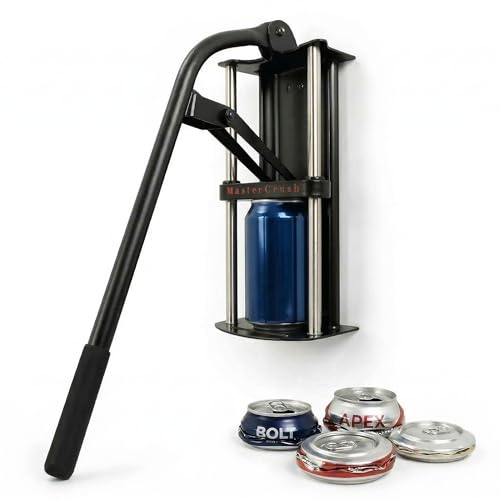
The MasterCrush stands apart with a named capacity range from 12 to 32 ounces, broader than the 12- and 16-ounce manual alternative. Its powder-coated steel body and reinforced stainless steel rods mount vertically to a solid wall, and the gripped handle supplies the crushing force. The maker says it reduces cans and plastic bottles to about 20% of their original size. This suits a household sorting several container sizes; the 4.7-pound unit requires a secure mounting surface and included screws.
Bottom line: Pick this if you want one wall-mounted manual crusher for several can sizes.
McKay 12/16 oz Wall-Mounted Crusher

The McKay pairs an all-steel frame with a built-in bottle opener, giving it a different everyday setup from the broader-capacity MasterCrush Wall-Mounted Crusher. It is designed for standard 16-ounce aluminum cans and can also crush 12-ounce cans. Its cushioned handle and two-moving-part design keep operation simple, and the maker says cans compress to about 20% of original size. This is a fit for a fixed wall, table, or countertop location; its narrower can-size range is a limitation for anyone who routinely recycles larger containers.
Bottom line: Choose this for 12- and 16-ounce cans and a built-in bottle opener.
NKAIKE Pneumatic Can Crusher
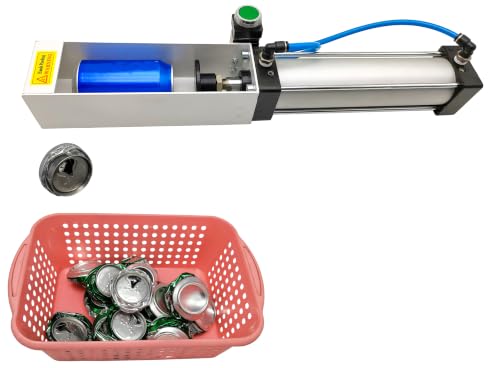
The NKAIKE uses an air cylinder rather than a hand lever, so it is the only pneumatic option among these heavy-duty crushers. Its steel frame and piston use a 63-millimeter bore and 200-millimeter stroke; the maximum can dimensions are 2.8 inches in diameter and 7 inches tall. It requires an air compressor and a 100-psi working pressure, so it suits a workshop already equipped for compressed air. That added equipment requirement makes it a poor match for a simple kitchen or garage recycling station.
Bottom line: Choose this only if your setup can supply the required 100 psi.
How to choose a heavy duty can crusher
Start with can capacity, then choose the force source that fits your workspace. A hand-operated lever uses mechanical advantage: a longer handle trades a longer pull for less force at the can. A pneumatic crusher replaces that effort with compressed air, but it also requires a compressor and the specified pressure. For an occasional household stream, a wall-mounted manual unit is usually the simpler arrangement; for frequent crushing in a workshop with air equipment, pneumatic operation may fit better. Check the maximum can height and diameter against the largest container you recycle. Do not assume that a crusher for soda cans accepts every food can or plastic bottle; container shape and material affect fit and safe operation.
Mounting and clearance for can crushers
A wall-mounted crusher needs a solid surface that can resist repeated pulling force. Mounting into a wall stud or solid masonry is more secure than relying on drywall alone; use hardware suitable for the wall material. Leave enough space below the lever for its full stroke and for a can to be placed and removed without striking a counter. A countertop installation should be secured against movement, especially when the handle is pulled down. Before mounting, measure the crusher and available work area, and confirm that the installation point accommodates the whole lever path. Keep the crushing zone away from children, and never place fingers between the crushing plate and can.
Manual and pneumatic can crushers compared
Manual crushers are self-contained, while pneumatic models require a compressor capable of the operating pressure. The right choice depends on available equipment and the containers you need to crush.
| Type | Power source | Choose when |
|---|---|---|
| Wall-mounted manual | Hand lever | You want a fixed, compressor-free setup |
| Pneumatic cylinder | Compressed air | You have air equipment meeting the unit’s pressure requirement |
Manual designs vary in handle shape and capacity, so check whether the manufacturer gives a range or just one can size. Pneumatic operation does not mean universal fit: cylinder stroke, can diameter, and can height still set limits. Disconnect air before clearing a jam or servicing a pneumatic unit, and keep hands out of the crushing path during operation.
Safe can crushing and recycling habits
Empty cans before crushing, and inspect the container for sharp edges or damage before handling it. Crushed metal can have sharp seams, so keep hands clear of the output area and use gloves when handling flattened cans. Do not put glass containers into a can crusher; glass can shatter into dangerous fragments. Recycling rules differ by local program, particularly for crushed containers, so check whether your program accepts flattened cans and whether it requires lids or labels to be handled separately. Keep the crusher mounted firmly and use it only for the container materials and sizes it is designed to accept.
Frequently Asked Questions
Can a can crusher handle both 12- and 16-ounce cans?
Some manual crushers accommodate both sizes, but capacity varies by model. Check the can-size range before buying, especially if your household also recycles larger cans.
Does a pneumatic can crusher need an air compressor?
Yes, a pneumatic crusher needs a compressor that can supply the required working pressure. The NKAIKE model specifies 100 psi, so confirm your compressor can meet that requirement.
Can you mount a can crusher on drywall?
A loaded crusher should be anchored to a solid support, such as a wall stud or masonry, rather than drywall alone. Repeated handle force can loosen an installation that is not secured to the wall structure.
Should cans be crushed before recycling?
Recycling programs differ on whether they accept flattened cans, so check your local rules first. Empty cans before crushing, and handle flattened metal carefully because edges can be sharp.
Are can crushers safe to use around children?
A can crusher has a pinch point where the lever and crushing plate meet, so children should stay clear during use. Keep hands away from the crushing path and store or mount the unit where children cannot operate it unsupervised.