
Best Hobeyhove Adjustable Dog Wheelchair Alternatives

The best fit among these adjustable dog wheelchairs is Whisker Bark Adjustable Wheelchair, Large because it adjusts in height, width, and length and has a 50-to-80-pound range. None of the options is identified as Hobeyhove, so choose a different product only if its fit better matches your dog.
A rear-support wheelchair holds a dog’s hindquarters while its front legs provide propulsion; measure carefully and supervise use, since a poor fit can create pressure or instability.
We earn a commission if you buy through links on this page. As an Amazon Associate I earn from qualifying purchases. Products are compared on manufacturer specifications, not hands-on testing.
- Best overall: Whisker Bark Adjustable Wheelchair, Large – Three-way adjustment and a 50-to-80-pound size range make fit the deciding advantage.
- Best for larger dogs: LetPetRun Large Rear-Leg Wheelchair – The size supports dogs weighing 55 to 90 pounds.
- Best for washable support: Gray Adjustable Dog Wheelchair, Medium-Large – Its removable mesh harness is machine-washable.
| Product | Best for | Weight range | Adjustments | Frame or wheels | Shop |
|---|---|---|---|---|---|
| Whisker Bark Adjustable Wheelchair, Large | Three-way adjustment | 50–80 lb | Height, width, length | Stainless steel frame; rubber wheels | Check Price on Amazon |
| LetPetRun Large Rear-Leg Wheelchair | 55–90-pound dogs | 55–90 lb | Adjustable fit | — | Check Price on Amazon |
| Gray Adjustable Dog Wheelchair, Medium-Large | Washable harness | — | Height, length, width | — | Check Price on Amazon |
| Healing Blue Adjustable Medium Wheelchair | 5.5-inch wheels | — | Height, width, length | 5.5-inch wheels; metal frame | Check Price on Amazon |
| Adjustable Four-Wheel Pet Wheelchair, Large | Four-wheel support | — | Height, length, width | Tires and bearings | Check Price on Amazon |
Adjustable Dog Wheelchairs
Compare the fit ranges and construction features before choosing a rear-support cart.
Whisker Bark Adjustable Wheelchair, Large

Three-way fit adjustment and a 50-to-80-pound size range distinguish this wheelchair from options with narrower or differently described sizing. Whisker Bark uses a stainless steel frame, solid rubber wheels, and padded harness areas with breathable belly support. The maker says the wheels roll on grass, sidewalks, pavement, and indoor surfaces, and the bathroom-friendly design allows natural relief. This is a useful choice when you need to tune multiple dimensions. Its size range is limited to 50–80 pounds, so dogs outside that interval need another fit.
Bottom line: Choose this if your dog is 50–80 pounds and needs adjustment in all three dimensions.
LetPetRun Large Rear-Leg Wheelchair

The 55-to-90-pound range is the clearest differentiator for this large-size LetPetRun cart. The maker calls for measuring both weight and body length before selecting a size, and describes a soft, skin-friendly harness intended to reduce friction during longer wear. The included size details give a 15-to-21-inch leg measurement, which may help narrow the fit. Choose it when your dog’s weight falls in that interval and its measurements match. The features do not establish its frame material or wheel construction, so buyers prioritizing those specifics should compare another option.
Bottom line: Choose this for a dog in the 55–90-pound range when the leg measurement also fits.
Gray Adjustable Dog Wheelchair, Medium-Large

A removable, machine-washable mesh harness sets this medium-large wheelchair apart for owners who want to clean the support separately. The frame adjusts in height, length, and width; the dimensions are 17.7 inches high, 19.7 inches long, and 11.8 inches wide. Its rear U-shaped harness is designed to leave room for potty breaks without removing the cart. This option may suit a medium or large dog whose measurements align with those dimensions. No weight interval is supplied, so confirm the fit using the maker’s size chart before ordering.
Bottom line: Choose this if a washable harness is important and the dimensions fit your dog.
Healing Blue Adjustable Medium Wheelchair
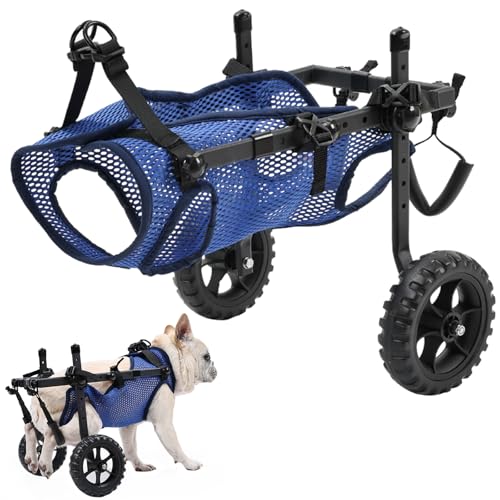
Its 5.5-inch anti-slip wheels and adjustable height, width, and length distinguish this medium-dog wheelchair. The maker describes a reinforced metal frame and says the wheels roll on grass, pavement, sidewalks, and uneven outdoor surfaces. A chest measurement range of 15.8 to 22.8 inches is provided for sizing. Consider it when that measurement suits your dog and you want a cart described for both daily walks and rehabilitation training.
Bottom line: Choose this if your dog’s chest measures 15.8–22.8 inches and the medium size fits.
Adjustable Four-Wheel Pet Wheelchair, Large

A four-wheel layout and support for both dogs and cats distinguish this large wheelchair from the rear-leg carts. Its height, length, and width are adjustable, and it includes carrying straps and leg harnesses; the maker says the design does not hinder defecation. Tires and bearings are described for movement across varied terrain. Confirm the frame’s full fit and intended support configuration before choosing it.
Bottom line: Choose this only when four-wheel support and its adjustable large configuration match your pet.
How to choose an adjustable dog wheelchair
Choose by the dog’s measurements and support needs, not the size label alone. Measure body length from the shoulder area to the base of the tail, plus the height from the floor to the hip and the width across the body; compare those dimensions with the cart’s adjustment range. Weight ranges help screen options, but they do not replace body measurements. Rear-support carts are generally for pets whose front legs can propel them, while four-wheel designs support more of the body. A practical rule: if any key measurement falls outside the adjustment range, skip that size rather than relying on a label such as medium or large. Have a veterinarian or rehabilitation professional assess fit when weakness, pain, or recent surgery affects safe movement.
Dog wheelchair fit and adjustment
A correctly fitted wheelchair keeps the pelvis level and lets the front legs reach the ground naturally. Adjust height so the rear support carries the hindquarters without lifting the front end; set width to avoid rubbing the hips and inner legs, and length so the frame does not crowd the shoulders or tail. Check the harness edges and skin after short sessions, especially around the groin and armpits, where straps can rub. Start indoors on a flat, nonslip floor for a few minutes, then increase time only if the dog moves comfortably. A cart that tilts, shifts, or causes skin redness needs adjustment or a different size before outdoor use.
Rear-support carts versus four-wheel wheelchairs
Rear-support carts suit dogs that can bear weight and move with their front legs; four-wheel models are intended to provide support at both ends. The difference affects how the pet steers and how much assistance is required, so match configuration to ability rather than assuming more wheels are always better. This comparison table summarizes the choice by need.
| Need | Cart type | Fit check |
|---|---|---|
| Hind-leg support with front-leg mobility | Rear-support cart | Front legs can reach the floor and propel the dog |
| Support beyond the hindquarters | Four-wheel wheelchair | Confirm support arrangement and whole-body fit |
Neither configuration should be used as a substitute for veterinary guidance when the dog’s mobility has changed suddenly or the cause is unknown.
Safe use and care for a dog wheelchair
Supervise every session and use the wheelchair on stable ground before trying slopes or rough terrain. Keep sessions short at first and stop if the dog struggles, pants unusually, slips, or develops rubbing; mobility carts can catch on obstacles and should not be left on an unattended pet. Check fasteners, straps, and wheel movement before each use, and clean the harness as its care directions allow. A removable machine-washable harness can simplify cleaning, but not every design has one. After use, dry fabric and metal parts fully to reduce odors and corrosion. Recheck fit as weight or body condition changes, since a previously comfortable harness may become too tight or loose.
Frequently Asked Questions
How do I measure a dog for a wheelchair?
Measure body length, hip height, body width, and weight, then compare each with the cart’s size range. A difference of even an inch can affect clearance and harness placement, so use the maker’s measurement points rather than choosing by breed.
Can a dog wheelchair be used indoors?
Many carts can roll indoors on a flat, nonslip surface, but turning space matters. Leave enough room for the frame to pivot, and start with a few minutes in a clear area before navigating doorways or furniture.
How long should a dog wear a wheelchair?
Begin with short, supervised sessions of about 5 to 10 minutes and increase only if the dog moves comfortably. Stop to check for rubbing, fatigue, or distress, and ask a veterinary professional about session length for a dog recovering from injury or surgery.
Can dogs go to the bathroom in a wheelchair?
Some designs leave the rear and underside open for urination and defecation, but the harness shape determines clearance. Check that the pet can assume its usual posture without straps or frame parts obstructing the area.
Are dog wheelchairs safe on uneven ground?
Uneven ground can tip or snag a cart, even when its wheels are described for outdoor terrain. Start on level ground, supervise closely, and avoid steep slopes, loose gravel, and obstacles the wheels cannot cross steadily.