
Best Ice Fishing Tent With Stove Jack: 4 Compared

6-7 Person Insulated Pop-Up Tent suits most groups because its 74-square-foot fishable area pairs a stove jack with room for 6-7 anglers. Choose a different shelter if you need more floor area or a smaller 3-4-person fit.
A stove jack is a heat-resistant opening for routing a stove pipe through a tent roof or wall; it does not make the surrounding fabric fireproof.
We earn a commission if you buy through links on this page. As an Amazon Associate I earn from qualifying purchases. Products are compared on manufacturer specifications, not hands-on testing.
- Best overall: 6-7 Person Insulated Pop-Up Tent – Its 74-square-foot fishable area, stove jack and two heater ports suit a mid-size fishing group.
- Best for large groups: QualyQualy 8-10 Person Tent With Floor – The 147-square-foot area is the largest here, with a stove jack and floor.
- Best for small groups: 3-4 Person Stove-Jack Shelter With Floor – This shelter is identified for 3-4 people and has a stove-ready chimney port and removable floor.
| Product | Best for | Capacity | Floor area | Shop |
|---|---|---|---|---|
| 6-7 Person Insulated Pop-Up Tent | Mid-size crews | 6-7 people | 74 sq ft | Check Price on Amazon |
| QualyQualy 8-10 Person Tent With Floor | Large groups | 8-10 people | 147 sq ft | Check Price on Amazon |
| 3-4 Person Stove-Jack Shelter With Floor | Small groups | 3-4 people | — | Check Price on Amazon |
| 420D Hexagon Stove-Jack Shelter | Hexagon layout | 6-10 people | — | Check Price on Amazon |
Ice Fishing Tents With Stove Jacks
Compare the group size and floor area, then confirm that a stove and pipe fit the shelter’s jack and safety clearances.
6-7 Person Insulated Pop-Up Tent

6-7 Person Insulated Pop-Up Tent combines a 74-square-foot fishable area with a fire-resistant stove jack and two lower heater ports, giving a mid-size group more heating options than a jack alone. The shelter measures 10.5 by 9.4 feet and is described as a one-person pop-up setup, with 300D Oxford fabric, TPU windows and eight ice anchors. Its 6-7-person capacity is a close fit for group fishing. Buyers prioritizing maximum room should compare the larger floor area of QualyQualy 8-10 Person Tent With Floor; capacity claims do not account for bulky gear or stove clearances.
Bottom line: Choose this for a mid-size group that wants a stove jack plus separate heater ports.
QualyQualy 8-10 Person Tent With Floor
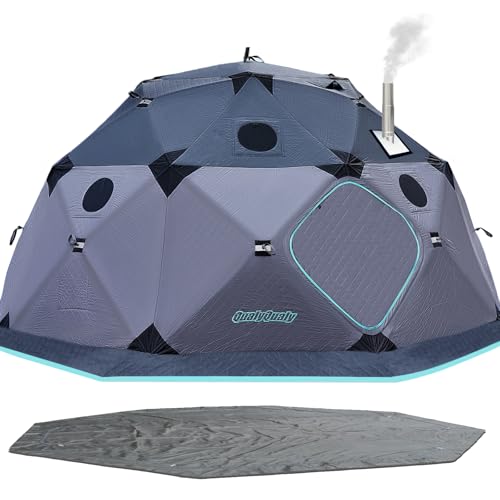
QualyQualy 8-10 Person Tent With Floor offers the broadest floor area here: 147 square feet, with an included floor, stove jack and 600D Oxford fabric insulated with 220 grams per square meter. Its 157-by-169-inch footprint gives larger crews room to spread out, while the 77-pound weight is worth considering for hauling and setup. Ten anchors and eight fixing ropes are included. The shelter is a stronger fit for a large party than a compact outing, but a big floor plan does not replace checking pipe clearance or ensuring adequate ventilation around a stove.
Bottom line: Pick this when the group needs the largest floor area and an included floor.
3-4 Person Stove-Jack Shelter With Floor

3-4 Person Stove-Jack Shelter With Floor is the small-group choice, specified for 3-4 people and supplied with a removable floor and stove-ready chimney port. Its three-layer construction pairs a 210D Oxford shell and lining with 120-gram insulation, and the frame uses 9.5-millimeter fiberglass poles. Four ice anchors and four guylines are named, making tie-down provisions a distinguishing feature. The specifications give no dependable floor dimensions, so this is a poor choice if you need to plan furniture or stove placement precisely; verify usable space before committing to a layout.
Bottom line: Choose this for a 3-4-person outing where a removable floor matters.
420D Hexagon Stove-Jack Shelter

420D Hexagon Stove-Jack Shelter stands apart with a hexagonal layout and 420D insulated Oxford fabric, and its dimensions convert to about 102 by 102 inches. The maker describes a pull-style pop-up setup and capacity for 6-10 people, with steel self-tapping anchors and fixing ropes. This footprint may appeal to anglers who prefer a compact, nearly square plan over the expansive shape of QualyQualy 8-10 Person Tent With Floor.
Bottom line: Pick this for a nearly square footprint and a 6-10-person capacity.
How to Choose an Ice Fishing Tent With a Stove Jack
Start with floor area and usable capacity, not the maximum number of people printed in a product name. Anglers need space for holes, chairs, tackle and a safe buffer around a stove; gear and a stove can make the practical capacity lower than a standing-room count. Compare footprint dimensions when given, since a square-ish shelter and a long rectangle use space differently. A stove jack only routes a pipe through a fabric panel; it does not mean every stove fits or that nearby fabric is fireproof. Match the pipe diameter to the jack and keep the stove, pipe and combustible items within the clearances required by their manufacturers. If the shelter’s usable dimensions are important to your layout, confirm them before ordering.
Stove Jack Safety and Ventilation
A tent stove burns fuel and can produce carbon monoxide, an odorless gas that can be fatal; never treat an open window or stove jack as a substitute for a working carbon monoxide alarm. Use only a stove designed for the fuel and setting, install its pipe through the compatible jack, and maintain the clearances specified for that stove and pipe. Keep the pipe assembled and stable, and keep clothing, bedding and other combustibles away from hot surfaces. A stove jack’s fire-resistant material reduces risk at the pass-through but does not make the whole shelter fireproof. Ventilation matters even in cold weather: keep the stove’s required air supply and exhaust path unobstructed, and leave immediately if an alarm sounds or anyone feels unwell.
Insulation, Floor Space and Shelter Setup
Insulation slows heat loss but does not create heat, so a larger shelter generally takes more heat input than a smaller one in the same conditions. Fabric denier describes yarn thickness, not a complete measure of warmth or weather performance; insulation weight and construction also matter. A floor can help separate gear from snow and slush, while a removable floor can make access to the ice easier. Set the shelter on a stable surface, secure its anchors and guy lines, and keep exits clear. Pop-up construction can speed deployment, but packed size and weight still affect transport. For a tight fishing layout, leave clear paths between the door, fishing holes and stove rather than filling every square foot.
Ice Shelter Anchoring and Weather Limits
Anchor count alone does not establish a shelter’s safe wind limit. Set anchors in suitable ice rather than relying on fabric weight, and recheck lines if conditions change. Ice strength is separate from shelter strength: the Minnesota DNR commonly recommends at least 4 inches of clear, newly formed ice for walking, while ice can vary across a single body of water. Snow-covered or cloudy ice is harder to judge, and no ice thickness guarantees safety. Check local conditions before traveling onto ice, and do not use a shelter’s anchors as evidence that the ice can support people or equipment.
Frequently Asked Questions
Can any wood stove fit an ice tent stove jack?
No; the pipe diameter and jack opening must be compatible. Check the stove maker’s required clearances as well, because a correctly sized jack does not protect nearby fabric from heat.
Does an insulated ice fishing tent stay warm without a heater?
Insulation slows heat loss but does not generate heat. Occupants, wind, outside temperature, ventilation and the shelter’s size all affect how quickly the interior cools.
How much room should I leave around a tent stove?
Use the clearance specified by the stove and pipe manufacturers; there is no single safe distance for every tent stove. Keep bedding, clothing and other combustibles outside that clearance, including above and around the pipe.
Should I use a carbon monoxide alarm inside a heated tent?
Yes; fuel-burning stoves can produce odorless carbon monoxide, so use an alarm rated for the conditions and follow its instructions. Keep required ventilation open and leave the shelter if the alarm sounds.
How thick should ice be before I walk to a shelter?
The Minnesota DNR commonly recommends 4 inches of clear, newly formed ice for walking, but thickness can vary across a lake. Snow-covered or cloudy ice is more difficult to assess, so check local conditions and avoid assuming a shelter makes the route safe.