
Best Interlocking Soundproof Floor Mats Compared

TroyStudio 16-Piece Felt Mats suits most music-room buyers because its 16 felt tiles have a NRC of 0.87 and are intended to absorb room sound and damp instrument vibration. Choose 20-Piece Black Felt Mats or Focusound 20-Piece Drum Rug instead if you need 20 tiles to cover a larger area; interlocking felt mats absorb sound in a room, but they are not a substitute for floor isolation or soundproof construction.
We earn a commission if you buy through links on this page. As an Amazon Associate I earn from qualifying purchases. Products are compared on manufacturer specifications, not hands-on testing.
- Best overall: TroyStudio 16-Piece Felt Mats – Sixteen 11-inch tiles with a NRC of 0.87 and instrument vibration-dampening use.
- Best for flexible coverage: 20-Piece Black Felt Mats – Twenty 11.8-inch tiles can be assembled to cover up to 17 square feet.
- Best for a drum setup: Focusound 20-Piece Drum Rug – Twenty felt tiles are specified for drum and piano use and cover up to 17 square feet.
| Product | Best for | Tile size | Pieces | Material | Shop |
|---|---|---|---|---|---|
| TroyStudio 16-Piece Felt Mats | Acoustic rating | 11 × 11 × 0.4 in | 16 | Polyester felt | Check Price on Amazon |
| 20-Piece Black Felt Mats | Custom coverage | 11.8 × 11.8 × 0.4 in | 20 | High-density felt | Check Price on Amazon |
| Focusound 20-Piece Drum Rug | Studio instruments | 11.8 × 11.8 × 0.4 in | 20 | Polyester felt | Check Price on Amazon |
Interlocking Soundproof Floor Mats Compared
Compare tile dimensions and set size against the footprint you need to cover; these felt mats absorb room sound rather than block sound through a floor.
TroyStudio 16-Piece Felt Mats

TroyStudio 16-Piece Felt Mats is the only set here with a NRC, at 0.87, which makes its acoustic rating the clearest point of comparison. The 16 polyester felt tiles measure 11 × 11 × 0.4 inches and are designed to interlock across a piano, drum or studio area. The maker also reports a 150 kg/m³ density and says the tiles absorb reverberation and damp instrument vibration. The smaller set has less total tile area than the 20-piece options, so it suits a defined instrument footprint better than a broad room floor.
Bottom line: Choose this set if a sound-absorption rating matters more than maximizing coverage.
20-Piece Black Felt Mats

20-Piece Black Felt Mats offers the largest specified coverage in this comparison: 20 interlocking tiles can form an area of up to 17 square feet. Each black mat measures 11.8 × 11.8 × 0.4 inches, making the set useful when a single instrument mat needs to extend around a stand or drum kit. Its features describe floor protection against scratches and knocks as well as sound absorption and vibration dampening. The specifications do not identify a fiber composition or acoustic rating, so buyers prioritizing those measurements should compare them against their needs before choosing this set.
Bottom line: Pick this set when the 17-square-foot maximum area is the deciding factor.
Focusound 20-Piece Drum Rug
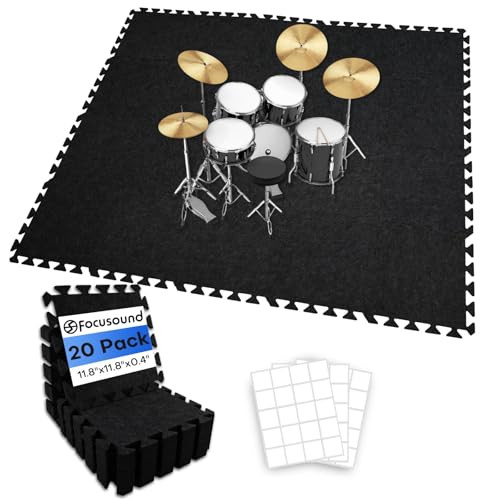
Focusound 20-Piece Drum Rug combines a 20-tile set with a polyester felt construction and 150 kg/m³ density. The 11.8-inch tiles connect to create up to 17 square feet, and the product is specifically framed for drum and piano setups in a music studio. The maker says the acoustic structure reduces echoes and reverberation while isolating instrument vibration from the floor. Its coverage matches the other 20-piece set, so the distinction is the named material and density rather than a larger floor area; it is not a purpose-built soundproof barrier.
Bottom line: Choose this set for a music setup where specified felt construction and density are useful selection points.
How interlocking acoustic floor mats work
Interlocking felt mats mainly absorb sound reflected inside a room; they do not stop sound transmission through walls or a floor like a sealed, decoupled assembly. NRC is a room-absorption rating: values typically range from 0 to 1, and a higher figure indicates more sound absorption across the measured frequencies. That measure does not describe low-frequency isolation from a kick drum or bass. For impact noise, resilient underlay systems use separation and mass, while a felt tile alone has little mass. Use these tiles to protect a defined instrument area and reduce reflected sound, not as a complete soundproofing treatment.
Choose coverage by measuring the instrument footprint
Measure the instrument, stool, stand feet and the space needed for safe access, then compare that rectangle with the mat coverage. A 12-by-12-foot room is 144 square feet, far larger than either 17-square-foot set, so a 20-piece pack covers a small zone rather than the room. Tile dimensions also set the available layout: 11.8-inch squares form a grid, but edge geometry can make the exact finished footprint differ slightly from a simple area estimate. Sketch the layout and allow clearance around pedals, cables and moving equipment before assembling; avoid placing tile edges where a stand foot could catch or rock.
Sound absorption versus vibration isolation
Room echo and structure-borne vibration are different problems. Felt can absorb some reflected mid- and high-frequency sound, while drum impacts can transmit low-frequency energy through floor contact. For a basic vibration reduction approach, use a purpose-designed resilient platform beneath the instrument; common DIY drum risers use isolation pads beneath a rigid platform, rather than relying on thin surface felt alone. Do not stack soft layers until the instrument rocks or shifts, especially beneath a piano or heavy stand. A stable, level instrument support and clear access to pedals matter more than covering extra floor around its legs.
| Problem | Useful approach | Key limitation |
|---|---|---|
| Room echo | Absorptive felt tile coverage | Does not seal sound paths |
| Drum impact vibration | Stable resilient instrument platform | Must remain level and secure |
| Sound through a floor | Decoupled construction assembly | Surface mats alone are insufficient |
Fit and placement mistakes to avoid
Interlocking tiles need a flat, clean floor so their joints sit flush and the instrument remains steady. Remove dust and debris before assembly; grit under a tile can create a high spot, and a raised edge may catch a shoe or cable. Keep mats away from wet areas because textile felt can retain moisture and is harder to clean than a solid rubber surface. Never place a heavy instrument on an uneven or unstable arrangement: check that every leg or foot sits fully supported and that the setup does not rock. Recheck joints after repositioning the kit, since repeated dragging can pull puzzle connections apart.
Frequently Asked Questions
Do interlocking felt mats soundproof a room?
No; felt mats absorb some sound inside a room but do not block sound traveling through walls or floors. NRC describes sound absorption, not sound isolation, so preventing sound transfer generally requires a sealed, sufficiently massive and decoupled assembly.
How much area does a 20-piece mat set cover?
The two 20-piece sets here specify a maximum of 17 square feet. Measure the instrument footprint first, because the actual usable rectangle depends on the tile layout and whether all tiles are needed around stands or pedals.
Can felt floor mats stop drum vibration downstairs?
Felt surface mats alone should not be relied on to stop low-frequency drum impact through a floor. A stable resilient platform beneath the kit is a more suitable approach, and it must not rock or shift under playing.
What does an NRC of 0.87 mean for a floor mat?
An NRC of 0.87 indicates substantial sound absorption under the rating method, on a scale that typically runs from 0 to 1. It does not mean the mat blocks 87% of sound or isolates vibration at every frequency.
How should I lay out interlocking mats under a piano?
Lay the tiles on a flat, clean surface and ensure every piano foot is fully supported without rocking. Measure the full footprint, including access for pedals, before assembly; do not put heavy legs near unsupported tile edges.