
Best Kimber Ultra Carry II Holsters Compared by Fit

We The People Kimber Ultra Carry II IWB is the best fit for most Kimber Ultra Carry II owners because it is formed specifically for the pistol and lets you adjust clip height and angle. Choose a different option if you prefer leather: Maxx Carry Cowhide IWB has a suede-lined interior and a belt-width limit, while Maxx Carry Full-Grain Leather IWB is a leather alternative.
An inside-the-waistband (IWB) holster rides inside the waistband of your pants; safe fit and trigger access matter more than material preference.
We earn a commission if you buy through links on this page. As an Amazon Associate I earn from qualifying purchases. Products are compared on manufacturer specifications, not hands-on testing.
- Best overall: We The People Kimber Ultra Carry II IWB – Formed specifically for the Kimber Ultra Carry II, with adjustable clip position for height and angle.
- Best for suede lining: Maxx Carry Cowhide IWB – Cowhide leather construction includes a suede-lined interior and a steel clip for belts up to 1.75 inches.
- Best for full-grain leather: Maxx Carry Full-Grain Leather IWB – Two-piece full-grain leather construction is molded for the Kimber Ultra Carry II.
| Product | Best for | Material | Clip or belt fit | Interior or guard | Shop |
|---|---|---|---|---|---|
| We The People Kimber Ultra Carry II IWB | Adjustable carry | — | Clip height and angle adjustable | — | Check Price on Amazon |
| Maxx Carry Cowhide IWB | Suede-lined leather | Cowhide leather | Steel spring clip; belts up to 1.75 in | Suede lining; full-length sweat guard | Check Price on Amazon |
| Maxx Carry Full-Grain Leather IWB | Molded leather | Full-grain leather | — | Full-length sweat guard | Check Price on Amazon |
Kimber Ultra Carry II holsters
Compare each option by its construction, attachment details and the features that affect everyday carry.
We The People Kimber Ultra Carry II IWB

We The People Kimber Ultra Carry II IWB stands apart for its adjustable clip position, which lets the wearer change the holster’s height and angle. It is made specifically for the Kimber Ultra Carry II and supports several carry orientations, including appendix, strong side, behind the hip and cross carry. The manufacturer says it is made in the USA and backed by a lifetime warranty. This option suits someone who wants a formed IWB holster with position adjustments. Its material and any lining are not included among the features, so buyers prioritizing leather or a particular interior should consider another option.
Bottom line: Pick this if adjustable clip position and multiple carry orientations matter most.
Maxx Carry Cowhide IWB
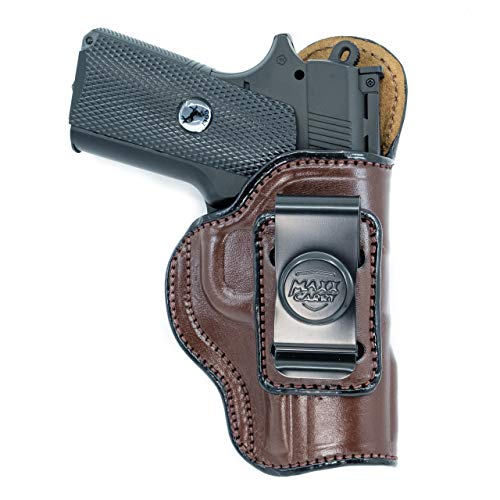
Maxx Carry Cowhide IWB is the leather choice with a specifically described suede lining and a full-length sweat guard. The cowhide IWB holster is offered for the Kimber Ultra Carry II in 9mm or .45 ACP, along with several other compact pistols. Its tempered steel spring clip fits belts up to 1.75 inches wide, making belt width a useful fit check before choosing it. This option suits someone who wants a lined leather interior and a high back between body and firearm. Its fit spans multiple models, so buyers should confirm the pistol version matches the holster’s intended fit.
Bottom line: Choose this for cowhide, a suede-lined interior and a belt-width limit.
Maxx Carry Full-Grain Leather IWB
Maxx Carry Full-Grain Leather IWB differs from the other leather option by specifying two-piece full-grain leather molded for the Kimber Ultra Carry II. The maker says the natural leather breathes and conforms to the body, and the holster has a full-length sweat guard. This IWB design suits a buyer seeking a molded leather holster for the named pistol rather than a broad multi-model fit. The available features do not establish its clip construction or belt-width range, so it is a weaker choice for anyone who needs those attachment measurements before deciding.
Bottom line: Choose this for a molded, full-grain leather IWB design.
How to choose a Kimber Ultra Carry II holster
Start with fit and trigger coverage, then weigh material and carry adjustment. The Ultra Carry II is a compact 1911-pattern pistol; a holster should be intended for that exact model and fully cover the trigger guard when the pistol is holstered. A close fit helps keep the pistol from shifting, but the draw should not require forcing the firearm. Carry position also affects access and concealment: appendix, strong-side, behind-the-hip and cross-draw positions change how the belt and clothing interact. If the pistol has an attached light, optic or other accessory, verify the holster is shaped for that configuration; a model-specific fit alone does not establish accessory clearance. Choose an adjustable clip when you want to experiment with ride height or angle.
This comparison is most useful when the pistol is in its standard configuration; check accessory compatibility and trigger coverage before carrying.
Leather and formed holster materials
Leather can flex and conform with wear, while molded synthetic holsters generally hold a fixed shape; neither material alone proves safe retention. The leather options here differ in stated construction: one has cowhide and a suede lining, while the other specifies two-piece full-grain leather molded for the pistol. A sweat guard is a raised or extended panel between the wearer and the firearm; it can reduce direct contact but does not replace a secure, correctly fitted holster. Choose leather when its feel and flexibility suit your preferences, and prioritize a design that keeps the trigger protected. Material choice cannot compensate for poor fit, a loose belt or a holster that collapses after the firearm is drawn.
Check carry fit and belt compatibility
Clip fit determines whether an IWB holster can attach securely to the belt or waistband setup you use. One option here gives a maximum belt width of 1.75 inches; another allows clip height and angle adjustments, while the third does not provide a belt-width measure. Measure the belt at its widest point and compare that figure with the holster’s limit before carrying. Ride height and cant—the forward or rearward angle of the grip—affect comfort, concealment and draw access, so test adjustments with an unloaded firearm in a safe setting. Holster fit can also change with clothing and belt stiffness. Do not assume that a fit for a bare pistol accommodates a mounted light or optic.
Safe holstering and daily carry
A holster should cover the trigger guard and stay in place during ordinary movement; keep fingers outside the trigger guard while drawing and reholstering. Reholster slowly, and stop if clothing, a drawstring or another object enters the holster mouth. Never push the firearm into a blocked or collapsed holster. An IWB holster places the firearm close to the body, so check for secure attachment and a clear path before each use. Practice unloaded first in a controlled setting, following safe firearm-handling rules. If a holster shifts, exposes the trigger or requires unusual force to draw, stop carrying it until the fit and setup are corrected. Do not rely on clothing to cover an exposed trigger.
Frequently Asked Questions
Will a Kimber Ultra Carry II fit a 1911 holster?
A 1911 holster is not automatically a fit for every 1911-pattern pistol. Confirm it is made for the Ultra Carry II and check that the trigger guard is fully covered when holstered.
Does an IWB holster fit a belt wider than 1.75 inches?
The spring clip on Maxx Carry Cowhide IWB is specified for belts up to 1.75 inches wide, so a wider belt exceeds that stated limit.
Can I use these holsters with a weapon light?
The product features do not confirm a light-compatible fit. A mounted light changes the pistol’s outside shape, so verify compatibility with the specific light before carrying.
How should I check a holster’s trigger coverage?
With the firearm unloaded and handled safely, confirm the holster fully covers the trigger guard and that clothing or other objects cannot enter the holster mouth. Stop using a setup that exposes the trigger or catches during reholstering.
What do holster ride height and cant change?
Ride height changes how high the grip sits above the waistband, while cant changes its angle. Small adjustments can affect access and concealment, so test a secure position with an unloaded firearm before carrying.