
Best Laser Plumb Bob: 3 Point Lasers Compared

The Firecore F501G 5-Point Laser is the best laser plumb bob for most point-transfer jobs because its five green dots include upward and downward plumb points plus three horizontal reference points. Choose DOVOH PV-360G Plumb Dot Laser for a compact two-dot tool, or a line-and-dot model if you also need projected lines.
We earn a commission if you buy through links on this page. As an Amazon Associate I earn from qualifying purchases. Products are compared on manufacturer specifications, not hands-on testing.
- Best overall: Firecore F501G 5-Point Laser – Five green dots transfer points up and down while adding forward, left, and right references.
- Best for compact use: DOVOH PV-360G Plumb Dot Laser – Projects aligned upward and downward plumb dots in a compact 4.5-inch-long tool.
- Best for three-point layouts: HUEPAR 9300G 3-Point Laser – Projects two plumb points and one front point, with no laser line.
| Product | Best for | Dot layout | Self-leveling | Shop |
|---|---|---|---|---|
| Firecore F501G 5-Point Laser | Point transfer | 5 dots: up, down, forward, left, right | Within 4° | Check Price on Amazon |
| DOVOH PV-360G Plumb Dot Laser | Compact alignment | Up and down dots | — | Check Price on Amazon |
| HUEPAR 9300G 3-Point Laser | Three-point layout | Two plumb dots, one front point | Self-leveling | Check Price on Amazon |
Laser plumb bobs compared
Compare the projected points and mounting setup to match the tool to your layout task.
Firecore F501G 5-Point Laser
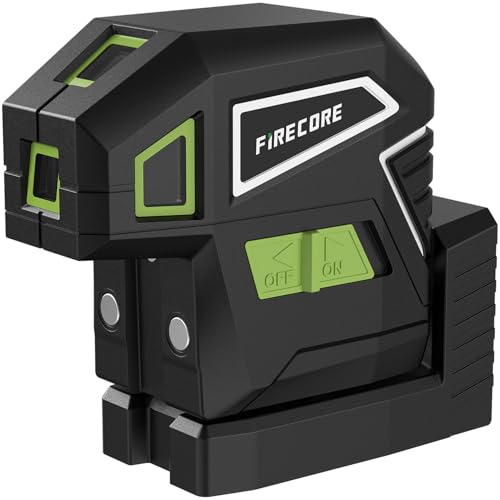
Five simultaneous green dots give the F501G more reference directions than the two- and three-point options. The upward and downward dots transfer a floor point to the ceiling, while forward, left, and right dots add horizontal references. The tool self-levels within 4° when unlocked; outside that range, it flashes to indicate an out-of-level condition. Two AA batteries and a carry pouch are included. This is a good fit when you want several reference points at once, but buyers who need laser lines or a specified working range should choose another option.
Bottom line: Choose this for point transfer with multiple directions.
DOVOH PV-360G Plumb Dot Laser

The PV-360G focuses on a matched upward and downward dot pair rather than extra reference points or line modes. Its 4.5-inch length and 2.5-inch width make it a compact option for vertical alignment of pipes, wires, or fixtures across floors and ceilings. It has a built-in rechargeable battery and includes a charging cable, but no charger, plug, or bracket. Choose it when vertical transfer is the main job; users who need a mounting bracket in the package or want forward and side dots should consider another model.
Bottom line: Pick it for a compact up-and-down alignment tool.
HUEPAR 9300G 3-Point Laser

The 9300G adds a forward reference point to its two plumb dots, but unlike line lasers it projects no laser line. Its three green spots support reference positioning for tasks such as locating a ceiling fan, closet, lighting system, pipe, or electrical outlet. The accuracy is 1/9 inch at 32 feet, and the tool is a Class 2 laser with output below 1 mW. This suits buyers who want discrete points and a front reference; choose a five-point unit for side dots or a line laser when continuous lines matter.
Bottom line: Choose it when three reference points are enough.
How to choose a laser plumb bob
Choose by the number and direction of reference points your layout needs. A two-dot tool transfers one point vertically; three or five dots add forward or side references that can help locate multiple positions without repositioning. Dot-only tools suit point transfer, while cross-line units project continuous horizontal and vertical references for tasks such as aligning cabinets or tile. For a ceiling-to-floor transfer, confirm that the tool provides both upward and downward dots. A tripod or magnetic mount can help position a laser, but the attachment must fit the surface and setup; a magnet needs a compatible steel target.
Dot lasers and line lasers compared
Dot lasers mark discrete positions, while line lasers project a visible line across a surface. Choose dots for transferring a point or locating a fixture, and choose lines when you need a continuous guide for alignment. Some combination tools provide both, but a plumb spot does not replace upward and downward dots if vertical transfer is the task. Green beams can be easier to see than red in bright indoor conditions, though visibility changes with ambient light and surface color. Keep the laser beam out of eyes and never aim it at another person.
Use this comparison to match the projection style to the task.
| Need | Projection to choose | Reason |
|---|---|---|
| Transfer one floor point to ceiling | Up/down plumb dots | Provides vertical reference points |
| Locate several adjacent positions | Three- or five-point dots | Adds forward or side references |
| Align a continuous edge | Horizontal or vertical line | Shows a line across the work surface |
| Both point transfer and straight guides | Combination dot-and-line tool | Provides both projection types |
Set up a plumb laser accurately
Place the tool on a stable, level surface or a securely attached mount before using its dots. Self-leveling models have a limited leveling window: the F501G works within 4°, and a tool outside its allowable range may indicate an error rather than provide a true reference. With more than 4° of surface tilt, reposition or shim the setup instead of relying on the projected point. Let the dots settle before marking, then check the spot against the intended floor or ceiling reference. Avoid moving the tool between the first and second marks; even a small shift changes the transfer.
Laser plumb bob safety and care
Class II visible laser products have output below 1 mW in the specifications supplied for these tools. Do not stare into the beam, look into it through optical instruments, or point it toward people; use the laser only on the work surface. Dust or a bump can affect setup, so keep the optics clean and transport the tool in its case or pouch when one is supplied. A low battery can interrupt a transfer, so start a long layout with charged batteries or a charged built-in battery. If work requires a longer range, compare the working range with the actual distance before relying on a mark.
Frequently Asked Questions
How does a laser plumb bob transfer a point?
A laser plumb bob projects vertically aligned dots so a floor reference can be carried to a ceiling. Place the tool securely, wait for the self-leveling indicator or beam to settle, and mark both points without shifting the tool.
Can a laser plumb bob project a line?
A dot-only plumb bob projects spots rather than continuous lines. Combination models add horizontal, vertical, or cross-line modes, which are useful when aligning an edge as well as transferring a point.
How far can a green plumb laser reach indoors?
Working distance depends on the tool and room lighting; one green line-and-dot model specifies 100 feet. Bright ambient light and light-colored surfaces can make a spot harder to identify, so match the rated range to the actual task.
What does a self-leveling range of 4 degrees mean?
A 4-degree self-leveling range means the tool can correct a limited amount of tilt from level. Beyond that range, reposition the base; the Firecore F501G flashes when it is out of level.
Are green laser dots always easier to see than red?
Green beams are often easier to see than red at comparable output, but ambient light and surface color still affect visibility. For bright rooms or longer distances, work closer to the tool’s range and use a suitable target surface.