
Best Low-Level Carbon Monoxide Detectors Compared

Kidde COBDL AA-Powered CO Detector is the best fit for most people who want a portable low-level carbon monoxide detector, because it gives a distinct alert at 30–70 ppm and runs on AA batteries. Choose Heiman 735ESY-T 3-Pack if you prefer a sealed 10-year battery, or Kidde COPDLQW Smart CO Detector if app notifications and a plug-in format suit your home better.
Carbon monoxide (CO) is an odorless, colorless gas, so an alarm—not smell—is the warning. Low-level alerts add earlier signals, but every household still needs properly placed CO alarms and a plan to leave for fresh air when an alarm sounds.
We earn a commission if you buy through links on this page. As an Amazon Associate I earn from qualifying purchases. Products are compared on manufacturer specifications, not hands-on testing.
- Best overall: Kidde COBDL AA-Powered CO Detector – Its distinct 30–70 ppm alert and AA-powered portable design suit home or travel use.
- Best for sealed-battery use: Heiman 735ESY-T 3-Pack – A built-in, non-replaceable battery is designed to run for 10 years.
- Best for app-connected homes: Kidde COPDLQW Smart CO Detector – It combines low-level alerts with Wi-Fi notifications and plug-in power with AA batteries.
| Product | Best for | Power | Low-level alert | Display | Shop |
|---|---|---|---|---|---|
| Kidde COBDL AA-Powered CO Detector | Home or travel | 2 AA batteries | 30–70 ppm alert | Digital backlit | Check Price on Amazon |
| Heiman 735ESY-T 3-Pack | Sealed-battery setup | Sealed lithium; 10 years | Low PPM; numeric threshold — | Digital | Check Price on Amazon |
| Heiman 735ESY AA CO Alarm | Replaceable batteries | 2 AA batteries | Low PPM; numeric threshold — | Digital | Check Price on Amazon |
| Kidde COPDLQW Smart CO Detector | Wi-Fi monitoring | Plug-in; 2 AA batteries | 30–70 ppm alert | Digital | Check Price on Amazon |
Low-Level Carbon Monoxide Detectors
Compare the alert approach, power format and display before choosing an alarm for your home or travel setup.
Kidde COBDL AA-Powered CO Detector

Kidde COBDL AA-Powered CO Detector stands out for its separate early-warning pattern at 30–70 ppm and its portable AA-powered format. It can sit on a table or mount on a wall, and the included mounting hardware supports either setup. A distinct alarm pattern at 70 ppm signals dangerous levels for all occupants, while an 85 dB alarm signals evacuation to fresh air. The backlit display, LED warning light and Test/Hush button add at-a-glance status and control. This is a practical choice for renters or travelers who want battery operation; the limitation is that it does not offer the app notifications of a Wi-Fi-connected alarm.
Bottom line: Choose this if portable AA power and a distinct 30–70 ppm alert matter most.
Heiman 735ESY-T 3-Pack

Heiman 735ESY-T 3-Pack differs by offering three compact alarms with a built-in, non-replaceable CR-2/3AZ lithium battery designed for 10 years of operation. It is a standalone alarm rather than a plug-in unit or a device wired to household power. Activation uses the included bracket and begins a 100-second warm-up before standby monitoring. The digital display and low-PPM detection address buyers seeking a compact alarm for multiple rooms. The tradeoff is that the battery cannot be replaced or the alarm manually turned off, so buyers who want replaceable power or a specific numeric low-level threshold should choose another format.
Bottom line: Pick this for a three-alarm setup with sealed batteries and no household wiring.
Heiman 735ESY AA CO Alarm
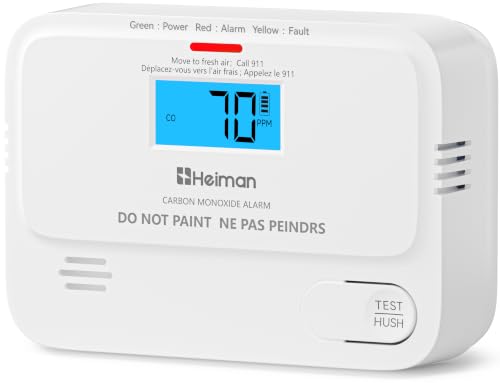
Heiman 735ESY AA CO Alarm is the replaceable-battery option in this group: it runs on two AA batteries rather than a sealed battery or plug-in power. The compact alarm has a digital display and low-PPM detection, and its operating temperature range is 40°F to 100°F. The maker says it is UL 2034 5th Edition certified and CSFM approved for residential CO alarm use. This model may suit households that want to change batteries themselves, but its temperature range is a meaningful constraint; it is not intended for garages, workshops or locations directly under vehicle exhaust.
Bottom line: Choose this if you want replaceable AA batteries and a compact digital alarm.
Kidde COPDLQW Smart CO Detector

Kidde COPDLQW Smart CO Detector is the connected choice, adding 2.4 GHz Wi-Fi app notifications and indoor air readings for humidity and TVOC alongside its low-level CO alert. It plugs into an outlet and uses two AA batteries, combining a fixed location with battery power. The maker says its distinct early-alert pattern begins at 30–70 ppm, with a separate pattern at 70 ppm for dangerous levels. The digital display and 85 dB alarm provide local signals as well. This model fits buyers who want remote alerts and air-quality monitoring; it requires a compatible 2.4 GHz Wi-Fi network for app connectivity.
Bottom line: Pick this for app alerts and indoor air monitoring in a Wi-Fi-connected home.
How to Choose a Low-Level Carbon Monoxide Detector
Choose by alert threshold, power source and where the alarm will sit. A low-level warning is an additional early signal, not a replacement for a standard CO alarm or a reason to ignore a louder alarm. The products here use either replaceable AA cells, a sealed battery or plug-in power with AA batteries; decide which arrangement you can maintain and access. For a home with frequent outages, prioritize battery operation or backup power. For a detector placed away from a convenient outlet, a battery-powered model avoids relying on wall power. If remote status matters, verify that the intended location has 2.4 GHz Wi-Fi before choosing a connected model. Follow the alarm maker’s placement instructions; never place an alarm where it can be blocked by furniture or curtains.
Where to Place Carbon Monoxide Alarms
Place CO alarms on every level of a home and outside each separate sleeping area, following the alarm maker’s mounting instructions. Keep alarms away from dead-air corners, and do not place them directly beside fuel-burning appliances unless the instructions call for it. CO alarms are not smoke alarms, so a combined device or separate smoke alarms may still be needed for fire warning. For an alarm intended for travel, use it as instructed in the temporary space and do not assume a detector can replace a permanent alarm system.
What Low-Level CO Alerts Mean
Low-level alerts can signal CO below the concentration and exposure time that trigger many conventional residential alarms, but they do not diagnose exposure or measure personal health risk. Alarm response depends on both concentration and duration, and a product’s distinct low-level pattern may differ from its emergency alarm. Treat any alarm as a reason to move people and pets to fresh air and contact emergency services or the fire department; do not stay indoors to investigate the source. Never use a fuel-burning generator, grill or camp stove inside a home, garage or enclosed area. Carbon monoxide has no reliable smell or color, so symptoms or the absence of odor are not a safe substitute for an operating alarm.
Battery and Connectivity Tradeoffs
Replaceable batteries make it possible to restore power by changing cells, while a sealed 10-year battery avoids routine replacement but cannot be changed when depleted. A plug-in alarm needs a suitable outlet, and a Wi-Fi model also depends on a compatible network for app alerts; its local alarm is the immediate warning. A useful decision rule is to choose a battery-powered model for spots with no dependable outlet, and a connected plug-in model only where 2.4 GHz Wi-Fi reaches the alarm. Test alarms regularly using their test control, and replace the entire alarm at its end-of-life signal or the maker’s service life. Never remove batteries to silence an alarm: move outside and call for help instead.
Frequently Asked Questions
What does a low-level carbon monoxide alert mean?
A low-level alert signals that the detector has reached its early-warning condition, which can occur before a conventional alarm sounds. Treat the alert seriously, move people and pets to fresh air, and seek emergency help rather than waiting indoors.
Where should carbon monoxide alarms be installed at home?
Install CO alarms on every home level and outside each separate sleeping area, following the model’s mounting directions. Keep the alarm unobstructed so sound and air can reach it.
Can a carbon monoxide detector work during a power outage?
Battery-powered alarms can continue to operate without household power while their batteries have charge. A plug-in alarm with AA backup also has battery power, but check and maintain its backup batteries as directed.
How often should carbon monoxide alarms be tested?
Test each alarm at least monthly using its test button, and replace it at its end-of-life signal or service-life deadline. A test-button check confirms the alarm electronics and sounder respond, not that the sensor can detect every concentration.
Can a CO detector be used in a garage?
Use a model in a garage only if its instructions permit that location; the Heiman 735ESY is specifically not intended for garages or directly under vehicle exhaust. Vehicle exhaust can create unsafe CO, so never run a vehicle in an enclosed garage.