
Best Lubricant for Fan Motors: 3 Oils Compared

Ceiling Fan Oil, 8 oz is the best lubricant for fan motors for most household fans because it is made for box, ceiling, table and portable fans. Choose Liquid Bearings Synthetic Fan Oil for outdoor fans or its included needle applicators, and Multi-Purpose Fan Lubricant, 100 ml for a compact bottle with a precision dropper. Fan motors differ: verify that your motor calls for oil before applying any lubricant.
We earn a commission if you buy through links on this page. As an Amazon Associate I earn from qualifying purchases. Products are compared on manufacturer specifications, not hands-on testing.
- Best overall: Ceiling Fan Oil, 8 oz – Its uses cover box, ceiling, table and portable fans.
- Best for outdoor fans: Liquid Bearings Synthetic Fan Oil – The maker says it is intended for indoor or outdoor fans and includes two needle applicators.
- Best for precise drops: Multi-Purpose Fan Lubricant, 100 ml – A fine-point nozzle is designed to direct oil onto targeted moving parts.
| Product | Best for | Volume | Applicator | Intended use | Shop |
|---|---|---|---|---|---|
| Ceiling Fan Oil, 8 oz | Household fans | 8 oz | — | Box, ceiling, table and portable fans | Check Price on Amazon |
| Liquid Bearings Synthetic Fan Oil | Outdoor fans | — | Two needles: ½ in and 1½ in | Indoor and outdoor fans | Check Price on Amazon |
| Multi-Purpose Fan Lubricant, 100 ml | Precise application | 100 ml | Fine-point dropper | Household motors and mechanisms | Check Price on Amazon |
Fan Motor Lubricants
Match the lubricant and application method to the fan motor’s maintenance requirements.
Ceiling Fan Oil, 8 oz

For a broad range of household fan types, this 8-ounce oil is intended for box, ceiling, table and portable fans. The maker says it is formulated for vintage and modern fans and begins working quickly to free a stuck fan. Its larger bottle suits someone maintaining several compatible fans. The limitation is that the name and use claims do not identify a specific motor lubrication system, so confirm the motor is designed to receive oil before applying it; sealed bearings generally are not serviced by adding oil.
Bottom line: Choose it for household fans when the motor is designed for oil lubrication.
Liquid Bearings Synthetic Fan Oil
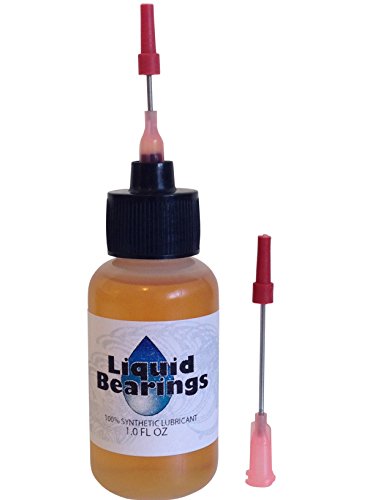
Outdoor-fan use and two needle lengths distinguish this synthetic oil from the other options. The maker says it is suitable for indoor or outdoor fans and can displace sticky oil to help free a frozen motor. The included ½-inch and 1½-inch needles provide different approaches for reaching an oil port. It suits a fan with an accessible lubrication point, but the needle applicators do not make oil appropriate for every motor; confirm the motor’s lubrication requirements first.
Bottom line: Pick it when an oil-requiring fan needs a needle applicator or outdoor use.
Multi-Purpose Fan Lubricant, 100 ml

A fine-point dropper sets this 100 ml bottle apart, allowing targeted application to moving parts. The maker says the liquid is for household electric motors, including ceiling and exhaust fans, as well as sliding tracks and small hinges; it also claims an anti-rust protective film. The compact bottle suits occasional maintenance where controlled drops matter more than a large supply. Its uses are broad rather than tied to a particular fan motor design, so verify that the motor calls for liquid oil before use.
Bottom line: Choose it for controlled drops on a compatible household fan motor.
How to Choose a Fan Motor Lubricant
Choose by the motor’s lubrication design, not by the word “fan” on the container. Many modern fan motors have sealed bearings that are not meant to be opened or oiled, while some older motors use oil ports or oil-bath designs. Oil and grease are not interchangeable: grease is a thickened lubricant that stays in place, while oil flows through an intended oiling path. Check the fan’s manual or motor label for the required lubricant type and service point. If the motor has no service port and is marked sealed or permanently lubricated, do not add oil. Applying lubricant in the wrong place can interfere with operation or damage components.
Fan Lubricant Types and Applications
Liquid oil is appropriate only for fan motors with an oiling point, while grease is used only where the motor or bearing design calls for grease. Needle applicators and fine tips can help place liquid oil at a port, but they do not establish that a motor needs lubrication. A typical ceiling fan oil-bath motor and a small computer fan bearing are different assemblies, so do not substitute one lubricant type based on the shared word “fan.” Use this decision guide before choosing a product.
| Fan or motor condition | What to choose | Decision |
|---|---|---|
| Motor specifies an oil port or oil bath | Compatible fan oil | Use only the specified oiling point |
| Bearing design specifies grease | Compatible bearing grease | Do not replace it with liquid oil |
| Sealed or permanently lubricated motor | No added lubricant | Do not open or oil the bearing |
Applying Fan Motor Oil Safely
Disconnect power before servicing any fan, including a ceiling fan, and wait for the blades to stop completely. Apply oil only at a manufacturer-designated port; an applicator needle is not a reason to force oil into a sealed housing. Keep lubricant off electrical contacts, belts and surfaces that should remain dry. Excess oil can leak or attract dust, so use only the quantity called for by the motor’s maintenance guidance rather than flooding the bearing. If the fan continues to bind or make noise after proper lubrication, stop using it and inspect the cause instead of repeatedly adding oil.
Common Fan Lubrication Mistakes
The most common mistake is treating every noisy fan as an oil-starved motor. Noise can also come from loose hardware, blade imbalance or worn bearings, none of which oil necessarily fixes. Another mistake is applying penetrating or household oil when the motor specifies another lubricant; product type and service point matter. Do not use lubricant as a substitute for correcting a mechanical fault, and never reach near moving blades. If a fan has no designated oil point or its instructions call the bearing sealed, leave the bearing closed and investigate another cause of noise or resistance.
Frequently Asked Questions
Do all fan motors need added lubricant?
No, many modern fan motors use sealed bearings and are not meant to be oiled. Add lubricant only when the motor’s instructions identify a service point and lubricant type.
Can I use grease instead of fan motor oil?
No, oil and grease serve different bearing designs and should not be substituted. Use grease only when the motor or bearing specifies grease; use oil only at an oil port or oil bath intended for it.
Should I oil a noisy ceiling fan?
Not automatically; loose hardware, blade imbalance or worn bearings can also cause noise. Turn off power and check for a designated oil port before applying any lubricant.
How much oil should I put in a fan motor?
Use only the quantity specified for that motor, since oil ports and oil-bath designs differ. Do not fill an unmarked opening or add oil to a sealed bearing.
Is it safe to lubricate a fan while it is running?
No, disconnect power and wait until the blades stop before maintenance. Keep hands, applicators and lubricant away from moving parts and electrical contacts.