
Best Military Dog Gas Mask Options Compared by Protection

The MIRA Safety FirstBreed Animal Ark is the closest match for a military-style dog gas mask because it is a protective enclosure designed to receive filtered air from a powered respirator. It requires a separate MB-90 PAPR, so choose a different option if you need a wearable particle mask for smoke, dust or ash rather than an enclosure.
We earn a commission if you buy through links on this page. As an Amazon Associate I earn from qualifying purchases. Products are compared on manufacturer specifications, not hands-on testing.
- Best overall: MIRA Safety FirstBreed Animal Ark – A collapsible animal enclosure with positive-pressure filtered air when paired with the required MB-90 PAPR.
- Best for smoke particles: K9 Mask Air Filter, Large – Includes three replacement filters and adjustable neck and snout straps.
- Best for a medium dog: Reusable Dog Air-Filter Mask, Medium – A reusable, adjustable mask offered in a medium size.
| Product | Best for | Protection approach | Size | Power requirement | Shop |
|---|---|---|---|---|---|
| MIRA Safety FirstBreed Animal Ark | Powered enclosure | Positive-pressure enclosure | 53 × 33 × 26 in | MB-90 PAPR required | Check Price on Amazon |
| K9 Mask Air Filter, Large | Smoke particles | Wearable particle filter | Large; 11.25 × 7.13 × 3.5 in | No powered unit specified | Check Price on Amazon |
| Reusable Dog Air-Filter Mask, Medium | Medium dog | Wearable particle mask | Medium | No powered unit specified | Check Price on Amazon |
| Reusable Dog Air-Filter Masks, Small, 2-Pack | Small dog | Wearable particle mask | Small; 2 masks | No powered unit specified | Check Price on Amazon |
Dog Gas Masks and Air-Filter Options
The key distinction is whether you need a powered enclosure or a wearable mask intended to filter particles.
MIRA Safety FirstBreed Animal Ark

Unlike wearable dog masks, the Animal Ark is a collapsible enclosure designed to receive filtered air from a powered respirator. The manufacturer says it works as a positive-pressure system with the MB-90 PAPR, which is required and sold separately. Its laminate-230 construction has reinforced seams; the maker states more than 6 hours of resistance to blister agents and a 15-year shelf life. At 53 × 33 × 26 inches and 19 pounds, it needs dedicated storage and a suitable location. Choose it when an enclosure fits your plan; it is not a standalone mask.
Bottom line: Choose this when you need an enclosure and can provide the required PAPR.
K9 Mask Air Filter, Large

The K9 Mask is a wearable air-filter rather than a military-style gas mask. Its ‘Extreme Breathe’ filter refills are intended for particles in smoke, ash, dust and smog, and the package includes three refills. Two adjustment straps fit around the neck and snout. The maker recommends allowing 1–3 weeks for training, an important consideration before a smoky or dusty event. Choose it for particle exposure and gradual acclimation, not as a substitute for a powered enclosure or as evidence of protection from chemical gases or vapors.
Bottom line: Choose this for a large dog and particle-filtering needs, not chemical-vapor protection.
Reusable Dog Air-Filter Mask, Medium

The medium-size blue mask is a wearable option for buyers who want an adjustable dog mask rather than an enclosure. Its maker describes it as reusable and breathable, with particle filtering for smoky environments and outdoor pollution. The specifications do not establish a CBRN capability or identify a filter standard, so do not treat it as military-grade protection against gases or vapors. Fit matters: a mask that shifts or leaves gaps may not provide the intended particle filtering. Choose it only for the general particle-mask use and a dog suited to the medium size.
Bottom line: Choose this for a medium dog needing a general wearable particle mask.
Reusable Dog Air-Filter Masks, Small, 2-Pack
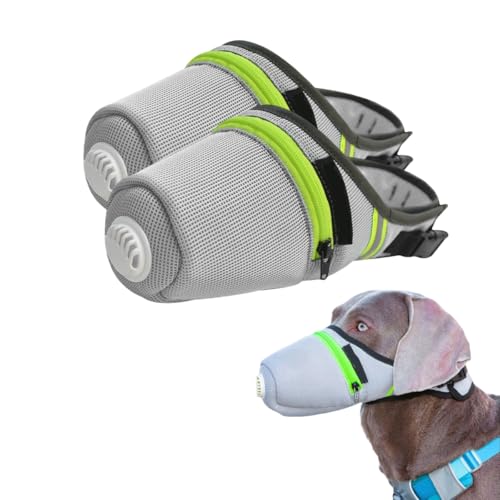
This two-mask small-size set differs from the single medium option by offering two masks in a small fit. The maker describes them as reusable, adjustable and intended to filter particles in smoky or polluted conditions, with volcanic ash and cold-weather use also mentioned. Those claims do not establish protection against chemical agents, gases or vapors. A wearable mask must fit snugly without restricting breathing; check the fit while the dog is calm and stop if breathing looks difficult. Choose this option for a small dog and general particle exposure, not CBRN use.
Bottom line: Choose this for a small dog when two general-purpose particle masks are useful.
How to choose a dog gas mask
Start by separating particle filtration from protection against chemical gases and vapors. Smoke, dust and ash are particles; a particulate filter is not automatically a gas filter, and a general dog mask is not automatically a CBRN respirator. The Animal Ark uses a different approach: it is an enclosure supplied by a powered air-purifying respirator, and the required MB-90 must be available for operation.
Use this decision rule: if your requirement is specifically chemical-agent protection, only consider a system whose maker explicitly identifies that use and whose complete operating setup is available. Do not infer protection from phrases such as “gas mask” or “air-filter.” For particulate exposure, assess whether the mask is designed for those particles and whether the dog can tolerate a secure fit. No wearable option here is established as a military-certified canine respirator.
Enclosure versus wearable dog masks
An enclosure and a wearable mask differ in how they deliver air. A positive-pressure enclosure receives air from its compatible powered unit; the Animal Ark requires the MB-90 PAPR, so the enclosure alone cannot provide its intended operation. Wearable masks sit on the dog’s face and rely on the fit and filter, making fit and acclimation central concerns.
Use this comparison to identify the type that matches the need:
| Type | Air delivery | Best matched use |
|---|---|---|
| Powered enclosure | Filtered air supplied by compatible PAPR | Enclosed animal protection setup |
| Wearable particle mask | Air passes through mask filter | Specified particle exposure such as smoke or dust |
Neither category should be assumed to protect from every airborne hazard. Confirm the hazard type and the complete system’s capability before relying on it.
Fit and acclimation for dog masks
A wearable mask needs a stable fit around the snout and head without interfering with breathing. Check that straps hold the mask in place and that the dog can breathe comfortably; remove it immediately if the dog shows distress. The K9 Mask maker recommends 1–3 weeks of training before use, which is a practical reason not to wait until smoke or poor air quality is already present.
Size labels alone do not establish fit across breeds because snout shape and head proportions vary. Introduce a mask briefly in a calm setting and increase time only while the dog remains comfortable. For an enclosure, compare its 53 × 33 × 26-inch dimensions with the planned storage and setup space, and remember that the required powered unit is a separate part of operation.
Particle filters and hazard limits
Particle filters are intended for airborne particles, not necessarily gases or vapors. Smoke can contain both particles and gases, so a claim about filtering smoke particles should not be read as proof of protection from all smoke components. Similarly, volcanic ash and dust claims concern particles, not chemical-agent performance.
Match the filter’s purpose to the hazard, and do not use an ordinary wearable particle mask as a substitute for a complete CBRN system. The Animal Ark maker describes resistance to blister agents, but it must operate with its required MB-90 PAPR; the resistance period is not a guarantee against every agent or condition. When a hazard may be immediately dangerous, move the dog away from exposure rather than relying on an unverified mask.
Frequently Asked Questions
Can a dog wear a human gas mask safely?
A human mask should not be assumed to fit a dog’s muzzle or maintain a seal. Dogs have different facial shapes and breathing needs, so use only equipment designed for animals and stop if breathing is impaired.
Does a particle mask protect dogs from chemical gases?
Not by default: particle filters are not the same as gas or vapor filters. Verify that the complete system specifically identifies the hazard, rather than relying on the phrase “gas mask.”
How long should I train a dog to wear a mask?
The K9 Mask maker recommends 1–3 weeks of preparation. Begin in calm conditions with short sessions and stop if the dog shows signs of breathing difficulty or distress.
Does the Animal Ark work without its PAPR?
No, the maker says the MB-90 PAPR is required for operation and is sold separately. The enclosure measures 53 × 33 × 26 inches, so account for both the powered unit and setup space.
Are dog masks suitable for wildfire smoke?
A mask described for smoke particles may address particulate matter, but smoke also contains gases. Move dogs away from smoke exposure when possible and do not assume a particle mask protects against every component.