
Best Muffler Repair Putty: 5 Options Compared

Permatex 80333 Muffler and Tailpipe Putty suits most buyers because the maker says it seals exhaust leaks at temperatures up to 2,000°F and is safe for catalytic converters. Choose Walker 35958 Muffler/Exhaust Putty instead for out-of-round pipe connections; for a large amount of compound, consider MPD Muffler Cement Putty, 16 oz.
Muffler repair putty is a paste or cement used to seal small holes, cracks and joints in exhaust components. It cannot restore badly rusted or structurally damaged pipe.
We earn a commission if you buy through links on this page. As an Amazon Associate I earn from qualifying purchases. Products are compared on manufacturer specifications, not hands-on testing.
- Best overall: Permatex 80333 Muffler and Tailpipe Putty – The maker says it seals exhaust leaks up to 2,000°F and is safe for catalytic converters.
- Best for joints: Walker 35958 Muffler/Exhaust Putty – The maker identifies out-of-round muffler and pipe connections as a suitable use.
- Best for larger repairs: MPD Muffler Cement Putty, 16 oz – The 16-ounce container holds more compound than the other options.
| Product | Best for | Package size | Key use | Shop |
|---|---|---|---|---|
| Permatex 80333 Muffler and Tailpipe Putty | Everyday exhaust leaks | 4 oz | Mufflers, tailpipes, joints | Check Price on Amazon |
| LOCBONDSO High Temp Exhaust Repair Kit | High-heat joints | 5.3 fl oz | Joints, mufflers, tailpipes | Check Price on Amazon |
| Walker 35958 Muffler/Exhaust Putty | Uneven pipe joints | — | Out-of-round connections | Check Price on Amazon |
| MPD Muffler Cement Putty, 16 oz | Larger repair jobs | 16 oz | Cracks, holes, seams | Check Price on Amazon |
| NASCA High Temp Exhaust Sealant, 5.3 oz | Non-slumping paste | 5.3 oz | Mufflers, converters, tailpipes | Check Price on Amazon |
Muffler repair putty options
Compare each compound’s package size, stated heat rating and intended exhaust repair use.
Permatex 80333 Muffler and Tailpipe Putty

Permatex 80333 stands out for pairing a 2,000°F temperature limit with catalytic-converter compatibility. The 4-ounce package is intended for mufflers, tailpipes, joints and converters, and the maker says the putty permanently repairs exhaust holes and leaks while sealing out fumes. That makes it a practical choice for a small, localized leak when the surrounding metal remains sound. The package is smaller than the 5.3-ounce options and far smaller than the 16-ounce cement, so it may not suit repeated repairs or broad coverage.
Bottom line: Choose this for a small exhaust leak when converter compatibility matters.
LOCBONDSO High Temp Exhaust Repair Kit

LOCBONDSO has the highest heat limit among these options: the maker rates it to 2,012°F. Its 5.3-fluid-ounce non-slumping formula is intended for exhaust-system joints, mufflers, tailpipes and catalytic converters, and the maker says it sets quickly. The thicker formula may help keep compound in place during application, while the package is larger than the 4-ounce Permatex pouch. The heat rating alone does not make it suitable for a badly corroded pipe; use it only where the metal can still support a seal.
Bottom line: Pick this when a high stated heat limit and non-slumping formula are priorities.
Walker 35958 Muffler/Exhaust Putty

Walker 35958 is the option here specifically aimed at out-of-round muffler and pipe connections. The maker says it works on exhaust joints exposed to elevated temperatures and sets up in minutes, which may suit a joint that does not mate evenly. Its dimensions are 8.5 inches long, 9 inches high and 0.54 inch wide, but those measurements do not establish how much usable compound the package contains. Confirm that the part fits your vehicle and connection before purchase, especially if the repair depends on a particular pipe size.
Bottom line: Choose this for an uneven-fitting muffler or pipe connection.
MPD Muffler Cement Putty, 16 oz
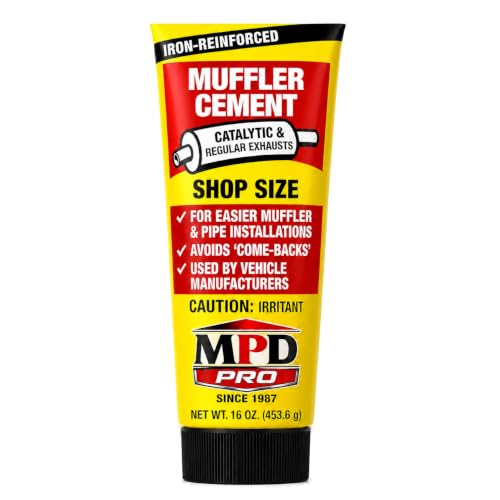
MPD offers the largest package, at 16 ounces, making it the practical choice when you need more compound than the smaller packets provide. The maker describes it as a paste for cracks, holes and seams on exhaust systems, mufflers, tailpipes and catalytic converters, with a hard finish that resists vibration and thermal cycling. No numerical heat limit is supplied in the specifications, so buyers who need to compare a specific temperature rating should favor a product with one. More compound does not make a failed or deeply rusted component repairable.
Bottom line: Choose this when package quantity matters more than a temperature limit.
NASCA High Temp Exhaust Sealant, 5.3 oz

NASCA pairs a non-slumping paste with a 2,012°F heat limit, matching LOCBONDSO’s rating while giving buyers another 5.3-ounce option. The maker says the sealant is intended for automotive mufflers, converters and tailpipes and is designed to seal cracks, holes and leaks. Its thick consistency is meant to stay where applied rather than run or drip.
Bottom line: Pick this for a thick paste with a 2,012°F limit.
How to choose muffler repair putty
Choose muffler repair putty based on the leak’s location, the metal condition and the compound’s temperature limit. Small pinholes and joints on otherwise solid pipe are better candidates than large gaps, loose seams or metal that flakes under light pressure; putty cannot replace missing structure. Compare the application claims: Walker 35958 Muffler/Exhaust Putty is specifically aimed at out-of-round connections, while Permatex 80333 Muffler and Tailpipe Putty names holes, leaks and joints and has a heat limit. A heat rating is a limit claimed for the compound, not a guarantee that any repair will last under every driving condition. If the leak is near a converter, check whether the chosen product is expressly described as converter-safe or converter-compatible.
When putty is not the right exhaust repair
Replace or professionally repair a pipe when rust has created a wide opening, a clamp cannot hold the joint, or the surrounding metal is soft and crumbling. Exhaust systems carry hot gases, and leaks can let carbon monoxide enter the passenger compartment; never run the engine in an enclosed garage, and treat exhaust odor inside the vehicle as urgent. A repair compound seals surfaces but does not restore a weak hanger, cracked flange or detached pipe. For a joint repair, use a product intended for exhaust joints and keep the repair area small and supported. With a hole larger than a small localized defect or metal damage extending beyond the immediate leak, choose a component repair instead of relying on putty.
Preparing an exhaust surface for putty
Surface preparation matters because grease, loose rust and soot can keep a compound from bonding to the pipe. Work only on a fully cool exhaust; exhaust components can remain hot well after the engine stops. Remove loose scale and contamination from the repair area, then apply the compound as directed by its manufacturer. Do not start the vehicle in a closed space while working or curing the repair: exhaust fumes can contain carbon monoxide, which has no reliable smell. Some compounds set quickly, but setting time is not necessarily the same as full cure time. If the product gives a cure procedure, use that timing rather than assuming a short wait is enough.
Muffler putty types and stated heat limits
Exhaust putties and cements are paste-like sealers for localized leaks; products differ in package amount, application claims and stated temperature rating. Use the table to narrow options by repair need, then check the actual pipe condition before choosing a compound. A high heat figure is useful for comparison but does not establish suitability for a damaged component or prove a permanent repair. The temperature claims below come from the product makers; a dash means there is no numerical rating to compare in these specifications.
| Repair need | Option | Stated heat rating |
|---|---|---|
| Small leak, converter compatibility | Permatex 80333 Muffler and Tailpipe Putty | Up to 2,000°F |
| Out-of-round joint | Walker 35958 Muffler/Exhaust Putty | — |
| High-heat non-slumping paste | LOCBONDSO High Temp Exhaust Repair Kit or NASCA High Temp Exhaust Sealant, 5.3 oz | Up to 2,012°F |
| Larger amount of compound | MPD Muffler Cement Putty, 16 oz | — |
Frequently Asked Questions
Can muffler putty seal a large exhaust hole?
Muffler putty is intended for localized leaks, not a large opening or missing metal. If rust extends beyond the hole or the pipe feels weak, replace or professionally repair the damaged section.
How long should muffler repair putty cure?
Cure time varies by formula, so use the cure procedure for the exact compound rather than treating a quick set as a full cure. Keep the engine off during application, and do not cure the repair with the vehicle running in an enclosed space.
Is muffler putty safe to use near a catalytic converter?
Only choose a product whose maker explicitly says it is suitable for converter use. For example, Permatex 80333 is described as safe for catalytic converters; do not infer that compatibility from a temperature rating alone.
Can I apply exhaust putty while the pipe is warm?
Apply putty only to a fully cool exhaust. Pipes and mufflers can stay hot after shutdown, so wait until they have cooled before touching or preparing the repair area.
Will muffler putty stop exhaust fumes inside a car?
A sound repair may seal a localized exhaust leak, but fumes inside the cabin require prompt attention because exhaust can contain carbon monoxide. Stop driving if exhaust odor enters the cabin and have the leak inspected.