
Best Neck Traction Device for Home: 5 Types Compared

ComforTrac-Deluxe Home Cervical Traction Kit 2.0 is the best neck traction device for home for buyers who want an adjustable setup, with incline positions of 10, 15, and 20 degrees. Choose a different style if you need a door-mounted system or a wearable inflatable collar with a neck-size range.
Cervical traction applies a pulling force to the neck; use it only with guidance from a qualified clinician, since the right method and force depend on the person.
We earn a commission if you buy through links on this page. As an Amazon Associate I earn from qualifying purchases. Products are compared on manufacturer specifications, not hands-on testing.
- Best overall: ComforTrac-Deluxe Home Cervical Traction Kit 2.0 – The kit offers three incline positions and a contouring memory-foam headrest.
- Best for incremental adjustment: Home Door Traction Device with Spring Scale – Its door-mounted pulley system uses a calibrated spring scale marked up to 40 lb.
- Best for a specified collar fit: Air Collar Neck Traction Device, 2nd Gen Pump – The air collar gives a fit range of 13.7–16.8 inches around the neck.
- Best for a wider collar range: Siwei Inflatable Cervical Neck Traction Brace – The inflatable brace lists a 12–17-inch neck-size range and adjustable air support.
| Product | Best for | Configuration | Adjustment | Fit | Shop |
|---|---|---|---|---|---|
| ComforTrac-Deluxe Home Cervical Traction Kit 2.0 | Incline adjustment | Home traction kit | 10°, 15°, 20° incline | — | Check Price on Amazon |
| Home Door Traction Device with Spring Scale | Door pulley setup | Over-door pulley | 0–40 lb scale | 74–82 in door height | Check Price on Amazon |
| Air Collar Neck Traction Device, 2nd Gen Pump | Air collar fit | Wearable air collar | Up to 20 lb pressure | 13.7–16.8 in neck | Check Price on Amazon |
| comness Over-Door Cervical Traction Device | Compact door setup | Over-door sling | Pull-height adjustment | Door thickness 6.6–7.3 in | Check Price on Amazon |
| Siwei Inflatable Cervical Neck Traction Brace | Adjustable air brace | Inflatable neck brace | Adjustable air and straps | 12–17 in neck | Check Price on Amazon |
Neck traction devices for home
Compare the setup style and fit details first, then choose a device only if its use has been cleared for you by a clinician.
ComforTrac-Deluxe Home Cervical Traction Kit 2.0
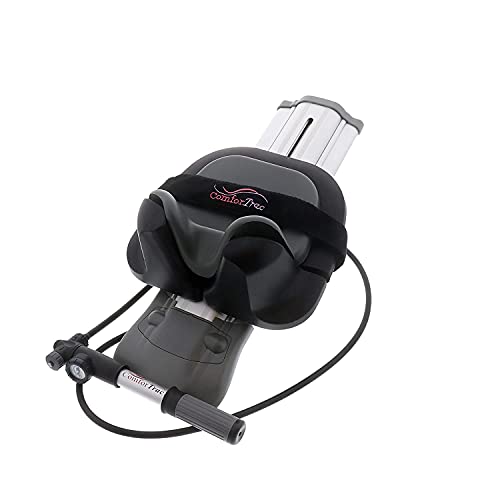
ComforTrac-Deluxe Home Cervical Traction Kit 2.0 stands apart with three incline choices—10, 15, and 20 degrees—rather than a door-mounted sling or wearable collar. The kit includes a contouring memory-foam headrest and carrying case, and its dimensions are 11 × 7 × 7 inches; weight is 7 lb. The maker describes the device as intended for home cervical traction. This format may suit someone who has clinician guidance and wants to choose among set angles. The maker does not give a force range, so it is a poor fit if a prescribed force setting is essential.
Bottom line: Choose this if set incline positions and a padded headrest matter most.
Home Door Traction Device with Spring Scale

Home Door Traction Device with Spring Scale differs from the other options by using an over-door pulley and a ratcheting mechanism with a spring scale. Its scale is described as calibrated from 0 to 40 lb, and the maker recommends door heights of 74–82 inches for optimal use. At 0.9 lb, it is the lightest option with a weight. The setup may suit buyers who need incremental adjustment and have a compatible door. It requires a stable door arrangement and clinician-directed force selection; the scale range is not a recommendation for how much force to use.
Bottom line: Pick this if a door-mounted pulley and calibrated scale suit your setup.
Air Collar Neck Traction Device, 2nd Gen Pump

Air Collar Neck Traction Device, 2nd Gen Pump is the wearable air collar option, unlike the door-mounted systems and headrest kit. Its fit range is a neck circumference of 13.7–16.8 inches, and the maker says the adjustable pressure reaches up to 20 lb. The second-generation model includes an electric pump, according to its name. This design may suit someone whose neck measurement falls within that range and who has been advised to use an air collar. Measure around the neck before choosing; the specified fit range makes this a poor match outside those dimensions.
Bottom line: Choose this if your neck measures 13.7–16.8 inches and an air collar is appropriate.
comness Over-Door Cervical Traction Device

comness Over-Door Cervical Traction Device uses an over-door sling with a pull system that adjusts its height, making its setup distinct from the scale-based pulley and inflatable collars. The maker says its door stop fits doors 0.55–0.61 ft thick, which converts to about 6.6–7.3 inches. That measurement is the key fit check for this option; a door outside the range may not work with the stop. This may suit buyers who want a compact door-hanging design.
Bottom line: Pick this if your door thickness is within its range.
Siwei Inflatable Cervical Neck Traction Brace

Siwei Inflatable Cervical Neck Traction Brace is an inflatable neck brace with adjustable air support and two Velcro straps, rather than a pulley system or headrest-based kit. Its fit range is 12–17 inches around the neck, slightly wider than the range given for Air Collar Neck Traction Device, 2nd Gen Pump. The brace weighs about 0.55 lb and has a flocked fabric surface. This style may suit someone who wants a wearable, strap-adjustable device and whose neck measurement falls within range.
Bottom line: Choose this if an inflatable brace fits your neck measurement and care plan.
How to choose a home neck traction device
Choose by setup, fit, and the adjustment method your clinician recommends—not by the largest force number. Home devices generally fall into three formats: a headrest or table-style kit, an over-door pulley or sling, and a wearable air collar or brace. A scale in pounds measures force, while an incline in degrees describes angle; those numbers are not interchangeable. Before selecting a design, ask what method and settings are appropriate for you. A door device also depends on door height or thickness, while a collar depends on neck circumference. For example, if your measured neck is outside a collar’s range, choose another format rather than trying to force a fit. Never treat a maximum scale value as a target.
Check neck and door fit before setup
Measure the neck at the position and manner the maker specifies; a collar’s fit range is a circumference, not a collar length. In this group, the collar ranges are 13.7–16.8 inches and 12–17 inches. If your measurement falls outside the relevant range, do not assume straps or inflation will make the collar fit safely. Door devices need a separate check: one maker recommends a 74–82-inch door height, while another gives a stop thickness of 0.55–0.61 ft, or about 6.6–7.3 inches. This table separates the fit checks from the adjustment styles; verify your own measurements before choosing.
| Device style | Fit check | Adjustment described |
|---|---|---|
| Headrest kit | — | 10°, 15°, 20° incline |
| Door pulley | 74–82 in door height | 0–40 lb scale |
| Air collar | 13.7–16.8 in neck | Up to 20 lb pressure |
| Over-door sling | 6.6–7.3 in door thickness | Pull-height adjustment |
| Inflatable brace | 12–17 in neck | Air and strap adjustment |
Use cervical traction with safety guidance
Cervical traction is not a one-setting-fits-all device: force, duration, and position should be chosen with a qualified clinician, especially for home use. Do not increase force because a device’s scale or pressure limit allows it. Stop using a device and contact a clinician if it causes new or worsening symptoms such as pain, numbness, weakness, dizziness, or headache. Neck pain after a significant injury or pain with new weakness or numbness warrants prompt medical evaluation rather than trying traction at home. Keep door-mounted equipment secured as intended and do not use it if the door or stop shifts during setup. A device’s advertised intended use does not establish that it is suitable for a particular person.
Frequently Asked Questions
How do I measure my neck for an air traction collar?
Use a flexible tape to measure the circumference of your neck where the collar is intended to sit, then compare the result with the range. The collar options here cover 13.7–16.8 inches and 12–17 inches, so a measurement outside the selected device’s range is a reason not to use that fit.
Are door-mounted neck traction devices universal fit?
No, door requirements can differ by design. One model recommends a door height of 74–82 inches, and another specifies a door-stop thickness of 0.55–0.61 ft, about 6.6–7.3 inches.
Does a 40-pound traction scale mean I should use 40 pounds?
No, the scale’s upper value is a device range, not a personal setting recommendation. Have a qualified clinician specify appropriate force and use only that guidance rather than increasing force to the maximum.
Can I use a neck traction device after a neck injury?
Do not start traction after a significant neck injury without medical evaluation. Fractures and instability need assessment, and new weakness or numbness after an injury calls for prompt medical care rather than a home device.
What should I do if traction causes tingling or dizziness?
Stop using the device and contact a clinician if tingling, dizziness, worsening pain, or new weakness appears. Do not continue or increase the force to see whether the symptoms pass.