
Best No Bark Dog Collars: 5 Options Compared

For most people, No-Shock Sound & Vibration Collar is the clearest starting point because it uses sound and vibration rather than shock and fits necks from 6 to 25 inches. Choose another option if you want selectable stimulation, a two-collar pack, or a different set of controls.
A bark collar detects barking and delivers a chosen cue; it works best as one part of training, not as a substitute for addressing why a dog barks.
We earn a commission if you buy through links on this page. As an Amazon Associate I earn from qualifying purchases. Products are compared on manufacturer specifications, not hands-on testing.
- Best overall: No-Shock Sound & Vibration Collar – Its sound-and-vibration approach avoids shock and its neck range is 6–25 inches.
- Best for selectable feedback: Kollgux 4-Mode Smart Bark Collar – Offers beep, vibration, combined feedback, and adjustable static stimulation.
- Best for two dogs: Koguzl Two-Collar Bark Collar Pack – The package contains two collars and offers five modes with seven sensitivity levels.
- Best for simple no-shock cues: Dogrook Beep & Vibration Collar – Uses beep and vibration, with two vibration modes and seven sound stages.
| Product | Best for | Feedback modes | Sensitivity settings | Fit range | Shop |
|---|---|---|---|---|---|
| No-Shock Sound & Vibration Collar | No-shock training | Sound, sound + vibration | — | Neck 6–25 in | Check Price on Amazon |
| Kollgux 4-Mode Smart Bark Collar | Flexible feedback | Beep, vibration, combined, static | Adjustable | — | Check Price on Amazon |
| Koguzl Two-Collar Bark Collar Pack | Two-collar pack | Five training modes | 7 levels | 11–120 lb | Check Price on Amazon |
| FAFAFROG 27-Inch Smart Bark Collar | Display and protection | Beep, vibration | 5 levels | 27 in | Check Price on Amazon |
| Dogrook Beep & Vibration Collar | Sound-stage choice | Beep, vibration | — | 12–110 lb | Check Price on Amazon |
No Bark Dog Collars Compared
Compare feedback style and fit first, then choose controls that suit your training plan and your dog.
No-Shock Sound & Vibration Collar

Unlike options that include static stimulation, this collar is designed around sound and vibration. The maker says its bark detection is intended to distinguish the dog’s bark from common surrounding noises, and it describes an IP67 waterproof rating. Its fit covers necks from 6 to 25 inches. That makes it a straightforward choice if you want a no-shock cue and your dog’s neck falls within that range. The two-mode approach offers fewer feedback choices than collars with beep-only or adjustable sensitivity settings.
Bottom line: Choose this if sound and vibration are the feedback you want and the neck range fits.
Kollgux 4-Mode Smart Bark Collar

This is the only option here that explicitly includes adjustable static stimulation alongside sound and vibration. The maker describes automatic bark detection, adjustable sensitivity, and multiple intensity settings, so it gives owners several feedback choices rather than a fixed cue. Start with the least intrusive setting that suits your training plan; static stimulation may not be appropriate for every dog or situation. Its product dimensions do not establish a neck-size range, so confirm the collar fit before choosing it if your dog’s neck is unusually small or large.
Bottom line: Choose this if you need several feedback types, including adjustable static stimulation.
Koguzl Two-Collar Bark Collar Pack
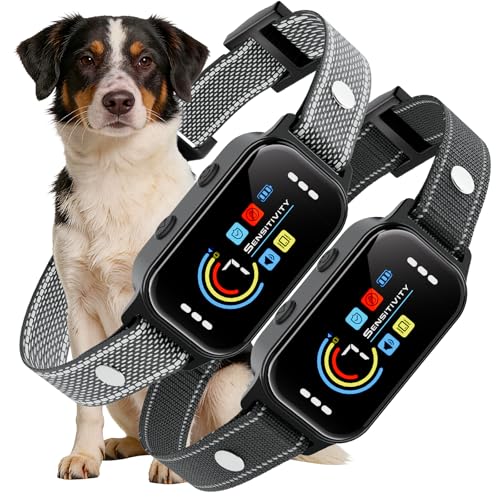
The two-collar pack separates itself by supplying two units, making it the only multi-collar option in this group. The maker describes five training modes, seven sensitivity levels, and an 11–120-pound dog range. It also claims an IP67 rating and an automatic pause after three activations in 45 seconds. Those controls may suit a household that wants to adjust feedback and sensitivity, but the mode names and feedback types should guide your decision: the feature summary does not identify each mode individually. Confirm both dogs fall within the weight range.
Bottom line: Choose this for two dogs that fit the range and need adjustable controls.
FAFAFROG 27-Inch Smart Bark Collar

The FAFAFROG stands out for its color display and an automatic pause feature: the maker says it stops working for 30 seconds after six consecutive activations. Its five sensitivity levels pair with beep and vibration feedback, and the collar length is 27 inches. The maker also describes bark recognition that requires continued barking and vocal-cord vibration. This combination gives you a visible status display and a pause safeguard, but the 27-inch length alone does not confirm a comfortable fit for every neck within that length.
Bottom line: Choose this if a display and an automatic pause are priorities.
Dogrook Beep & Vibration Collar

Dogrook focuses on sound and vibration rather than shock, with two vibration modes and seven sound stages. The maker says its microphone is designed to detect the dog’s bark and adjust sensitivity. The dog-weight range is 12 to 110 pounds. This makes it a fit to consider if you want a choice of sound cues and a no-shock approach. The feature summary gives no sensitivity-level count, so buyers who want a specific number of adjustment steps should compare that control carefully against options with levels.
Bottom line: Choose this if multiple sound stages and a no-shock approach matter most.
How to Choose a No Bark Dog Collar
Choose feedback style before counting modes: sound-only and vibration cues differ from collars that also offer static stimulation. Start with the least intrusive cue that matches your training plan, and pair it with rewards for quiet behavior; the collar alone does not teach a dog what to do instead. Barking can signal alerting, fear, boredom, or distress, so note when it happens and what precedes it. If barking occurs mainly when the dog is alone, or comes with fear or aggression, address that cause with a veterinarian or qualified trainer rather than relying on a bark collar. A practical rule: if you do not want static stimulation, eliminate any model whose controls include it.
Fit and Sensitivity Matter
Fit the collar snugly enough that its sensing and contact points remain in position, but not so tightly that it restricts breathing or irritates skin. A neck measurement is more useful than weight alone: measure around the area where the collar will sit and compare that measurement with the range. Sensitivity settings can help distinguish a dog’s bark from ambient noise, but overly high sensitivity may cause unwanted activations. Begin with a lower setting and observe whether the collar responds to the intended bark, then adjust gradually. Remove the collar regularly and check the skin for redness or rubbing; stop use if irritation appears.
Use Bark Collars as One Training Cue
A bark collar is a management tool, not a replacement for teaching an alternative behavior. Reward quiet moments, redirect the dog before a predictable trigger when possible, and keep training sessions short and consistent. Avoid using a collar to suppress barking that may indicate pain, fear, or distress; identify the trigger instead. Do not leave a training collar on continuously, and check the fit and skin at regular intervals. Water-resistance claims also do not make every collar suitable for every activity: follow the device’s care guidance, and remove it when it is not needed for training.
Common Bark Collar Mistakes
Choosing by weight alone is a common mistake because two dogs of the same weight can have very different neck sizes. Another is choosing the strongest setting first; begin conservatively and change one setting at a time so you can tell what the dog is responding to. Do not assume every “mode” means the same thing across collars: check whether the options are sound, vibration, static stimulation, or combinations. Finally, avoid using a bark collar to stop all vocalizing. Barking is normal communication, and the goal should be reducing a specific unwanted pattern while responding to the reason it occurs.
Frequently Asked Questions
How tight should a dog bark collar be?
A bark collar should sit securely without restricting breathing or rubbing the skin. Measure your dog’s neck at the collar position and compare it with the model’s fit range; check the skin regularly for irritation.
Can a bark collar stop barking from separation anxiety?
A bark collar does not resolve separation anxiety, which can involve distress rather than ordinary alert barking. If barking happens mainly when your dog is alone, seek help addressing the underlying cause instead of suppressing the sound.
Should I start with the highest sensitivity setting?
No; begin at a lower sensitivity and adjust gradually while observing whether the collar responds to your dog’s bark. High sensitivity can increase unwanted activations from other sounds or movement.
Are no-shock bark collars completely harmless?
No training device is automatically harmless for every dog; fit, duration, and the reason for barking matter. Stop using a collar if it causes skin irritation or distress, and address fear-related barking with qualified help.
Can a dog wear a bark collar all day?
A training collar should not be left on continuously. Remove it when it is not needed for training and inspect the contact area regularly for redness, rubbing, or other irritation.