
Best OBD2 Gauge Display: 4 Options Compared

ScanGauge 3 SG3 is the best OBD2 gauge display for most drivers because it can show up to nine gauges at once and fits 1996-and-newer cars and light trucks with a 16-pin OBD2 port. Choose another model if you want a GPS-and-OBD2 dual system or a more compact dashboard unit.
An OBD2 gauge display reads vehicle data through the diagnostic port, but the data available depends on the vehicle.
We earn a commission if you buy through links on this page. As an Amazon Associate I earn from qualifying purchases. Products are compared on manufacturer specifications, not hands-on testing.
- Best overall: ScanGauge 3 SG3 – Its touch screen can show up to nine gauges at once, with three configurable pages.
- Best for dual-system data: MH OBD2+GPS Head-Up Display – It combines OBD2 and GPS modes for driving data.
- Best for flexible mounting: WiiYii P6 OBD2+GPS Gauge – It offers an adjustable bracket for dashboard or windshield mounting.
| Product | Best for | Display layout | Data access | Vehicle fit | Shop |
|---|---|---|---|---|---|
| ScanGauge 3 SG3 | Multiple gauge views | Up to 9 gauges; 3 pages | OBD2; no app needed | 1996+ cars and light trucks | Check Price on Amazon |
| MH OBD2+GPS Head-Up Display | Dual-system readings | Head-up display | OBD2 and GPS | Vehicle OBD2 interface | Check Price on Amazon |
| WiiYii P6 OBD2+GPS Gauge | Flexible mounting | LCD gauge display | OBD2 and GPS | Most cars, per maker | Check Price on Amazon |
| LUFI Xs Gauge Display | Non-EV compatibility | Gauge display | Built-in PID commands | American 2008+; Japanese/European 2005+ | Check Price on Amazon |
OBD2 Gauge Displays Compared
Compare the available display layouts and vehicle compatibility before choosing a gauge.
ScanGauge 3 SG3

ScanGauge 3 SG3 stands apart with a touch screen that can show up to nine gauges across three configurable pages. It connects through the vehicle’s OBD2 port and needs no phone app, subscription, or separate batteries. The maker says it works with 1996-and-newer cars and light trucks that have a 16-pin OBD2 port, including newer WWHOBD vehicles; supported data varies by vehicle. This is a strong fit if you want several live readings visible together. It is not the right match for vehicles with 6- or 9-pin diesel ports.
Bottom line: Pick this if you want several customizable gauge views on one screen.
MH OBD2+GPS Head-Up Display

MH OBD2+GPS Head-Up Display is the choice here that explicitly pairs OBD2 and GPS systems. Its described readings include speed, tachometer, water temperature, voltage, drive time, altitude, mileage, turbo pressure, compass, and clock; it also offers fault-code scanning and data streams. The maker says it can display driving data through the car’s OBD2 interface and describes acceleration and braking tests. This suits drivers who want both system modes and fault-code functions. Its OBD2 readings depend on the car, so do not assume every vehicle provides every parameter.
Bottom line: Choose this if dual OBD2 and GPS modes are your priority.
WiiYii P6 OBD2+GPS Gauge
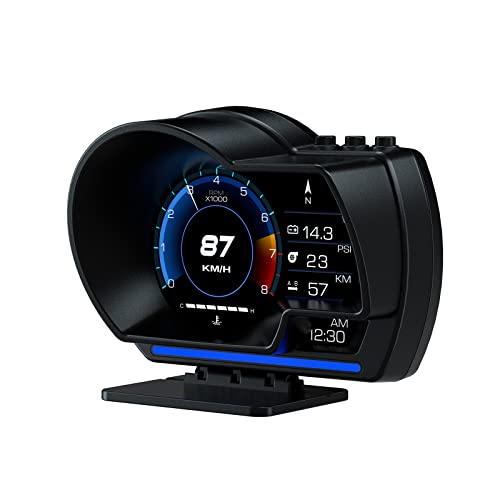
WiiYii P6 OBD2+GPS Gauge offers a choice of dashboard or windshield placement using an adjustable bracket, which distinguishes it from the touch-screen layout of ScanGauge 3 SG3. The maker describes ten switchable interfaces and lists speed, voltage, fuel consumption, RPM, and water temperature among its readings; it also mentions fault-code access and data streams. The display is aimed at drivers who want an adjustable viewing angle and multiple display modes. The maker’s compatibility wording is broad, so confirm that your vehicle supports the readings you want before relying on them.
Bottom line: Pick this if adjustable dashboard or windshield placement matters most.
LUFI Xs Gauge Display

LUFI Xs Gauge Display gives a specific vehicle-fit guide: American brands manufactured after 2008 and Japanese or European brands manufactured after 2005, with pure electric vehicles excluded. Its distinguishing caveat concerns oil and transmission temperature or pressure: these readings are not on the panel by default, and built-in PID commands can test vehicle support. This makes it a more appropriate shortlist option when your vehicle falls within the brand and year ranges and those readings are not essential. Compatibility can still differ by model and year, so check your exact vehicle before choosing.
Bottom line: Choose this when your non-electric vehicle fits its year ranges.
How to Choose an OBD2 Gauge Display
Choose by supported data and readability, not by the number of advertised readings. A vehicle’s OBD2 port provides standardized emissions-related diagnostics, while many live values beyond that core set rely on manufacturer-specific data. Compare which values matter to you—such as engine speed or coolant temperature—and whether the display presents them clearly at a glance. A screen with multiple pages can organize different driving views, while a head-up display can place readings nearer your line of sight. If you need a specific value such as transmission temperature, confirm support for your exact vehicle before buying; a gauge cannot display data the vehicle does not provide.
For a simple decision rule, if you need at least five simultaneous readings, prioritize a model that explicitly supports that many on one screen. If you mainly want speed or a few engine values, a simpler view may be easier to scan.
OBD2 Port and Vehicle Compatibility
Most US cars and light trucks from the 1996 model year onward use a standardized 16-pin OBD2 connector, but the connector alone does not guarantee that every display feature works. Check that your vehicle has the matching port and that the display supports its model year and powertrain. Diesel vehicles can use different diagnostic connectors, and a product limited to the 16-pin port will not fit a 6- or 9-pin diesel connector without a compatible solution. Pure electric vehicles may also lack support for conventional engine readings; LUFI Xs Gauge Display specifically excludes pure EVs.
Vehicle-specific support matters most for values beyond common engine data. Confirm the desired parameter before choosing a display, especially for oil temperature, transmission pressure, or other manufacturer-dependent readings.
OBD2 Gauge Display Types and Readings
OBD2 gauge displays generally use a dashboard screen, a head-up arrangement, or a combination of OBD2 and GPS data. OBD2 readings come from the vehicle computer; GPS-derived speed or position data does not depend on the same vehicle sensor stream. That distinction can help when a vehicle does not report a desired value, though GPS and OBD2 figures may not match exactly.
Use this comparison to match the format to your needs; it compares the display approaches in this group, not a guarantee that every vehicle supplies every reading.
| Display approach | Useful when | Check before choosing |
|---|---|---|
| Multi-page touch screen | You want several gauge layouts | Which values your vehicle reports |
| Head-up placement | You want readings positioned near your sight line | Mounting position and visibility |
| OBD2 plus GPS | You want both vehicle and satellite data modes | Which readings come from each mode |
Safe Placement and Use
Place a gauge where it does not block the windshield, obscure factory instruments, or interfere with airbags. Federal rules prohibit objects that obstruct a driver’s view through the windshield, and airbag deployment zones vary by vehicle; keep mounts away from marked airbag areas. A display intended to reduce downward glances can still distract if its pages, alarms, or settings demand attention while moving.
Set up the screen while parked, choose only the readings you need, and avoid changing layouts in traffic. If the display cannot be positioned without blocking vision or controls, use a different mounting location or skip that format.
Frequently Asked Questions
Does every OBD2 gauge show coolant temperature?
No. Many vehicles report coolant temperature, but available live data depends on the vehicle and the display. Confirm support for your exact model before choosing a gauge for that reading.
Can an OBD2 display work with a pure electric car?
Not necessarily, because conventional OBD2 engine readings may not apply to an electric powertrain. LUFI Xs Gauge Display specifically excludes pure electric vehicles, so check a device’s fit for your vehicle before relying on it.
Where is the OBD2 port usually located?
The 16-pin diagnostic connector is commonly under the dashboard near the steering column. Check around the lower dash and center area first, and consult your vehicle manual if it is not visible.
Does GPS speed match the car speedometer exactly?
Not always: GPS calculates speed from satellite position changes, while the vehicle speedometer uses vehicle systems and may be calibrated to read slightly high. Reception, signal loss, and rapid speed changes can affect GPS readings.
Can a gauge clear an engine fault code?
Some displays offer fault-code clearing, but clearing a code does not fix its cause. Diagnose the underlying issue first, since the warning can return if the fault remains.