
Best Oil Based Food Coloring for Chocolate Compared

Colour Mill Oil Blend 12-Color Set is the best oil based food coloring for chocolate for most people because its 12-color set includes 20-milliliter bottles and is intended for chocolate, ganache, and other recipes. Choose a larger palette if you want more shade options, or a smaller one if seven colors cover your needs.
Oil-soluble food coloring disperses in cocoa butter and other fats, unlike water-based dye, which can make melted chocolate seize.
We earn a commission if you buy through links on this page. As an Amazon Associate I earn from qualifying purchases. Products are compared on manufacturer specifications, not hands-on testing.
- Best overall: Colour Mill Oil Blend 12-Color Set – Twelve colors come in 20-milliliter bottles, and the maker identifies chocolate as a suitable use.
- Best for shade variety: Nomeca 20-Color Oil-Based Set – The 20-color set has the largest palette among these options.
- Best for a core palette: Cherrysea 7-Color Rainbow Set – Seven colors cover a compact rainbow range for chocolate and candy.
| Product | Best for | Color count | Bottle volume | Shop |
|---|---|---|---|---|
| Colour Mill Oil Blend 12-Color Set | Larger bottles | 12 | 20 mL each | Check Price on Amazon |
| 14-Color Oil-Based Food Coloring Set | Chocolate and candy | 14 | 0.25 fl oz each | Check Price on Amazon |
| Nomeca 20-Color Oil-Based Set | Most color choices | 20 | 0.25 fl oz each | Check Price on Amazon |
| Cherrysea 7-Color Rainbow Set | Basic rainbow shades | 7 | 0.25 fl oz each | Check Price on Amazon |
| 16-Color Oil-Based Food Coloring Set | Balanced palette | 16 | 0.25 fl oz each | Check Price on Amazon |
Oil Based Food Coloring for Chocolate
Compare each set’s palette and bottle size, then match it to the kinds of chocolate colors you plan to make.
Colour Mill Oil Blend 12-Color Set

Colour Mill Oil Blend 12-Color Set stands out for its 20-milliliter bottles, larger than the 0.25-fluid-ounce bottles in the other sets. The 12-shade palette includes colors such as black, chocolate, forest, lime, and royal blue. The maker says its oil blend is intended for chocolate, ganache, buttercream, and other baking uses, and describes the coloring as vegan and allergen-free. This set suits bakers who want a smaller color range in larger individual bottles. Its limitation is the 12-color palette, which offers fewer choices than the 14-, 16-, and 20-color sets.
Bottom line: Choose it if you want 20-milliliter bottles and a dozen shades.
14-Color Oil-Based Food Coloring Set

14-Color Oil-Based Food Coloring Set is a chocolate-and-candy-focused set with 14 colors, including several distinct greens and two pinks. Each bottle holds 0.25 fluid ounce. The maker says the oil-soluble formula is designed for chocolate, candy melts, cocoa butter, and other high-fat recipes. That stated range makes this set a fit for someone coloring both chocolate and candy melts rather than seeking a broad baking palette. The tradeoff is its 14-shade selection, which is smaller than the 16- and 20-color options. Check that its shades cover the specific colors you want before choosing it.
Bottom line: Pick it for chocolate and candy melts with several green shades.
Nomeca 20-Color Oil-Based Set

Nomeca 20-Color Oil-Based Set offers the widest palette here, with 20 colors that include teal, Tiffany blue, Klein blue, and multiple greens. The bottles hold 0.25 fluid ounce each. The maker describes the dyes as oil-based and identifies them for chocolate and candy melts; it also claims the colors do not change food taste. This range suits projects where a particular hue matters or where several colors are used together. The limitation is that the many shades come in smaller bottles than Colour Mill Oil Blend 12-Color Set, so it may be less suitable when larger quantities of a few colors are the priority.
Bottom line: Choose it when you need the broadest set of named shades.
Cherrysea 7-Color Rainbow Set
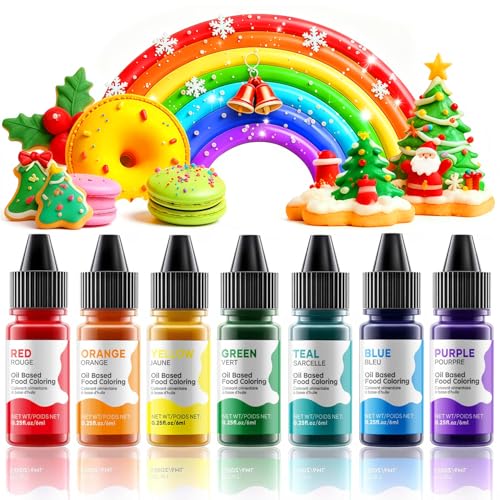
Cherrysea 7-Color Rainbow Set is the smallest palette in this group, with seven colors: red, orange, yellow, green, teal, blue, and purple. Each bottle is 0.25 fluid ounce. The maker says the oil-based dyes are designed for chocolate, butter, mousse, and candy, and describes them as vegan and gluten-free. A compact rainbow set suits occasional decorating or recipes that call for a few basic hues rather than many closely related shades. Its clear limitation is the seven-color range; buyers seeking black, brown, or multiple pinks and greens should consider a broader palette.
Bottom line: Pick it for a compact rainbow palette and occasional decorating.
16-Color Oil-Based Food Coloring Set

16-Color Oil-Based Food Coloring Set sits between the 14- and 20-color sets, with 16 shades including light blue, teal, lemon yellow, grape purple, and brown. Each bottle holds 0.25 fluid ounce. The maker says the formula is intended for chocolate and candy melts, and describes it as tasteless and odorless. This set suits decorators who want more than a basic rainbow without the largest palette in the comparison. The limitation is that its bottle size is smaller than Colour Mill Oil Blend 12-Color Set’s, which matters if you expect to use one shade in larger batches.
Bottom line: Choose it for a mid-sized palette with several nuanced shades.
How to choose oil-based coloring for chocolate
Choose a dye labeled oil-based or oil-soluble for chocolate because chocolate’s fat-based structure does not mix reliably with water. Even a small amount of water can cause melted chocolate to seize into a thick, grainy mass. For a broad choice of colors, compare shade count; for repeated use of a few colors, bottle volume matters more. White chocolate provides the clearest base for bright colors, while coloring dark chocolate usually produces muted results. A practical rule: if you need more than a dozen distinct shades, choose a palette with 14 or more colors; if you use a few colors in larger quantities, prioritize the larger bottles instead.
Check that the label identifies the product as food coloring and follow its handling directions. Do not substitute craft pigments or non-food colorants for edible dye.
How to color chocolate without seizing it
Keep water away from melted chocolate, including wet utensils and steam from a double boiler. Chocolate can seize when water droplets make its sugar and cocoa particles clump; adding more water is not a reliable fix for a coating or candy batch. Use dry equipment and add oil-soluble color in small amounts, mixing thoroughly before adjusting the shade. White chocolate is the easiest base for bright hues because it starts light, while milk and dark chocolate shift the final color. For molded or dipped chocolates, preserve the chocolate’s intended texture by avoiding additions that are not formulated for fat-based mixtures.
Color strength differs by product and by the chocolate base, so build toward the desired shade gradually rather than adding a large quantity at once. For a deep color, start with white chocolate and mix in incremental drops until the shade is even.
Color set sizes compared
Set size is a useful shortcut: a seven-color palette covers basic rainbow shades, while 14 to 20 colors provide more options for distinct hues. Bottle volume also changes the fit; the larger 20-milliliter bottles in Colour Mill Oil Blend 12-Color Set suit frequent use of a limited palette, while the 0.25-fluid-ounce bottles in the other sets prioritize shade variety. Use this table to narrow the choice by the amount of color range you need, not as a guarantee that a particular shade will look identical in every chocolate base.
| Need | Useful set size | What to weigh |
|---|---|---|
| Basic rainbow | 7 colors | Smallest palette, fewer specialty shades |
| Several color choices | 12–16 colors | Balance palette breadth and bottle volume |
| Broad shade selection | 20 colors | More options, smaller bottles here |
Common mistakes with chocolate dye
The most common mistake is using water-based dye in melted chocolate; water can make the mixture seize rather than blend smoothly. Another is expecting a bright result from a dark base: white chocolate is a better starting point for vivid colors, while milk or dark chocolate affects the final shade. Avoid adding a large amount of color at once, since gradual mixing makes shade adjustment easier. Also distinguish a product’s uses from its color count: a larger palette does not guarantee a specific result in every recipe. For food safety, use only coloring made for consumption and keep tools and work surfaces clean and dry.
Frequently Asked Questions
Why does water make melted chocolate seize?
Water can make the sugar and cocoa particles in melted chocolate clump, producing a thick, grainy mass. Keep utensils dry and use oil-soluble coloring made for chocolate.
Can oil-based food coloring color white chocolate?
Yes, oil-soluble coloring is suited to fat-based mixtures such as chocolate, and white chocolate gives colors a light base. Add color gradually and mix well to judge the shade.
Will food coloring look bright in dark chocolate?
Usually not as bright as it does in white chocolate, because the dark base affects the final shade. Use white chocolate when vivid colors are the priority.
How much food coloring should I add to chocolate?
Add a small amount at a time and mix before adjusting, since color strength and the chocolate base affect the result. Avoid adding water-based dye, which can cause seizing.
Are oil-based and water-based food colors interchangeable?
No; oil-soluble dyes are made to blend with fats, while water-based dyes can cause melted chocolate to seize. Match the coloring type to the recipe’s fat-based ingredients.