
Best Orthopedic Water Shoes: 3 Options Compared

For a wide fit and water-oriented use, Barefoot Orthopedic Water Shoe is the strongest match because it combines an extra-wide toe box with a flexible upper and slip-on, adjustable fit. Choose ELETON Barefoot Water Shoe if you prefer an elastic closure and ventilated sole; choose Orthofeet Kita Women’s Sneaker for walking in damp conditions, not for swimming or immersion.
We earn a commission if you buy through links on this page. As an Amazon Associate I earn from qualifying purchases. Products are compared on manufacturer specifications, not hands-on testing.
- Best overall: Barefoot Orthopedic Water Shoe – An extra-wide toe box, adjustable straps and water, beach and pool use make it the broadest match.
- Best for ventilated feel: ELETON Barefoot Water Shoe – A ventilated sole and elastic closure distinguish this lightweight barefoot-style option.
- Best for damp walks: Orthofeet Kita Women’s Sneaker – Its water-repellent stretch upper and cushioned arch-support design suit walking rather than water activities.
| Product | Best for | Fit and closure | Sole and support | Water-related use | Shop |
|---|---|---|---|---|---|
| Barefoot Orthopedic Water Shoe | Wide toe room | Extra-wide; adjustable slip-on | Zero-drop, minimalist | Beach, pool, swimming, hiking | Check Price on Amazon |
| ELETON Barefoot Water Shoe | Ventilated barefoot feel | Unisex; elastic-band closure | Zero-drop, ventilated sole | Water use; hiking and running | Check Price on Amazon |
| Orthofeet Kita Women’s Sneaker | Damp-weather walking | Women’s wide; hands-free slip-on | Arch support; cushioning | Water-repellent upper | Check Price on Amazon |
Orthopedic Water Shoes Compared
Compare the toe room, closure and intended water use before choosing a pair.
Barefoot Orthopedic Water Shoe

Barefoot Orthopedic Water Shoe is the most directly water-oriented option here, with an extra-wide toe box and adjustable straps rather than a fixed elastic closure. The maker says its flexible knitted upper and lightweight zero-drop sole are designed to allow natural toe splay and a barefoot feel; the product is also described for beach, pool, swimming and hiking use. Its wide women’s and men’s sizing may suit people who want more toe room. The tradeoff is a minimalist sole, which may not suit someone seeking substantial cushioning or pronounced arch support.
Bottom line: Choose this pair if a roomy toe box and minimalist water-oriented design matter most.
ELETON Barefoot Water Shoe
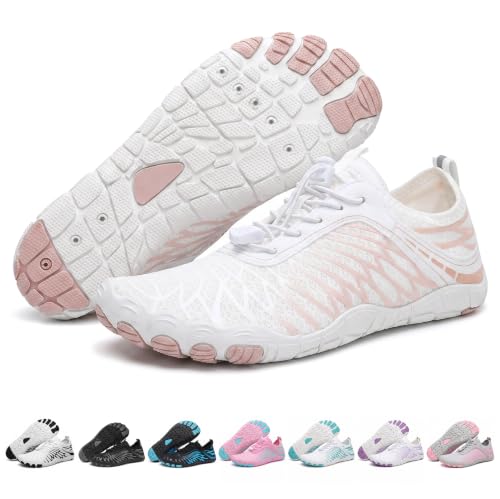
ELETON Barefoot Water Shoe stands apart with an elastic-band closure and a ventilated sole, instead of Barefoot Orthopedic Water Shoe’s adjustable straps. The maker says its flexible synthetic mesh upper and zero-drop sole provide a lightweight barefoot feel, and identifies the shoe for water use as well as hiking and running. This can fit buyers who want a simple pull-on design and airflow through the sole. Unlike Barefoot Orthopedic Water Shoe, the specifications do not establish an extra-wide fit or adjustable fastening, so people who need either feature should prioritize a shoe with those specific fit characteristics.
Bottom line: Pick this option if ventilation and an elastic pull-on closure are your priorities.
Orthofeet Kita Women’s Sneaker

Orthofeet Kita Women’s Sneaker is a walking sneaker rather than a water shoe: its useful distinction is a water-repellent stretch upper paired with arch support and ergonomic cushioning. The maker says the upper sheds moisture and flexes, while the included orthotic insole provides anatomical arch support and cushioning. A hands-free entry may suit walkers who want a wide toe box and do not want to bend to tie shoes. The limitation is important: water-repellent fabric is not the same as a shoe intended for swimming, pool use or prolonged submersion.
Bottom line: Choose this sneaker for damp walks and support, not for swimming or immersion.
How to choose orthopedic water shoes
Start with the activity and the amount of support you want: a minimalist water shoe and a cushioned walking sneaker serve different jobs. Water shoes are commonly built with mesh or other quick-draining uppers and flexible soles; a water-repellent walking upper is meant to shed splashes, not necessarily to drain or tolerate submersion. For fit, leave roughly a thumb’s width—about 0.4 to 0.5 inch—between the longest toe and the front of a shoe, with no side pressure across the forefoot. If you need arch support, check that the footbed or removable insole provides it; a wide toe box alone does not indicate arch support. Avoid choosing by the word “orthopedic” alone: compare the actual fit, sole and intended use.
Water shoes versus water-repellent walking shoes
Water shoes and water-repellent walking shoes differ most in their intended exposure: one is built for water activities, while the other sheds moisture during ordinary walking. A mesh water shoe typically uses a flexible, perforated upper and drainage-friendly construction; a water-repellent upper may slow surface wetting but can still become saturated. Use this distinction to match the shoe to the activity.
This quick guide separates intended use from comfort features.
| Need | Look for | Limit to keep in mind |
|---|---|---|
| Pool or beach activity | Water-oriented design and secure fit | Check fit before entering water |
| Room across toes | Wide toe box and adequate length | Wide does not automatically mean supportive |
| Damp-weather walking | Water-repellent upper and walking cushioning | Not a substitute for immersion-ready footwear |
How wide should water shoes fit
A water shoe should hold the heel securely while leaving the toes room to spread without rubbing. A practical starting point is about 0.4 to 0.5 inch of space beyond the longest toe; foot shape and sock use can change the fit. Try shoes late in the day if your feet tend to swell, and check that the upper does not press on bunions or the sides of the forefoot. Adjustable straps can help fine-tune a fit, while elastic closures are faster but offer less adjustment. For any activity in moving water, avoid a loose shoe that can slip off; do not size up so much that the heel lifts with each step.
What support features matter in wet conditions
Arch support, cushioning and a wide toe box are separate fit features, so identify which one you need instead of treating them as interchangeable. A zero-drop sole places the heel and forefoot at the same level; it does not by itself provide arch support or cushioning. Wet surfaces can also be slippery, and a “non-slip” label cannot guarantee traction on every tile, rock or pool deck. Walk cautiously on wet flooring and use footwear intended for the surface. If you rely on custom orthotics, verify that the shoe’s footbed can accommodate them and remains secure when wet.
Frequently Asked Questions
Can barefoot water shoes provide arch support?
A zero-drop sole does not necessarily provide arch support. Check for a shaped footbed or an orthotic insole if arch support is a requirement.
How much toe room should water shoes have?
About 0.4 to 0.5 inch beyond the longest toe is a useful starting point. The shoe should still hold the heel securely without forefoot pressure.
Are water-repellent shoes suitable for swimming?
Not necessarily: water-repellent means the upper sheds some moisture, not that the shoe is made for submersion. Choose footwear specifically intended for water activity for swimming or pool use.
Are zero-drop shoes good for all-day walking?
Zero-drop describes the level relationship between heel and forefoot, not cushioning or support. If you are new to minimalist footwear, increase wear gradually and stop if discomfort develops.
How should water shoes fit for pool use?
They should stay secure at the heel while allowing toe movement, with roughly 0.4 to 0.5 inch of space ahead of the longest toe. A loose fit can slip off, so test the closure before entering the water.