
Best Personal Alarms for Women: 3 Models Compared

Fauxomor 140 dB Alarm, 3-Pack suits most people because its three-alarm set offers more ways to keep an alarm within reach, and the maker gives it a 140 dB siren rating. Choose She’s Birdie 3.0 or TECKNET Rechargeable Alarm instead if you want a single alarm, with She’s Birdie 3.0 offering a pull-and-push control and TECKNET Rechargeable Alarm a rechargeable design.
A personal alarm is a portable siren intended to attract attention; it can add an alert but cannot guarantee protection. Keep one accessible and learn how to activate and silence it before you need it.
We earn a commission if you buy through links on this page. As an Amazon Associate I earn from qualifying purchases. Products are compared on manufacturer specifications, not hands-on testing.
- Best overall: Fauxomor 140 dB Alarm, 3-Pack – The three-pack provides multiple alarms, and the maker gives the siren a 140 dB rating.
- Best for simple reuse: She’s Birdie 3.0 – The rechargeable alarm activates by pulling its top ring and deactivates by pushing it.
- Best for USB charging: TECKNET Rechargeable Alarm – Its rechargeable design includes a low-battery notice and a strobe light.
| Product | Best for | Power | Pack size | Shop |
|---|---|---|---|---|
| Fauxomor 140 dB Alarm, 3-Pack | Multiple carry spots | Battery-powered | 3 alarms | Check Price on Amazon |
| She’s Birdie 3.0 | Pull-ring operation | Rechargeable | 1 alarm | Check Price on Amazon |
| TECKNET Rechargeable Alarm | USB charging | Rechargeable | 1 alarm | Check Price on Amazon |
Personal Alarms for Women
Compare the activation style, power and included quantity to find an alarm you can keep close at hand.
Fauxomor 140 dB Alarm, 3-Pack
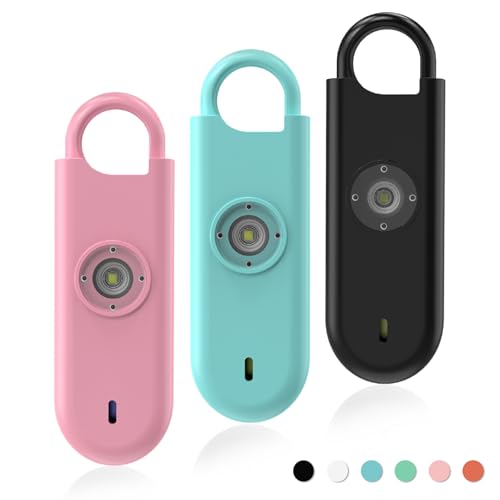
Fauxomor 140 dB Alarm, 3-Pack stands out for including three alarms in one set, so it suits someone who wants one for different bags or household members. The maker says pulling the top pin activates the siren and strobe, while reinserting it turns them off; the maker also gives the siren a 140 dB rating and describes a low-battery warning. Each alarm measures 3.66 inches long and weighs about 0.18 pound. The limitation is that this is not the rechargeable option here, so choose another model if USB charging is a priority.
Bottom line: Choose this set if you want several alarms to keep in different carry spots.
She’s Birdie 3.0

She’s Birdie 3.0 uses a pull-ring control and is designed as a reusable single alarm, making it a fit for someone who wants a straightforward activation routine. The maker gives its siren a 130 dB rating and says the alarm pairs it with a flashing strobe; pulling the ring activates it and pushing it deactivates it. Its dimensions are 1.25 by 0.6 by 3.7 inches. Unlike the three-alarm set, it provides one unit, so buyers who want alarms for multiple bags or people should consider a pack instead.
Bottom line: Choose this if a pull-ring control and reusable single alarm suit your routine.
TECKNET Rechargeable Alarm

TECKNET Rechargeable Alarm is the rechargeable choice with a low-battery alert, a useful distinction for someone who prefers charging over keeping replacement batteries on hand. The maker gives the siren a 130 dB rating and says the alarm includes an SOS strobe; it also claims up to 500 days of standby on a charge. The unit measures 3.94 inches tall and weighs 0.06 pound. Its single-alarm format is less suited to buyers equipping several bags, and standby figures are maker claims rather than a guarantee of runtime in every situation.
Bottom line: Choose this if you want a single alarm with rechargeable power and a battery warning.
How to Choose a Personal Alarm
Choose the alarm whose control you can reach and operate quickly, not just the one with the largest printed siren figure. Personal alarms commonly use a pull pin, pull ring, or button; practice activation and shutoff so the control is familiar. Siren ratings in decibels are not directly comparable unless measurement distance and test conditions match, and sound level falls with distance. A 10 dB increase is commonly perceived as roughly twice as loud, but that does not mean an alarm’s real-world effect doubles. If you carry multiple bags, keep an alarm on the one you use most rather than assuming a spare in a drawer will help. Use the rating as one specification, not a promise of deterrence.
Where to Carry and How to Use an Alarm
Carry a personal alarm where one hand can reach it without searching through a packed bag; a key ring, outer pocket or clipped strap can reduce fumbling. Before relying on a new model, identify its activation and stop controls, then test it briefly in an open area away from other people. Sirens can be painfully loud at close range, so avoid holding an active alarm near your ears or another person’s ears. A flashing strobe can also be uncomfortable for people sensitive to bright or flashing light. An alarm is an attention signal, not a substitute for moving toward a safer public place or contacting emergency services when needed.
Personal Alarm Types Compared
Pull-pin and pull-ring alarms are useful when you want a direct mechanical action; button-operated designs can be quicker to access but may require guarding against accidental presses. Rechargeable models avoid routine battery replacement, while battery-powered designs depend on their specific batteries remaining usable. Compare the control and power type before choosing, then keep the alarm accessible and check its readiness periodically. The table summarizes the practical choice by need, rather than treating siren ratings as a guarantee of performance.
| Need | Useful alarm feature | Trade-off to consider |
|---|---|---|
| More than one carry location | Multi-unit set | Keep each unit accessible |
| Recharge instead of replace | Rechargeable battery | Remember to recharge |
| Simple activation | Pull pin or ring | Practice stopping it too |
How to Maintain a Personal Alarm
Check the alarm at regular intervals and after it has been dropped, soaked or left unused for a long time; a short functional check can reveal a loose control or depleted power source. Rechargeable alarms need a charge before extended storage and after a low-battery warning. Battery-powered alarms should be checked according to their maker’s guidance, since battery type and replacement method differ. Avoid storing an alarm where moisture, lint or pressure can obstruct its sound outlet or activation control. Keep it out of reach of young children unless an adult is supervising, because a loud siren can startle and harm hearing at close range.
Frequently Asked Questions
How loud should a personal alarm be?
A higher decibel rating indicates a higher sound-pressure level under the maker’s measurement conditions, but ratings are hard to compare without a test distance. Sound drops as distance increases, so carrying an alarm where you can activate it promptly matters as much as the printed number.
Are rechargeable personal alarms reliable?
Rechargeable alarms can be ready when their batteries have charge, but they still need periodic checks and recharging. Recharge before a trip or long period away from a charger, and pay attention to a low-battery warning if the alarm has one.
Can a personal alarm damage hearing?
A loud siren can cause discomfort or hearing injury when activated close to someone’s ears. Keep the speaker away from your head and other people, and test it briefly outdoors rather than in a small room.
Where should I attach a personal alarm?
Attach it to a key ring, outer pocket or bag strap where your hand can reach it without rummaging. Avoid burying the alarm under items, since access time matters when you need to activate it quickly.
How often should I check a personal alarm?
Check its function and power periodically, and always before relying on it for a trip or a change in routine. Recharge a rechargeable model after its low-battery alert or before extended storage; check battery-powered models using the maker’s guidance.