
Best Phlebotomy Practice Kit With Arm: 3 Compared

The Apprentice Doctor Phlebotomy Practice Arm Kit suits most learners because its 102-piece educational set includes a self-sealing practice arm for basic venipuncture study. Choose IV Practice Arm, Right Arm or Phlebotomy Practice Kit, Left Arm instead if you specifically need a right or left arm, respectively; a practice model is for training, not for drawing blood from a person.
We earn a commission if you buy through links on this page. As an Amazon Associate I earn from qualifying purchases. Products are compared on manufacturer specifications, not hands-on testing.
- Best overall: The Apprentice Doctor Phlebotomy Practice Arm Kit – Includes a self-sealing practice arm and a 102-piece educational set.
- Best for right-arm practice: IV Practice Arm, Right Arm – Models a right arm with basilic and cephalic veins and simulated flashback.
- Best for left-arm practice: Phlebotomy Practice Kit, Left Arm – Models a left arm with basilic and cephalic veins and simulated flashback.
| Product | Best for | Arm side | Vein features | Shop |
|---|---|---|---|---|
| The Apprentice Doctor Phlebotomy Practice Arm Kit | Student skill practice | — | Self-sealing veins | Check Price on Amazon |
| IV Practice Arm, Right Arm | Right arm training | Right | Basilic, cephalic, dorsal | Check Price on Amazon |
| Phlebotomy Practice Kit, Left Arm | Left arm training | Left | Basilic, cephalic, dorsal, MCV | Check Price on Amazon |
Phlebotomy Practice Kits With an Arm
Compare the arm orientation, vein details and stated kit contents to match a model to your training needs.
The Apprentice Doctor Phlebotomy Practice Arm Kit

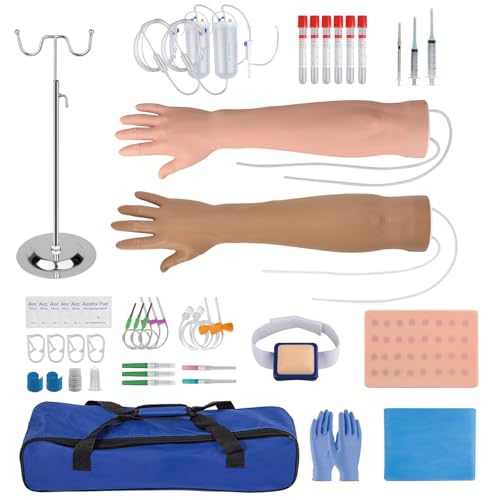
The Apprentice Doctor Phlebotomy Practice Arm Kit is the only option here with a 102-piece educational set, pairing a self-sealing practice arm with simulation components and supplies. The maker says the silicone arm has lifelike skin texture and a visible flashback effect, and the kit includes online learning. That makes it a fit for students or beginners who want a broad practice set for basic venipuncture study. The trade-off is that the arm side and specific vein layout are not identified here, so learners who need a particular side should choose a model that names it.
Bottom line: Choose this set if you want a self-sealing arm and a 102-piece educational kit.
IV Practice Arm, Right Arm

IV Practice Arm, Right Arm is the right arm choice, with modeled basilic and cephalic veins plus palpable dorsal metacarpal veins. Its silicone surface and simulated flashback and catheter insertion are geared toward practicing access techniques, and the hand details include the palm, fingers and joints. Pick it when training specifically calls for a right-side model or attention to hand veins. The trade-off is that the set contents are not itemized here, unlike a competing option with a 102-piece kit, so confirm what supplies are included if you need more than the arm.
Bottom line: Choose this model when right arm orientation is the deciding requirement.
Phlebotomy Practice Kit, Left Arm
Phlebotomy Practice Kit, Left Arm offers a left arm model and names both basilic and cephalic veins, along with dorsal veins and MCV that can be palpated. The maker says its silicone surface simulates flashback and catheter insertion, while hand details include the metacarpal area, palm and fingers. This is the more suitable pick when learners need left-side practice or want to work on locating the named hand veins. Its contents are not itemized here, so it may be less suitable than a set with a piece count for buyers prioritizing a defined bundle of supplies.
Bottom line: Choose this model when left arm practice and palpable hand veins matter most.
How to Choose a Phlebotomy Practice Arm
Choose by the skill you need to rehearse: arm-side orientation, vein palpation, or a broader educational set. IV Practice Arm, Right Arm models a right arm, Phlebotomy Practice Kit, Left Arm a left arm, and The Apprentice Doctor Phlebotomy Practice Arm Kit specifies a 102-piece set with a self-sealing arm. A simulation model can help practice hand position and needle approach, but it cannot reproduce every patient’s vein depth, mobility or anatomy. Training labs commonly use task trainers alongside instructor demonstration and supervised practice, rather than treating a model as proof of clinical competency. Before selecting, decide whether your course requires a particular side or named vein landmarks; those requirements are more useful than a general claim of realism.
What Simulated Flashback and Self-Sealing Veins Mean
Simulated flashback is a visual cue intended to represent blood entering a needle or tubing during a training scenario; it is not real blood or evidence that a technique is safe for patients. Self-sealing veins are designed to close after puncture, but repeated use can still wear the puncture area and reduce realism. Follow the model’s care guidance and rotate puncture sites rather than repeatedly using one spot. Needle gauge and collection equipment depend on the training objective, so a practice arm does not determine clinical equipment choices. This table summarizes the practical differences that are clear from the models’ stated features.
| Training need | Model feature to prioritize | Choice |
|---|---|---|
| Right-side landmarks | Right arm, named basilic and cephalic veins | IV Practice Arm, Right Arm |
| Left-side landmarks | Left arm, named basilic and cephalic veins | Phlebotomy Practice Kit, Left Arm |
| Broader practice set | Self-sealing arm and 102-piece educational kit | The Apprentice Doctor Phlebotomy Practice Arm Kit |
Safe Use of Phlebotomy Training Equipment
Use practice arms only in a training setting; never insert a needle into a person based on practice with a model alone. Needles and other sharps belong in an approved sharps container immediately after use, not loose on a work surface or in regular trash. Training programs should teach hand hygiene, appropriate gloves, and a no-recapping approach for used needles as part of standard precautions. Treat any simulation fluid as a training material and clean spills according to the equipment’s care guidance. If the practice arm is shared, clean it between users and keep needles, tubing and fluid components organized to reduce accidental punctures and contamination.
Frequently Asked Questions
Can a phlebotomy practice arm replace supervised training?
No; a practice arm helps rehearse hand position and simulated access, but it cannot reproduce patient anatomy or replace instructor supervision. Use it as a training aid before supervised clinical practice.
What is simulated flashback on a practice arm?
Simulated flashback is a visual training cue that represents blood return during needle placement. It uses a model’s simulation system, not real blood, and does not confirm clinical competence.
How should used needles from practice be discarded?
Put used needles directly into an approved sharps container without recapping them. Keep the container close to the practice station so sharps are not carried loose across a room.
Why does a practice arm’s left or right side matter?
Arm side matters when a course or exercise requires practice on a particular orientation or vein landmark. Choose a model that identifies the required side rather than assuming the arm can be switched.