
Best Pop Up Sprinkler Heads for Lawn Coverage

Rain Bird 1804VAN 4-Inch Spray Head suits most lawns because its adjustable 0–360-degree arc and spray reach up to 15 feet make it easier to match coverage to edges and corners. Choose Hunter PGP-ADJ 4-Inch Rotor instead for larger open areas that need a rotor’s longer reach, or Rain Bird 1804LN 4-Inch Body if you want to select a compatible nozzle separately.
Pop-up sprinkler heads retract below grade when off; spray heads distribute water in a fixed pattern, while rotors rotate a stream across a larger area.
We earn a commission if you buy through links on this page. As an Amazon Associate I earn from qualifying purchases. Products are compared on manufacturer specifications, not hands-on testing.
- Best overall: Rain Bird 1804VAN 4-Inch Spray Head – Its adjustable full-circle arc and reach up to 15 feet suit varied lawn edges and beds.
- Best for large lawns: Hunter PGP-ADJ 4-Inch Rotor – The gear-drive rotor reaches approximately 22 to 52 feet.
- Best for custom setups: Rain Bird 1804LN 4-Inch Body – The nozzle-free body lets you choose a compatible Rain Bird 1800 Series nozzle.
| Product | Best for | Type | Coverage | Shop |
|---|---|---|---|---|
| Rain Bird 1804VAN 4-Inch Spray Head | Adjustable lawn edges | Spray head | Up to 15 ft | Check Price on Amazon |
| Hunter PGP-ADJ 4-Inch Rotor | Broad open lawns | Gear-drive rotor | Approximately 22–52 ft | Check Price on Amazon |
| Rain Bird 1804LN 4-Inch Body | Nozzle customization | Sprinkler body, no nozzle | Depends on selected nozzle | Check Price on Amazon |
Best Pop Up Sprinkler Heads
Choose by area size, spray pattern and whether you want a nozzle included.
Rain Bird 1804VAN 4-Inch Spray Head

Rain Bird 1804VAN 4-Inch Spray Head stands out for its variable arc, which adjusts from 0 to 360 degrees for coverage ranging from a narrow edge to a full circle. The four-pack includes 4-inch pop-up heads, fixed-spray variable-arc nozzles and 1/2-inch female threaded inlets. Rain Bird says the spray distance reaches up to 15 feet. The textured adjustment collar is designed for hand adjustment, useful when shaping a watering zone around sidewalks or beds. Its shorter reach is a limitation for broad open lawns; those areas may call for a rotor instead.
Bottom line: Choose this for small to medium zones where adjustable arcs matter more than long reach.
Hunter PGP-ADJ 4-Inch Rotor

Hunter PGP-ADJ 4-Inch Rotor differs from the spray heads by using a gear-driven rotor to sweep water across a wider area. The two-pack has a 4-inch pop-up, a preinstalled 3.0 GPM nozzle and an adjustable 40–360-degree arc. Hunter gives an approximate spray distance of 22 to 52 feet; optional nozzles are sold separately for further adjustment. This longer throw can reduce the number of heads needed in an open lawn, but the rotor’s minimum reach is already beyond what many narrow strips or small beds need. Its 3/4-inch inlet also differs from the 1/2-inch inlets on the Rain Bird bodies.
Bottom line: Choose this for open areas that need a longer throw and adjustable rotor arc.
Rain Bird 1804LN 4-Inch Body
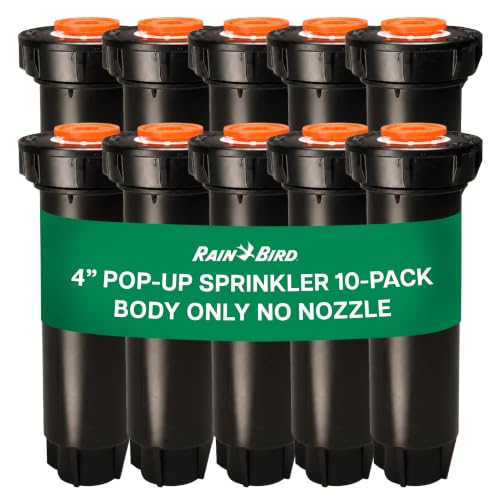
Rain Bird 1804LN 4-Inch Body is a body-only option, unlike the other products, which include a nozzle. The 10-pack has 4-inch pop-up bodies with 1/2-inch female NPT threaded inlets, mesh filter screens and stainless-steel springs. Rain Bird says the design includes a pressure-activated wiper seal and supports quick nozzle changes without tools. This format suits an existing Rain Bird 1800 Series setup or a project where nozzle choice is deliberate. It is not ready to spray on its own: buyers who need a complete head should choose a nozzle-included option or obtain compatible nozzles separately.
Bottom line: Choose this when you want body replacements and will select compatible nozzles.
How to Choose Pop Up Sprinkler Heads
Choose spray heads for short, shaped zones and rotors for larger open areas. Spray-head patterns commonly cover about 5 to 15 feet, while rotors often serve roughly 15 to 50 feet or more; actual reach depends on nozzle and operating conditions. Set head spacing so each head reaches the neighboring head, a layout called head-to-head coverage. That overlap helps limit dry gaps when wind or pressure changes distribution. For a strip narrower than a spray head’s reach, use an adjustable arc or a nozzle designed for the strip rather than aiming a full circle at pavement. Also match the threaded inlet to the irrigation fitting already installed; 1/2-inch and 3/4-inch connections are not interchangeable without a suitable fitting.
Spray Heads and Rotors Compared
Spray heads water a fixed area, while rotors rotate a stream across a broader arc. The choice usually follows zone size and shape: shorter-throw spray heads suit smaller zones, and longer-throw rotors suit broad lawns. Compare reach and water application rate before placing different head types on the same valve zone; spray heads and rotors commonly apply water at different rates, so mixed zones can water unevenly if run for one shared duration.
The table summarizes the main choice by area and setup:
| Type | Typical use | Planning consideration |
|---|---|---|
| Fixed spray | Small areas and shaped edges | Shorter reach; match head spacing to nozzle throw |
| Gear-drive rotor | Broad open lawn | Longer reach; plan for rotation and arc |
| Body without nozzle | Custom replacement or build | Requires a compatible nozzle |
Under 4 feet of available clearance around a small bed, avoid choosing a rotor solely for its maximum reach; select a pattern that can be contained within the zone.
Pop-Up Height and Lawn Fit
A 4-inch pop-up is a common choice for ordinary turf, but grass height and thatch can obstruct spray if the stem rises too little above the finished soil. Common pop-up options include 2, 4, 6 and 12 inches; choose a taller body where dense groundcover or a raised planting bed would block a shorter stem. The retracted height is not the same as the exposed pop-up rise, so confirm the needed clearance against the actual planting and mowing conditions. Set the body upright and keep its top near grade: a head buried too deep can be blocked by soil, while one left too high can catch a mower or foot traffic.
Installation and Seasonal Care
Flush a new irrigation line before installing nozzles so construction grit does not clog small spray openings. A clogged nozzle can create a dry patch or uneven spray; clean the nozzle and filter screen rather than enlarging an opening with a pin. Keep spray heads vertical and avoid covering their tops with mulch. In freezing climates, drain or blow out irrigation lines before hard freezes; trapped water can expand and crack heads or fittings. Use regulated compressed air only within the system maker’s pressure limit, because excessive air pressure can damage components. At spring startup, inspect each zone for tilted heads, leaks and blocked spray before adjusting arc or run time.
Frequently Asked Questions
How far apart should pop up sprinkler heads be installed?
Space heads so each one reaches the neighboring head, known as head-to-head coverage. For a spray pattern reaching 15 feet, that generally means spacing no wider than the pattern’s effective reach; wind and pressure can reduce it.
Are spray heads and rotor heads interchangeable?
They can sometimes share an irrigation system, but they should generally be separated into zones because their application rates differ. A spray head uses a fixed pattern, while a rotor sweeps a stream across its arc.
What pop-up height works for ordinary lawn grass?
A 4-inch pop-up is a common turf choice, provided the spray clears the grass. Dense or taller planting may need a 6-inch or taller body to avoid blockage.
Why does a pop-up sprinkler head fail to retract?
Dirt around the stem, a damaged seal or a bent body can prevent retraction. Rinse away soil and check that the body is vertical; replace a damaged head rather than forcing the stem down.
Should sprinkler heads be winterized before freezing weather?
Yes, in climates where irrigation lines can freeze, drain or properly blow out the system before hard freezes. Water left in a head or pipe can expand and crack components; keep compressed air within the system maker’s pressure limit.