
Best Rotator Cuff Brace: 3 Supports Compared

The Sparthos Rotator Cuff Shoulder Brace is the best rotator cuff brace for most people seeking adjustable compression, because it is designed for mild to moderate discomfort without severe immobilization.
Rotator cuff braces range from compression supports that allow movement to slings that hold the arm close to the body. Match the support level to your clinician’s plan, especially after surgery or a dislocation.
We earn a commission if you buy through links on this page. As an Amazon Associate I earn from qualifying purchases. Products are compared on manufacturer specifications, not hands-on testing.
- Best overall: Sparthos Rotator Cuff Shoulder Brace – Adjustable chest and arm straps provide compression and moderate stabilization while allowing movement.
- Best for stronger support: FIGHTECH Rotator Cuff Shoulder Brace – The maker describes medium-to-strong support from constant shoulder pressure.
- Best for neoprene construction: Komoko Neoprene Shoulder Brace – Neoprene and reinforced stitching are identified as core materials.
| Product | Best for | Support style | Fit | Shop |
|---|---|---|---|---|
| Sparthos Rotator Cuff Shoulder Brace | Adjustable compression | Compression sleeve | Universal | Check Price on Amazon |
| FIGHTECH Rotator Cuff Shoulder Brace | Firm shoulder support | Compression wrap | Large/X-Large; bicep 12–17 in | Check Price on Amazon |
| Komoko Neoprene Shoulder Brace | Neoprene support | Compression sleeve | Adjustable; left or right arm | Check Price on Amazon |
Rotator cuff braces
Compare support level and fit before choosing a brace for everyday movement or a period of restricted motion.
Sparthos Rotator Cuff Shoulder Brace

Unlike a sling that holds the arm close to the torso, this brace uses compression and adjustable chest and arm straps while allowing movement. The maker says it is intended for mild to moderate shoulder pain and offers moderate stabilization, including support associated with rotator cuff injuries and AC joint discomfort. Its universal fit may suit someone who wants adjustable support rather than a fixed-size garment. The key limitation is explicit: this brace is not intended for severe immobilization, so it is not the choice when an arm must be kept still after a serious injury or procedure.
Bottom line: Choose this for adjustable compression when you still need shoulder movement.
FIGHTECH Rotator Cuff Shoulder Brace

This wrap is distinguished by its medium-to-strong support and a broad adjustable design, rather than the moderate stabilization described for a lighter compression sleeve. The maker says constant pressure is intended to support the shoulder and discourage overextension; the product is offered in four sizes, and this Large/X-Large version gives a bicep range of 12–17 inches. That range makes measuring important before selection. The variant’s fit may not work for arms outside that bicep span, and the maker’s recovery language should not substitute for medical advice.
Bottom line: Pick this if its 12–17-inch bicep range fits and you want firmer wrap support.
Komoko Neoprene Shoulder Brace
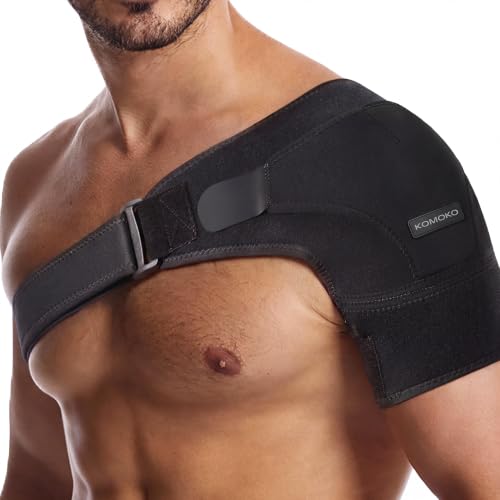
Neoprene construction sets this brace apart from the other exact-fit supports, and its adjustable design fits either the left or right arm. The maker describes it as a shoulder compression sleeve intended to support the joint while preserving mobility, with use cases including rotator cuff and AC joint discomfort. Neoprene and precision stitching are also identified as construction features.
Bottom line: Choose this if you want an adjustable neoprene sleeve for either arm.
How to choose a rotator cuff brace
Choose by how much movement needs to remain possible: compression sleeves support the shoulder while permitting motion, while immobilizing slings secure the arm against the body. For mild discomfort where movement is still appropriate, a sleeve with adjustable straps can be easier to tailor; for post-injury immobilization, use a sling only when advised by a clinician. A brace cannot diagnose a tear or determine whether movement is safe. Shoulder pain after a fall, visible deformity, new numbness, or sudden weakness calls for prompt medical assessment rather than relying on a brace alone.
Check two fit points before choosing: the arm circumference or bicep range and the strap path around the chest. A loose brace may shift, while an overly tight brace can cause numbness, tingling, color change, or increased pain; loosen it and seek medical guidance if those occur.
Compression sleeves versus shoulder slings
Compression sleeves are the better match when support with some shoulder motion is the goal; slings are designed to hold the arm close to the body. The distinction matters more than the word “brace” in a product name. A sling with a waist strap can limit swinging, but it also restricts ordinary arm use; a wrap or sleeve is not equivalent to immobilization. Use a sling for the period and position recommended by a clinician, because prolonged immobilization can contribute to stiffness.
This table compares the practical role of each support type.
| Support type | Movement | Best matched need |
|---|---|---|
| Compression sleeve or wrap | Some movement remains | Support during permitted daily activity |
| Arm sling | Arm held close to torso | Temporary restriction when directed |
Do not use a flexible sleeve as a substitute for immobilization when a clinician has told you to keep the shoulder still.
How to size a shoulder brace
Measure the body area named in the size chart rather than choosing by shirt size. Shoulder supports may use bicep circumference, underbust measurement, forearm length, or a combination; those measurements are not interchangeable. For example, a bicep range only helps if measured at the same location the maker specifies. If your measurement falls between sizes, check the maker’s size guidance and account for whether the brace must fit over clothing.
Fit should feel secure without restricting circulation. After putting a brace on, check that fingers remain warm and normally colored and that there is no new tingling or numbness. Confirm the lift or immobilization range with a clinician when a brace is intended for post-operative use.
Safe use and care for shoulder braces
A shoulder brace should not increase pain, numbness, tingling, or visible swelling; remove or loosen it and get medical advice if those symptoms appear. Skin under a brace can become irritated, particularly when straps rub or sweat remains trapped, so check the skin after removal and keep the garment clean and fully dry before reuse. Neoprene can retain heat, making breaks and skin checks especially useful during longer wear.
Do not sleep in a support unless the product permits it and your clinician agrees; sleeping position can press straps against the neck or shoulder. Following shoulder surgery or a dislocation, the treating clinician should set wear duration and permitted movement, since a brace’s general support claims cannot establish a safe rehabilitation schedule.
Frequently Asked Questions
Can a shoulder brace heal a rotator cuff tear?
A brace can provide support but cannot repair a torn tendon. New weakness or pain after an injury warrants clinical assessment, since treatment depends on the tear and shoulder function.
Can I sleep in a rotator cuff brace?
Only sleep in one if its design permits it and a clinician agrees. Straps can shift or press on the neck and shoulder during sleep, so stop if numbness or tingling develops.
How tight should a shoulder compression brace feel?
A compression brace should feel secure without causing numbness, tingling, increased pain, or changes in finger color or temperature. Loosen or remove it if any of those signs appear.
Should a shoulder brace be worn all day?
Wear duration depends on the support type and the reason for using it; post-operative or dislocation care needs a clinician-set schedule. Take it off for a skin check if irritation or pressure develops.
How do I measure for a shoulder support brace?
Use the measurement the maker’s chart requests, such as bicep circumference or underbust, rather than relying on clothing size. Measure at the chart’s specified location and compare the result with its range.