
Best Saddle Leather Conditioner: 5 Options Compared

Farnam Leather New Deep-Conditioner, 16 oz is the best fit for most saddle owners because it is made for saddles and leather tack and is intended for deep conditioning. Choose Farnam Leather New Glycerine Cleaner, 32 oz if you want a glycerine cleaner that also conditions, or Feilove Saddle Soap Kit, 3.52 oz if cleaning and the included brush and cloth matter more than a dedicated restorer.
Saddle leather conditioner replenishes moisture in leather; it is different from a cleaner, which is meant to remove dirt and grime.
We earn a commission if you buy through links on this page. As an Amazon Associate I earn from qualifying purchases. Products are compared on manufacturer specifications, not hands-on testing.
- Best overall: Farnam Leather New Deep-Conditioner, 16 oz – A saddle- and tack-focused deep conditioner in a 16-ounce bottle.
- Best for cleaning and conditioning: Farnam Leather New Glycerine Cleaner, 32 oz – A glycerine saddle and leather cleaner that also moisturizes and protects against moisture.
- Best for avoiding darkening: Bickmore Bick 4 Conditioner, 8 oz – Bickmore says its 8-ounce formula will not darken leather.
| Product | Best for | Product type | Size | Notable feature | Shop |
|---|---|---|---|---|---|
| Farnam Leather New Deep-Conditioner, 16 oz | Deep conditioning | Deep conditioner | 16 oz | Moisture protection | Check Price on Amazon |
| Farnam Leather New Glycerine Cleaner, 32 oz | Routine tack care | Glycerine cleaner-conditioner | 32 oz | Moisture protection | Check Price on Amazon |
| Bickmore Bick 4 Conditioner, 8 oz | Color-conscious care | Conditioner and cleaner | 8 oz | Will not darken leather | Check Price on Amazon |
| Leather CPR Cleaner and Conditioner, 18 oz | One-step upkeep | Cleaner and conditioner | 18 oz | Water-based | Check Price on Amazon |
| Feilove Saddle Soap Kit, 3.52 oz | Cleaning with tools | Saddle soap kit | 3.52 oz | Brush and cloth included | Check Price on Amazon |
Saddle Leather Conditioners Compared
Choose based on whether you need a dedicated conditioner, a cleaner-conditioner, or a saddle soap kit.
Farnam Leather New Deep-Conditioner, 16 oz

Unlike the cleaner-conditioner options, this Farnam formula is specifically a deep conditioner and restorer for saddles and leather tack. Farnam says it penetrates to moisturize and restore softness and pliability, and that it protects against moisture. The 16-ounce size suits owners who want a dedicated conditioning product rather than an all-in-one cleaner. Its limitation is that it is not presented as a cleaner, so remove surface dirt before conditioning; dirt left on leather can be rubbed into the surface during application.
Bottom line: Choose this if your priority is dedicated conditioning for saddles and tack.
Farnam Leather New Glycerine Cleaner, 32 oz
This 32-ounce glycerine formula combines saddle cleaning with conditioning, unlike the dedicated deep restorer. Farnam says it restores softness and pliability, moisturizes, and protects against moisture; the formula contains no silicones, waxes, or petroleum distillate. The larger bottle is a fit for owners who want a multipurpose tack-care product and clean as part of maintenance. Its limitation is the combined cleaner-conditioner role: buyers seeking a dedicated deep conditioner rather than a product for regular cleaning may prefer the separate Farnam restorer.
Bottom line: Choose this for a larger cleaner-conditioner suited to regular saddle and tack care.
Bickmore Bick 4 Conditioner, 8 oz

Bick 4 stands out for its claim that it will not darken leather, a consideration for light-colored tack or anyone who wants to preserve the shade of leather. Bickmore says the formula cleans, polishes, and protects and can be used on saddles and tack as well as footwear, furniture, and other leather goods. The 8-ounce bottle is smaller than the Farnam options. Its broad-use formula is less saddle-specific than a product explicitly centered on conditioning saddles, so choose it when color preservation is the main deciding factor.
Bottom line: Choose this when avoiding a change in leather shade is your main concern.
Leather CPR Cleaner and Conditioner, 18 oz

Leather CPR combines cleaning and conditioning in one step and is presented for real leather across home, vehicle, clothing, and saddle uses. The 18-ounce bottle sits between the smaller Bick 4 and larger Farnam cleaner-conditioner by volume. Leather CPR says its water-based formula lifts dirt and oils while replenishing moisture, without a greasy film or sticky residue. Its broad household and automotive focus makes it less specialized for tack than the Farnam saddle products; it suits buyers looking for a multi-use formula that also lists saddles among its uses.
Bottom line: Choose this for a multi-use cleaner-conditioner that includes saddle leather.
Feilove Saddle Soap Kit, 3.52 oz
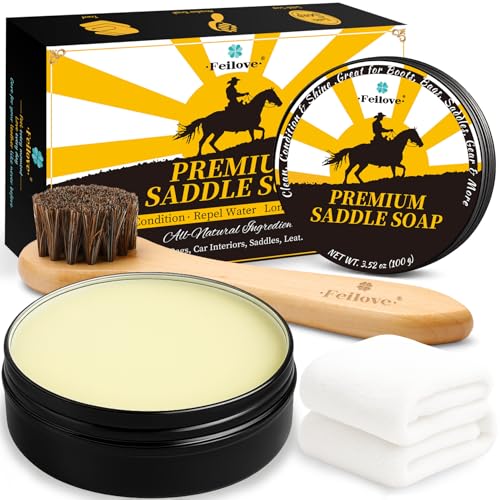
Feilove is the only kit here that includes a horsehair brush and cloth alongside the saddle soap, making it the pick for buyers who want cleaning tools with their leather-care product. Its formula includes Castile soap, glycerin, lanolin, and beeswax, and Feilove says it cleans while helping maintain flexibility and softness and leaves a light moisture-repelling barrier. The soap quantity is 3.52 ounces, far less than the bottled conditioners. Because it is primarily a cleaning kit, it may not suit someone seeking a dedicated deep-conditioning product.
Bottom line: Choose this if you want saddle soap and basic cleaning tools together.
How to Choose Saddle Leather Conditioner
Choose by the job: a dedicated conditioner is for replenishing moisture, while a cleaner-conditioner combines dirt removal with conditioning. Saddle-specific products such as the Farnam options make the intended tack use clear; broad-use formulas can also suit saddles when their uses include tack. Decide whether avoiding color change matters, and whether a brush or cloth is useful. A practical rule: if the saddle has visible dirt, clean it first rather than rubbing conditioner over grit. If it is clean but feels dry, choose a conditioner rather than paying attention only to cleaning claims. For routine care, use a small amount first and assess the leather before applying more; excess product can leave a surface residue.
Conditioner, Cleaner, and Saddle Soap Differences
A conditioner replenishes moisture, a cleaner targets dirt, and some formulas combine both jobs; saddle soap is primarily a cleaner. The distinction matters because a cleaner alone may not meet a need for deeper conditioning, while a conditioner is not a substitute for removing grit first. A glycerine cleaner-conditioner can suit regular maintenance when cleaning and moisturizing are both priorities. A deep conditioner is a more direct choice when the leather is already clean. The table compares the product types by purpose, not by performance: select the row that matches the saddle’s condition and the care task you need to do.
| Care type | Primary job | Choose when |
|---|---|---|
| Dedicated conditioner | Moisturize leather | Leather is clean and needs conditioning |
| Cleaner-conditioner | Clean and moisturize | You want both steps in one formula |
| Saddle soap | Clean leather | Dirt removal and cleaning tools are priorities |
How to Apply Conditioner to Saddle Leather
Apply saddle conditioner to clean, dry leather in a thin, even layer, and start with a small test area in an inconspicuous spot. A test patch helps reveal a change in shade or finish before treating a larger panel; even formulas marketed as non-darkening should be checked on the specific saddle. Keep product off hardware and surfaces where a slick finish would be undesirable, and wipe away excess rather than allowing a thick film to remain. Avoid saturating seams or stitching. Tack supports a rider’s weight, so inspect leather, stitching, billets, and straps for cracking or damage before use; conditioner cannot repair a weakened load-bearing part.
How Often to Condition Saddle Leather
Conditioning frequency depends on use, storage, and dryness rather than a fixed calendar interval. The Farnam products recommend use every few months, but that is their care guidance, not a universal schedule for every saddle or climate. Check tack regularly: frequent riding, sweat, dust, and dry storage can mean more cleaning, while over-conditioning can leave leather soft or coated. Clean dirt after use and let damp tack dry naturally away from direct heat before conditioning. Heat can dry and stiffen leather, and conditioning wet leather can interfere with even product absorption. Use the minimum amount that meets the leather’s needs, then reassess its feel and surface before repeating.
Frequently Asked Questions
Can saddle conditioner darken leather?
Some formulas can change the appearance of leather, so test a hidden area first. Bickmore says Bick 4 will not darken leather, but a patch test remains a sensible check on a particular saddle.
Should I clean a saddle before conditioning it?
Yes, remove surface dirt first so grit is not rubbed into the leather. Let damp leather dry naturally before applying conditioner, and avoid direct heat that can dry or stiffen it.
How often should I condition leather tack?
Farnam recommends its Leather New products every few months, but use and storage affect the interval. Check the leather routinely and avoid repeated applications when it already feels supple or has a surface film.
Can I use saddle soap as a conditioner?
Saddle soap is primarily a cleaner, though some formulas also help maintain softness. If the leather is clean but needs deeper moisture replenishment, choose a dedicated conditioner rather than relying on soap alone.
Is it safe to ride after conditioning a saddle?
Check that the leather is dry and not slick before riding. Inspect billets, straps, stitching, and other load-bearing areas, because conditioner cannot restore strength to cracked or damaged tack.