
Best Scissors for Cutting Cardboard: 5 Picks Compared

Stedi JD-11 9-Inch Shears suits most people cutting cardboard because its 9-inch finely serrated blades are designed for corrugated sheets and thick paper. Choose WORX ZipSnip WX082L.2 instead for powered cutting with less hand strain; for occasional cuts on single sheets, a manual pair may be simpler to control.
We earn a commission if you buy through links on this page. As an Amazon Associate I earn from qualifying purchases. Products are compared on manufacturer specifications, not hands-on testing.
- Best overall: Stedi JD-11 9-Inch Shears – Its 9-inch blades have fine serrations and are specifically intended for cardboard.
- Best for powered cutting: WORX ZipSnip WX082L.2 – The cordless electric cutter is designed to cut cardboard with less hand strain.
- Best for household tasks: BoFuYuan 8-Inch Utility Scissors – Its 8-inch utility design includes wire-cutting and stripping slots.
| Product | Best for | Length | Blade or cutting design | Power | Shop |
|---|---|---|---|---|---|
| Stedi JD-11 9-Inch Shears | Corrugated sheets | 9 in | Finely serrated | Manual | Check Price on Amazon |
| WORX ZipSnip WX082L.2 | Powered cutting | 8.5 in | Rotating blade | Cordless electric | Check Price on Amazon |
| BoFuYuan 8-Inch Utility Scissors | Mixed household use | 8 in | Serrated | Manual | Check Price on Amazon |
| Muzziz Heavy-Duty Utility Scissors | General utility cuts | 8.2 in | Small serrations | Manual | Check Price on Amazon |
| RooPro 8.5-Inch Utility Scissors | Comfort grip | 8.5 in | Sharp blades | Manual | Check Price on Amazon |
Scissors for cutting cardboard
Match blade engagement and tool style to the cardboard thickness and amount of cutting you expect to do.
Stedi JD-11 9-Inch Shears
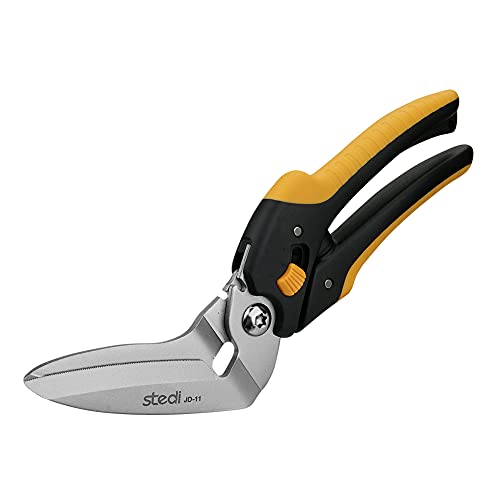
Stedi JD-11 9-Inch Shears is the longest manual pair here, with 9-inch finely serrated blades intended for cardboard and thick paper. The maker says its 420J2 stainless steel blades are hardened and angled at 45 degrees, and that a spring helps reduce the pressure needed during cutting. That combination makes it a sensible choice for repeated cuts through corrugated sheets. Its larger size may be less convenient for small, intricate trimming than a shorter pair; choose a compact option if precise detail work matters more than reach.
Bottom line: Choose these for longer cuts through corrugated cardboard by hand.
WORX ZipSnip WX082L.2

WORX ZipSnip WX082L.2 stands apart as a cordless electric cutter rather than a hand-operated scissor. It uses a rotating blade and includes two safety cutting blades, a replacement blade, and a storage case. The maker says its powered action can cut tougher material with less hand strain than manual scissors, which may matter when a project involves many cuts. The tool is heavier than the manual pairs at about 0.86 lb, so a hand-powered pair may suit fine, controlled trimming better.
Bottom line: Pick this for repeated cuts when powered assistance matters more than scissor-style control.
BoFuYuan 8-Inch Utility Scissors

BoFuYuan 8-Inch Utility Scissors combines an 8-inch serrated blade design with household and workshop functions beyond cardboard cutting. The maker says it can cut hard packaging and cardboard, and the handles incorporate wire-cutting and wire-stripping slots plus a nutcracker function. That makes it a fit for someone who wants one utility tool for varied chores, not only box breakdown. The feature-packed design is less specialized for cardboard than a longer pair explicitly built around corrugated material.
Bottom line: Choose these for mixed household cutting tasks that include cardboard.
Muzziz Heavy-Duty Utility Scissors

Muzziz Heavy-Duty Utility Scissors pairs small blade serrations with a metal handle, giving it a straightforward utility-shear profile. The maker says the serrations grip tough materials including cardboard, carpet, leather, and rope, while the oversized handle is designed for a secure hold. The 8.2-inch length places it between the shorter utility pair and the 9-inch model. The product is presented for broad tasks rather than specifically optimized corrugated cutting, so choose a more cardboard-focused pair if that is your main job.
Bottom line: Pick these for general household or workshop cuts across several materials.
RooPro 8.5-Inch Utility Scissors

RooPro 8.5-Inch Utility Scissors uses thick stainless steel blades with an aluminum-alloy handle, making its handle material the clearest distinction from the other manual options. The maker says the scissors are suited to cardboard, carpet, leather, rope, rubber, and plastic packaging, and describes the grip as non-slip for longer tasks. At 8.5 inches, it offers a middle length among the manual shears here. No serrated edge is identified, so buyers prioritizing blade grip on corrugated layers may prefer a pair with serrations.
Bottom line: Choose these when an aluminum-alloy handle and broad utility use are priorities.
How to choose scissors for cardboard
For cardboard, prioritize blade grip and comfortable control over a long list of unrelated functions. Corrugated board contains a wavy inner layer between flat liners, so the blade must stay engaged as it crosses alternating layers. Serrations can help grip material rather than push it away; longer blades can cover more distance per stroke, but they are less handy for tight curves. Choose a manual serrated pair for occasional sheets, and consider a powered rotary cutter when repeated cutting causes hand strain. For clean, short cuts on a single thin panel, a standard sharp pair may be enough. Avoid trying to cut a thick stack at once: separate the layers so the blades do not twist or bind.
Cardboard thickness and cutting approach
Cutting one layer at a time is the reliable rule when the board starts to resist or buckle. Corrugated board is sold in different flute profiles and wall constructions; a single-wall panel and a multiwall shipping panel do not present the same resistance. Product specs here do not identify a maximum board thickness, so confirm cutting capacity before choosing a tool for unusually thick or laminated board. For a large box, flatten it and work along accessible seams rather than forcing closed scissors through folded corners. A practical decision rule is to switch methods if the handles cannot close through the board without extra force: score or separate the material instead of twisting the blades.
Manual shears versus a cordless cutter
Manual shears offer direct control, while a cordless cutter supplies powered blade motion. Serrated manual blades are useful when cardboard edges tend to slip; the electric model here uses a rotating blade and is presented for reducing hand strain on tougher material. Manual models are simpler for short cuts and small notches, while powered cutting can suit longer repeated work. Neither tool should be treated as a substitute for a dedicated box cutter in every situation.
| Cutting need | Tool style | Why |
|---|---|---|
| Occasional flat sheets | Manual shears | Direct control for short cuts |
| Corrugated material that slips | Serrated shears | Blade texture can help maintain engagement |
| Many repetitive cuts | Cordless cutter | Powered motion can reduce hand effort |
Use the choice that matches the task, not just the tool with the most functions.
Safe cardboard cutting and blade care
Keep hands and fingers outside the blade path, and cut away from your body; scissor points and powered cutting blades can cause serious injury. Stabilize a flattened panel on a clear work surface instead of holding a small piece near the blades. Do not use utility scissors’ wire slots on cardboard, and do not force a blade through a jam. Cardboard fibers and adhesive can collect at the pivot and blade edges, so brush away debris and wipe the blades dry after use. If the cutting action becomes rough, inspect the pivot and edge before continuing; a damaged or loose cutting tool is harder to control.
Frequently Asked Questions
Are serrated scissors better for corrugated cardboard?
Serrations can help a blade grip corrugated layers instead of sliding across them. They are a useful feature when cardboard slips under smooth blades, though they do not remove the need to avoid forcing a thick stack.
Can regular household scissors cut cardboard?
Sharp household scissors can handle thin cardboard and short cuts, but corrugated board puts more resistance on the blades. For recurring cuts or thicker panels, choose a robust pair with serrations or use a powered cutter suited to the job.
How do I cut a large cardboard box safely?
Flatten the box first and cut along an accessible seam on a clear, stable surface. Keep your other hand outside the cutting path and direct the cut away from your body.
Should I cut several cardboard layers at once?
Separate layers when the blades begin to buckle the board or need extra force to close. Cutting a single layer at a time reduces binding and twisting, especially at folded corners.