
Best Scratch Proof Reading Glasses: 4 Picks Compared

Reader Republic’s 4-pack is the best fit for most people seeking scratch-resistant reading glasses because it combines +2.50 magnification with scratch-resistant lenses. Choose a different option if you need +2.00 or +1.50 strength, a six-pair pack, or a particular frame style.
We earn a commission if you buy through links on this page. As an Amazon Associate I earn from qualifying purchases. Products are compared on manufacturer specifications, not hands-on testing.
- Best overall: Reader Republic Blue Light Readers +2.50 – Four pairs, +2.50 magnification and scratch-resistant lenses suit readers who want a matching set.
- Best for +2.00 strength: OPULIZE PEP Readers +2.00, 6-Pack – The six-pair pack combines scratch-resistant lenses with a rectangular frame and spring hinges.
- Best for oversized frames: Oversized Square Readers +1.50, 4-Pack – The four-pack uses an oversized square frame and +1.50 magnification.
| Product | Best for | Magnification | Pack size | Frame or hinge | Shop |
|---|---|---|---|---|---|
| Reader Republic Blue Light Readers +2.50 | +2.50 readers | +2.50 | 4 pairs | Spring hinge | Check Price on Amazon |
| Blue Light Spring Hinge Readers +2.50 | Multicolor options | +2.50 | 5 pairs | Resin spring hinge | Check Price on Amazon |
| OPULIZE PEP Readers +2.00, 6-Pack | +2.00 strength | +2.00 | 6 pairs | Spring hinges | Check Price on Amazon |
| Oversized Square Readers +1.50, 4-Pack | Oversized square frames | +1.50 | 4 pairs | Spring hinges | Check Price on Amazon |
Scratch-resistant reading glasses compared
Compare the magnification, pack size and frame features before choosing a pair for close-up reading.
Reader Republic Blue Light Readers +2.50
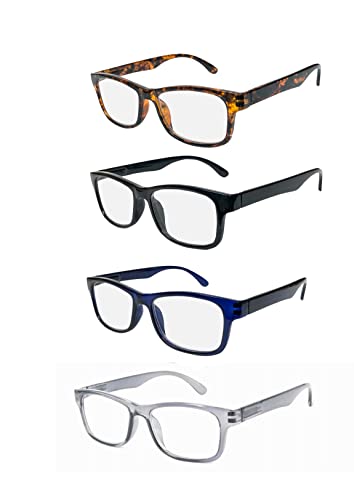
Reader Republic pairs +2.50 magnification with scratch-resistant lenses and blue light-blocking lenses, setting this multipack apart from the lower-strength choices. The four pairs come in black, charcoal and tortoise shell color options, and the flexible spring hinge is intended to accommodate movement at the temples. The maker says the lenses have no color difference and can be used indoors or outdoors. This option suits someone who needs +2.50 and wants matching-strength spares; it is a poor fit if you need another diopter strength or a single pair.
Bottom line: Choose this set if +2.50 is your needed strength and you want four pairs.
Blue Light Spring Hinge Readers +2.50

The five-pair assortment offers one more pair than the four-pair sets and combines +2.50 magnification with a resin spring hinge frame. Its features include UV400 protection and transparent anti-reflective lenses; the maker says the lenses restore true color. Multicolor C is the color choice, making the set useful for someone who wants several spares rather than a single dedicated pair. The tradeoff is that the specifications do not identify a conventional frame measurement, so confirm that the fit is suitable before ordering if exact dimensions matter.
Bottom line: Pick this assortment if you need +2.50 and value five pairs.
OPULIZE PEP Readers +2.00, 6-Pack

OPULIZE PEP is the six-pair option at +2.00, with rectangular frames and spring hinges. The black pack is a straightforward choice for keeping spare readers in several places, and the lightweight frame distinguishes it from the oversized square option. Scratch-resistant lenses are included. The pack is made for buyers who need +2.00 rather than +2.50, so the magnification is its key limitation for anyone comparing these sets; do not select it based on pack size alone if your close-work prescription or needs call for a different strength.
Bottom line: Choose it for six black rectangular pairs in +2.00 strength.
Oversized Square Readers +1.50, 4-Pack

The oversized square style and +1.50 strength distinguish this four-pack from the rectangular, stronger options. The maker positions the readers for close-up tasks such as books, menus, labels and phone screens, and spring hinges are included. This is the best match in the group for someone seeking a larger square look at +1.50. Its use is close work, so it is not a substitute for distance glasses or a different prescribed strength; choose based on the magnification needed, not just the frame style.
Bottom line: Pick these if you need +1.50 and prefer oversized square frames.
How to choose scratch-resistant reading glasses
Start with magnification, then choose frame shape and spare-pair count. Reading glasses are commonly sold in strengths from +1.00 to +4.00 diopters, often in +0.25 increments; the right strength depends on reading distance and individual near-vision needs. A stronger number is not automatically better. If text looks distorted, one strength causes eye strain, or the two eyes need different correction, seek an eye-care professional rather than guessing from a multipack. Scratch-resistant coatings help reduce everyday surface marks but do not make lenses scratchproof; use a case and microfiber cloth, and keep lenses away from abrasive surfaces.
Magnification and reading distance
Reading distance is a useful first check: many people hold books about 14 to 16 inches away, while screens are often farther away. Test readers at the distance you actually use, with comfortable lighting; if you must move the material unusually close or far to focus, the strength may not suit you. A measurable rule is to compare the print at your normal working distance for several minutes: if it stays clear without squinting, that strength is a more plausible match than one that forces repositioning. Ready-made readers generally have the same power in both lenses, so they may not fit people with unequal prescriptions or significant astigmatism.
Frame fit, hinges and lens care
Spring hinges allow the temples to flex outward beyond a fixed hinge, which can help accommodate different head widths, but they do not guarantee a proper fit. Frames should sit level, avoid pinching at the temples and keep the pupils centered behind the lenses. Clean plastic lenses with lukewarm water and a small amount of mild soap before wiping with a clean microfiber cloth; wiping dry dust can drag grit across the surface. Store spare pairs in cases rather than loose in a bag or drawer. Scratch-resistant is a surface treatment, not permission to use paper towels, clothing or household glass cleaner.
Reading glasses versus screen glasses
Both reading glasses and computer glasses can magnify near text, but the best working distance differs: a book may be held around 14 to 16 inches away, while a desktop monitor is commonly positioned about 20 to 28 inches away. Standard readers can make a monitor blur if their strength is too strong for that farther distance. Blue light filtering is a separate lens feature and does not determine magnification or frame fit. Use the distance at which you work as the deciding condition: if a pair keeps print sharp at arm’s length but not at book distance, it is not a good all-purpose reading strength. People who use screens for long work sessions may benefit from asking an eye-care professional about a distance-specific prescription.
Frequently Asked Questions
How often should reading glasses be replaced?
Replace readers when the lenses are scratched enough to blur text, the frame no longer fits securely, or your near vision changes. An eye exam every one to two years is a common interval for adults, with earlier evaluation if vision changes suddenly.
Can scratch-resistant lenses still get scratched?
Yes, scratch-resistant lenses can still develop scratches because the coating reduces routine abrasion rather than preventing all damage. Keep lenses in a case and rinse off grit before wiping with microfiber.
What strength reading glasses should I start with?
Common ready-made strengths run from +1.00 to +4.00 diopters in +0.25 steps. Try the lowest strength that makes print clear at your normal reading distance without forcing you to hold material unusually close.
Are reading glasses safe to wear all day?
Readers are meant for near tasks and usually blur distance vision, so remove them before walking, driving or looking across a room. If you need them continuously or have headaches with readers, have your vision checked.
Do blue light readers replace computer glasses?
Not necessarily: blue light filtering does not change the magnification needed for a monitor’s distance. Many monitors sit about 20 to 28 inches away, farther than a typical book, so select strength for that working distance.