
Best Solar Power Walkie Talkies: 5 Models Compared

For off-grid recharging, BAOFENG UV-5R Solar Flare is the closest fit because its 1,800mAh battery has a USB-C port, though none of these radios is described as solar-powered. Choose a different model if you need a multi-radio work bundle or a license-free FRS radio rather than a ham handheld.
Solar charging requires a compatible solar panel or power bank; a USB-C port alone does not mean a radio has a built-in solar panel.
We earn a commission if you buy through links on this page. As an Amazon Associate I earn from qualifying purchases. Products are compared on manufacturer specifications, not hands-on testing.
- Best overall: BAOFENG UV-5R Solar Flare – The battery’s USB-C port supports recharging from a power bank, car charger or laptop.
- Best for warehouse teams: Retevis RT86 Six-Pack – Six radios and a six-way charger are paired with an IP54-rated, 1-meter-drop-resistant design.
- Best for compact teams: Retevis RT68 Six-Pack – A six-radio FRS bundle includes a six-way charger and ear-hook earpieces.
| Product | Best for | Radio type | Pack size | Charging feature | Shop |
|---|---|---|---|---|---|
| BAOFENG UV-5R Solar Flare | Off-grid recharging | Ham handheld | 1 radio | USB-C battery charging | Check Price on Amazon |
| Retevis RT86 Six-Pack | Warehouse teams | Two-way radio | 6 radios | Six-way charger | Check Price on Amazon |
| Retevis RT68 Six-Pack | Compact FRS teams | FRS walkie-talkie | 6 radios | Six-way charger | Check Price on Amazon |
| Retevis RT68H Six-Pack | Display-equipped teams | FRS walkie-talkie | 6 radios | Six-way charger | Check Price on Amazon |
| Retevis RT86 Four-Pack | Heavy-duty crews | Two-way radio | 4 radios | Rechargeable battery | Check Price on Amazon |
Solar Power Walkie Talkies and Off-Grid Options
These radios differ in charging method, radio type and team bundle, so match the radio to your power source and operating needs.
BAOFENG UV-5R Solar Flare
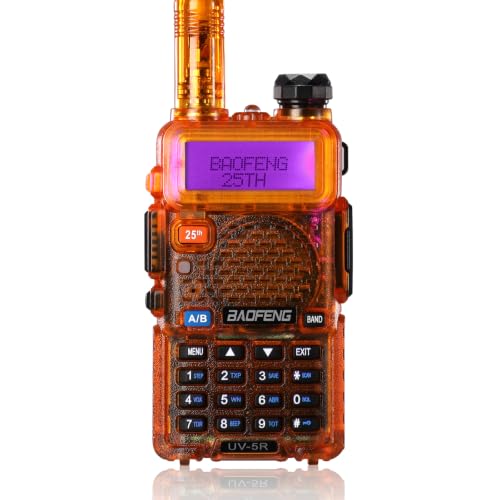
BAOFENG UV-5R Solar Flare is the only radio here with a USB-C port built into its battery, making it the closest match for recharging from portable power. Its 1,800mAh lithium-ion battery can recharge via a power bank, car charger or laptop, and the package includes a hard-shell carrying case. The 5W handheld is intended for outdoor, daily or collection use. The limitation is that USB-C is not a solar panel: you need a compatible solar-charged power source, and ham-radio use requires the appropriate license and operating knowledge.
Bottom line: Choose this if you want a handheld radio that can recharge from a USB-C power source.
Retevis RT86 Six-Pack

Retevis RT86 Six-Pack stands out as a team bundle for demanding warehouse environments, with six radios, a six-way charger, ABS housing, IP54 protection and 1-meter drop resistance. The maker claims coverage up to 700,000 square feet or 50 floors and up to 16 hours of battery life; actual coverage depends on buildings, interference and antenna conditions. Its charger is designed for a shared outlet, not solar input. Buyers planning off-grid shifts need to confirm that their power station or solar setup can run the charger safely and supply enough energy for the radios.
Bottom line: Choose this for a six-person warehouse team that values ruggedness and centralized charging.
Retevis RT68 Six-Pack

Retevis RT68 Six-Pack is a compact, license-free FRS bundle with six radios, ear-hook earpieces and a multi-unit charger that charges up to six radios or batteries together. The radios measure 4.56 inches high, 1.96 inches wide and 1.37 inches long. The maker claims 12-hour battery life and describes the bodies as shock- and vibration-resistant. This is a team communications kit rather than a solar-specific handheld; the charging station still needs a suitable power source, so it is less convenient than a radio with USB-C battery charging for portable recharging.
Bottom line: Choose this for a compact FRS team kit with shared charging and earpieces.
Retevis RT68H Six-Pack
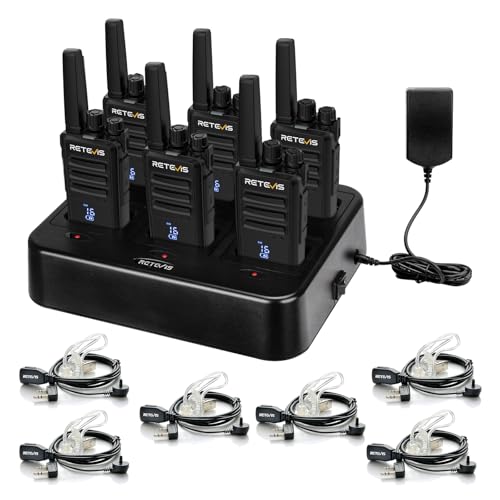
Retevis RT68H Six-Pack adds a shatterproof active-view LED display to a six-radio FRS bundle, so users can see channel and power information rather than relying only on voice prompts. Its included charger can charge all six radios and six spare batteries from one AC outlet, which is useful when a team rotates charged batteries. The radios are ABS and described as surviving a 1-meter fall. Like the other multi-radio kits, the charger is not identified as solar-compatible, so this bundle suits teams with access to an AC source more readily than mobile off-grid users.
Bottom line: Choose this if visible channel and power information matters to a team.
Retevis RT86 Four-Pack

Retevis RT86 Four-Pack is a four-radio heavy-duty set, distinguished by a hidden screen and high-gain antennas. The maker claims up to 700,000 square feet of coverage, communication across a 50-floor building and up to 16 hours of battery life; walls, metal shelving and other radio traffic can reduce real-world range. Its ABS body is aimed at work settings such as warehouses and construction sites. No solar or USB charging method is identified for this version, so buyers seeking renewable off-grid charging should verify how its battery is recharged before selecting it.
Bottom line: Choose this for a four-radio crew prioritizing a rugged work-oriented radio.
How to choose a solar-ready walkie talkie
A solar-ready radio needs a charging path that matches the output of your panel or battery. A USB-C port, as on BAOFENG UV-5R Solar Flare, can connect to a solar-charged USB power bank, but the panel itself must supply compatible regulated output; do not connect a panel directly unless its voltage and charging method are approved for the device. Multi-unit chargers generally use AC, so plan for an inverter or suitable power station when operating away from outlets. For an individual outdoors user, favor a direct USB charging path; for a crew, compare total charger load and how many radios must recharge at once.
Solar panel and power-bank fit
Solar panels are commonly rated in watts, but usable charging power falls with shade, clouds, panel angle and heat. A practical decision rule is to use a panel with a USB output and a power bank as the buffer, rather than relying on a panel’s changing output to charge a radio directly. Confirm connector type and supported input before pairing equipment. Battery capacity in mAh does not translate directly to hours of radio use because transmit time draws more power than standby; duty cycle and battery age also change runtime. Keep the radio and battery out of direct sun while charging, since excess heat can damage lithium-ion batteries.
FRS and ham radios compared
FRS and amateur-radio handhelds differ in licensing and operating rules, not just range. FRS is generally license-free for personal use in the United States, with radios restricted to permitted FRS frequencies, power and antenna configurations. The UV-5R is a ham handheld, so transmitting requires an FCC amateur license, and its 5W rating does not guarantee a particular distance. Buildings, terrain, antenna placement and interference are major range factors. Choose FRS for simple team communication when its limits fit; choose a ham radio only if you are prepared to get licensed and operate on authorized frequencies.
Charging and battery safety
Lithium-ion radio batteries should be charged with their compatible charger and kept away from excessive heat, moisture and damaged cables. A charger with overcharge, over-voltage and short-circuit protection can reduce electrical risk, but it does not make an unsuitable solar connection safe. Keep charging equipment dry, use a stable surface and stop using a battery that is swollen, leaking or unusually hot. Multi-bank chargers also need adequate ventilation, especially when charging several batteries together. For emergency readiness, keep a charged spare power bank and test the full radio-and-charger setup before leaving reliable power.
Frequently Asked Questions
Can I charge a walkie talkie directly from a solar panel?
Only when the radio or charger explicitly supports the panel’s voltage and charging method. A safer portable setup is a regulated USB solar panel charging a power bank, then connecting a USB-C radio such as BAOFENG UV-5R Solar Flare.
Does the BAOFENG UV-5R have a built-in solar panel?
No built-in solar panel is identified for BAOFENG UV-5R Solar Flare; its battery has a USB-C charging port. Use a compatible external USB power source, and check that its output matches the radio’s charging requirements.
Do ham walkie talkies require a license in the United States?
Yes, transmitting on amateur-radio frequencies generally requires an FCC amateur license. Receive-only listening does not require that license, but transmission must follow the applicable frequency and power rules.
How far can a handheld walkie talkie communicate indoors?
Indoor range has no reliable fixed figure because walls, floors, metal shelving and interference attenuate radio signals. Treat maker range claims as idealized and test communications in the actual building, especially across floors.
How should I store a rechargeable radio battery?
Store lithium-ion radio batteries cool, dry and away from direct sunlight, and avoid leaving them fully discharged for long periods. Inspect batteries and cables before charging, and discontinue use if a pack is swollen, damaged or abnormally hot.