
Best Solar Powered Fence Charger: 5 Options Compared

Epoify 45-Mile Solar Charger is the best solar powered fence charger for most buyers who want broad advertised coverage plus AC backup alongside solar power. Choose a smaller-range model if your fence is short or you need a post-mounting feature; advertised mileage is an ideal-condition figure, not a guarantee for every fence.
A fence charger, also called an energizer, sends brief electrical pulses through a properly installed fence rather than supplying continuous current.
We earn a commission if you buy through links on this page. As an Amazon Associate I earn from qualifying purchases. Products are compared on manufacturer specifications, not hands-on testing.
- Best overall: Epoify 45-Mile Solar Charger – Its maker advertises up to 45 miles of coverage and includes solar and AC power.
- Best for adjustable output: FarmNix 30-Mile Adjustable Charger – Its maker specifies four output-energy settings from 0.3 to 1.5 joules.
- Best for post mounting: Zareba 5-Mile Rotating Charger – Its built-in bracket fits T-posts, Y-posts and round-wood posts, with 360-degree rotation.
| Product | Best for | Advertised range | Power / backup | Shop |
|---|---|---|---|---|
| Epoify 45-Mile Solar Charger | Long fence runs | 45 miles | Solar + AC | Check Price on Amazon |
| FarmNix 30-Mile Adjustable Charger | Variable output | 30 miles | Solar + AC | Check Price on Amazon |
| Zareba 5-Mile Rotating Charger | Rotating post mount | 5 miles | Solar; 2 weeks without sun | Check Price on Amazon |
| Zareba 10-Mile Low-Impedance Charger | Weedy fence lines | 10 miles; 5 light weeds | Solar; 2 weeks without sun | Check Price on Amazon |
| PLOWIC 10-Mile Solar Charger | Battery capacity | 10 miles | Solar; 10,400 mAh battery | Check Price on Amazon |
Solar Powered Fence Chargers Compared
Compare advertised fence length with energy rating and power options, then account for your actual fence conditions.
Epoify 45-Mile Solar Charger

Epoify 45-Mile Solar Charger combines the longest advertised range here with an AC backup option, making it a fit for buyers who need flexibility beyond solar charging alone. Its maker says the charger stores 1.2 joules, produces 7–11 kV pulses and can power up to 45 miles of fence. An 8-watt solar panel and 10,000 mAh battery are part of the package, and a short-circuit alarm is included. The 45-mile figure is for the maker’s capacity; vegetation, fence layout and grounding can reduce real-world performance. It suits larger installations, but buyers with a short run may not need its advertised reach.
Bottom line: Choose this when advertised reach and AC backup matter more than a post-mounting feature.
FarmNix 30-Mile Adjustable Charger

FarmNix 30-Mile Adjustable Charger stands out for adjustable output energy: its maker gives four settings—0.3, 0.8, 1.1 and 1.5 joules—rather than one fixed rating. The charger also has a 15-watt solar panel, a 12-volt 7 Ah sealed lead-acid battery and solar plus AC power. Its maker advertises up to 30 miles of range and 18 days of battery life at 0.3 joule, along with day and night modes. That runtime claim applies to the low-energy setting, not necessarily the higher settings. This model suits buyers who want selectable output; its advertised coverage is below Epoify 45-Mile Solar Charger.
Bottom line: Choose this if selectable output settings are more useful than maximum advertised range.
Zareba 5-Mile Rotating Charger
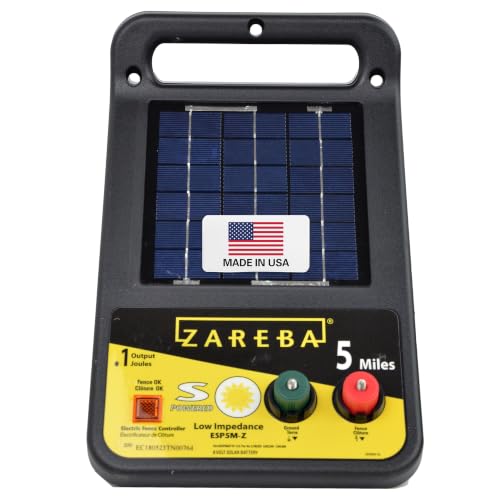
Zareba 5-Mile Rotating Charger differs through its rotating mount: the built-in bracket fits T-posts, Y-posts and round-wood posts, and the unit can rotate 360 degrees to aim toward sunlight. Its maker advertises up to 5 miles of fence in ideal conditions and operation for up to two weeks without sunlight. The charger is described as low impedance and intended for rotational grazing and livestock containment. This is the most clearly post-oriented option among the five, but its advertised reach is limited compared with the longer-range models. It makes more sense for a smaller paddock or a setup where adjustable orientation and mounting compatibility are priorities.
Bottom line: Choose this for a smaller fence where a rotating, multi-post-compatible mount is useful.
Zareba 10-Mile Low-Impedance Charger

Zareba 10-Mile Low-Impedance Charger gives two useful coverage figures rather than one: its maker advertises up to 10 miles in ideal conditions or 5 miles in light weeds. The charger has a 0.15-joule output rating, an internal rechargeable battery and a built-in bracket compatible with T-posts, Y-posts and round-wood posts. Its maker says it can operate for up to two weeks without sunlight. The reduced light-weeds figure is a reminder that vegetation touching a fence can change how much fence a charger can handle. This model suits buyers whose run is moderate and who want a coverage estimate for light weeds; its output rating is lower than FarmNix 30-Mile Adjustable Charger’s maximum setting.
Bottom line: Choose this when the light-weeds coverage figure is a relevant planning point.
PLOWIC 10-Mile Solar Charger

PLOWIC 10-Mile Solar Charger pairs a 0.20-joule output rating with a 10,400 mAh rechargeable battery and a 3-watt solar panel. Its maker advertises up to 10 miles of coverage and an IP55 waterproof rating, plus an operating temperature range of −4°F to 122°F. The charger is described for livestock, chicken, dog and garden fencing, with automatic day/night operation. Those use claims do not replace checking that the energizer and fence layout suit the animals being contained. This option suits buyers who value its battery-capacity and weather-rating specifications; it does not include the AC backup stated for Epoify 45-Mile Solar Charger and FarmNix 30-Mile Adjustable Charger.
Bottom line: Choose this if the battery capacity and IP55 rating fit your outdoor setup.
How to choose a solar fence charger
Choose by the fence’s actual condition, not just its advertised mileage. Energizers send short pulses; joules describe energy delivered or stored, so compare like with like rather than treating stored joules and output joules as identical. The five models span advertised ranges from 5 to 45 miles, but fence length alone does not account for weeds, wire type, grounding or connections. For a small, clean fence, a lower-range unit may be sufficient; if vegetation regularly touches the wire, allow extra capacity rather than planning right at the limit. For example, Zareba 10-Mile Low-Impedance Charger’s maker gives both a 10-mile ideal-condition figure and a 5-mile light-weeds figure. Solar exposure and battery reserve also matter at shaded sites.
Use the comparison table as an initial filter, then check the fence and installation requirements for your animals and location.
| Need | What to compare | Relevant option |
|---|---|---|
| Long advertised reach | Maximum range and backup source | Epoify 45-Mile Solar Charger |
| Adjustable pulse energy | Available output settings | FarmNix 30-Mile Adjustable Charger |
| Post placement flexibility | Mount compatibility and rotation | Zareba 5-Mile Rotating Charger |
| Light weeds considered | Separate coverage estimate | Zareba 10-Mile Low-Impedance Charger |
| Battery capacity and weather rating | mAh and IP rating | PLOWIC 10-Mile Solar Charger |
Fence length, weeds and voltage at the wire
Advertised mileage is usually a best-case planning number, while weeds and poor connections can pull voltage down along the fence. A fence tester helps locate weak points: test near the energizer first, then at distant sections, and repair shorts or vegetation contact if readings fall. Livestock commonly need several thousand volts at the fence to respect it; wool and heavy coats can require more than short-haired animals. Set the target for the animal and fence conditions, not for the charger’s headline voltage alone. With weeds touching the wire or a long, multi-strand run, choose a charger with more capacity than a clean, short fence requires. Zareba 10-Mile Low-Impedance Charger is the only model here that gives a separate light-weeds range.
Solar charging, batteries and backup power
Solar output depends on direct sunlight, panel orientation, shade and seasonal daylight; a panel facing away from the sun may not replenish its battery reliably. Keep the panel clear of dust and debris, and position it where it receives unobstructed sun for much of the day. Battery capacity and runtime claims are not interchangeable: FarmNix 30-Mile Adjustable Charger’s maker ties its 18-day runtime to a 0.3-joule setting, while Zareba 5-Mile Rotating Charger and Zareba 10-Mile Low-Impedance Charger advertise up to two weeks without sunlight. Lower output settings generally draw less stored energy than higher ones. For a site with frequent shade or prolonged cloudy stretches, solar plus AC backup offers another charging path, but it still needs a suitable power source and safe installation.
Grounding and safe fence installation
A fence energizer needs a complete circuit through the fence and its ground system; poor grounding can make an otherwise powered fence ineffective. Install ground rods in soil that stays reasonably moist, keep the grounding system separate from household electrical grounds, and use the energizer’s designated fence and ground terminals. Keep electric fence wires visibly separate from utility wiring and never connect a fence directly to household current. Check the fence periodically for broken insulators, loose joints, vegetation contact and damaged wires, since each can weaken the pulse or create a hazard. Keep people and animals away while making connections, and disconnect the charger before maintenance. Follow local rules for warning signs and placement, especially where the fence borders a public path.
Frequently Asked Questions
How many joules does a livestock fence charger need?
There is no single joule rating for every fence: the needed output depends on fence length, wire count, weeds and the animals being contained. Compare output joules rather than stored joules when the figures use different terms, and leave capacity beyond a clean, short run if vegetation regularly touches the wire.
How many volts should an electric fence have?
Livestock fences commonly need several thousand volts at the wire, and woolly or heavy-coated animals can require more than short-haired animals. Measure with a fence tester at distant sections as well as near the charger, because voltage can drop along a fence with shorts or poor connections.
Can a solar fence charger work on cloudy days?
A solar charger can continue from stored battery energy for a limited period without sun; the models here advertise runtimes ranging from up to two weeks to 18 days under specified conditions. Cloud cover, shade, battery condition and output setting affect how long the reserve lasts, so solar plus AC backup is useful where sunlight is unreliable.
How often should I check an electric fence?
Check fence voltage and walk the line regularly, especially after storms, mowing or vegetation growth. Broken insulators, loose wire joints and plant contact can drain the fence, so test near the charger and at the far end to isolate weak sections.
Can weeds reduce an electric fence charger’s range?
Yes, vegetation touching the wire can drain the pulse and reduce effective coverage. Zareba 10-Mile Low-Impedance Charger’s maker, for example, advertises 10 miles in ideal conditions but 5 miles in light weeds, so choose extra capacity when the fence line is not kept clear.