
Best Speed Controller for Exhaust Fan: 4 Picks

KB Electronics K177-1006 is the best speed controller for most exhaust-fan shoppers who need a wall-box control for a compatible 115V motor drawing no more than 6 amps. Choose a different option if you need plug-in operation, automatic temperature cycling or a controller limited to a specific fan brand or motor type.
We earn a commission if you buy through links on this page. As an Amazon Associate I earn from qualifying purchases. Products are compared on manufacturer specifications, not hands-on testing.
- Best overall: KB Electronics K177-1006 – A wall-box control rated for 115V and up to 6 amps, with fan and blower applications listed.
- Best for plug-in dial control: DIGITEN Variable Speed Controller – A grounded outlet controller with OFF, HIGH, MED and LOW dial settings.
- Best for iLIVING fans: iLIVING ILG8SFST Thermospeed Controller – Designed for compatible iLIVING variable-speed shutter fans and adds temperature-based on/off cycling.
| Product | Best for | Control style | Compatibility | Shop |
|---|---|---|---|---|
| KB Electronics K177-1006 | Wall-box installation | Wall-box control | Fans and blowers | Check Price on Amazon |
| DIGITEN Variable Speed Controller | Plug-in dial control | Grounded plug-in dial | Exhaust and inline duct fans | Check Price on Amazon |
| iLIVING ILG8SFST Thermospeed Controller | iLIVING shutter fans | Plug-and-play; speed and temperature | Compatible iLIVING variable-speed shutter | Check Price on Amazon |
| Cdmall 120V 15A Brushed-Motor Controller | Brushed AC motors | Variable voltage with LED display | Brushed AC motors only | Check Price on Amazon |
Best speed controllers for exhaust fans
Match the controller’s electrical rating and motor compatibility to the fan before choosing a control style.
KB Electronics K177-1006

For a wall-box installation, this KB Electronics control is rated for 115V and up to 6 amps, and fits a standard 2-by-4-inch electrical wall box. The applications include fans, blowers, attic fans and ventilators, and the unit is UL and CSA approved. It suits buyers whose fan motor is compatible with this control and falls within its rating. The key limitation is motor type: it must not be used with capacitor-start or capacitor-run motors, so confirm the fan motor type before wiring.
Bottom line: Choose this for a compatible 115V fan motor and a wall-box setup.
DIGITEN Variable Speed Controller
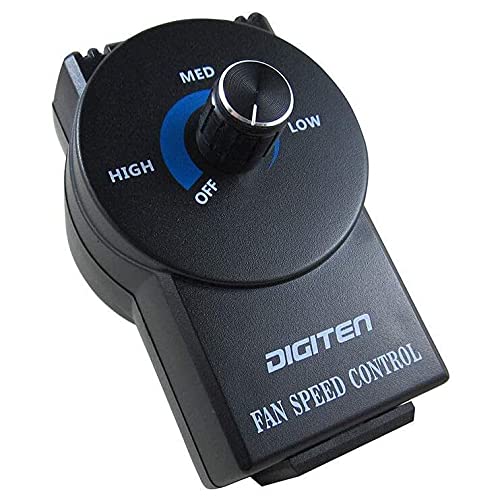
For a grounded outlet setup, the DIGITEN controller uses a plug-in format and a dial with OFF, HIGH, MED and LOW settings. Its uses include exhaust fans, inline duct fans and mini blowers, so it is a flexible option when the fan has a compatible plug and motor. The maker says the controller is intended to adjust fan speed and noise.
Bottom line: Choose this when you want a grounded plug-in dial and the electrical ratings match.
iLIVING ILG8SFST Thermospeed Controller
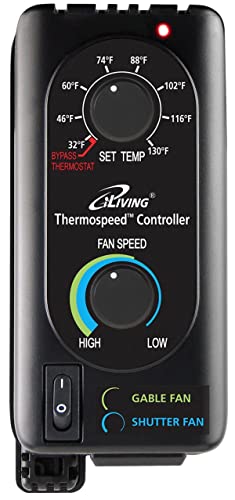
Unlike a general-purpose fan control, the iLIVING ILG8SFST combines speed adjustment with temperature-based on/off cycling, with a 120V rating and 3A FLA. It is designed for iLIVING variable-speed shutter fans from 7 to 24 inches and the named gable fan model; its NTC sensor reads temperature for the automatic cycle. This is the specialized choice for a compatible iLIVING fan, not a universal exhaust-fan controller. It does not work with single-speed fans, so check the fan model and speed-control capability first.
Bottom line: Choose this for a supported iLIVING variable-speed fan and temperature automation.
Cdmall 120V 15A Brushed-Motor Controller
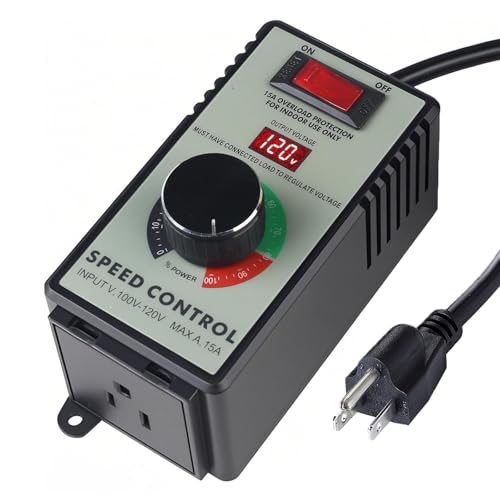
The Cdmall controller is distinguished by a built-in LED voltage display and a 120V, 15A rating. Its maker says it adjusts speed by reducing voltage and is intended for brushed AC motors, including compatible exhaust and duct fans. It also names overload protection as a feature. The motor restriction is decisive: this controller is not for brushless or DC motors, or appliances with electronic circuit boards. Confirm the fan motor type and its electrical requirements before selecting it; a matching voltage alone does not establish compatibility.
Bottom line: Choose this only when the fan uses a compatible brushed AC motor within its rating.
How to choose an exhaust fan speed controller
Choose by motor compatibility first, then match the controller’s voltage and current rating to the fan. A controller that reduces voltage or modulates AC power is not automatically suitable for every AC fan motor; some motors require a specific control method. Check the fan nameplate for voltage and amperes, and confirm the motor type in the fan documentation. Keep the controller within its maximum current; a controller’s higher amp rating does not make an incompatible motor safe to control. For a plug-in controller, the fan must have a compatible plug and outlet arrangement. For a wall-box control, wiring and enclosure requirements matter. Disconnect power before any wiring work, and use a qualified electrician if the installation involves fixed household wiring.
Wall-box versus plug-in fan controls
Wall-box controls suit a fixed wired installation, while plug-in controls suit fans that connect to an outlet. A standard 2-by-4-inch electrical wall box is a common enclosure size, but control dimensions and wiring still need to fit the installation. Plug-in controls avoid opening a wall box, yet they still need a grounded outlet and compatible fan connection where required. Use this comparison to narrow the format; it does not replace checking motor compatibility or electrical ratings.
| Need | Control format | Check before choosing |
|---|---|---|
| Fixed wall control | Wall-box controller | Box fit, wiring, motor type and rating |
| Outlet-connected fan | Plug-in controller | Grounding, plug fit, motor type and rating |
| Temperature cycling | Fan-specific temperature controller | Supported fan model and sensor placement |
Motor compatibility and electrical safety
Motor type is a hard compatibility condition: a controller designed for brushed AC motors should not be used on brushless or DC motors, and a control that excludes capacitor-start or capacitor-run motors must not be paired with them. A fan’s voltage and amp draw must also stay within the controller’s rating; use the fan’s nameplate values rather than estimating load. Temperature controllers add another fit requirement: both the fan model and its ability to run at variable speed must be supported. Never treat a voltage display, overload-protection claim or broad application list as proof of compatibility. Disconnect power before installation, keep electrical connections enclosed as required, and have fixed wiring handled by someone qualified.
Frequently Asked Questions
Can any exhaust fan use a speed controller?
No; the fan’s motor type and the controller’s approved compatibility determine whether speed control will work safely. Check the fan nameplate and motor documentation, then match voltage and current to the controller rating.
How do I match controller amps to a fan?
The controller’s maximum current rating must meet or exceed the fan’s required current at the same voltage. For example, a 6-amp maximum controller should not be used with a fan that draws more than 6 amps.
Can a temperature controller run a single-speed fan?
Not when the controller requires a variable-speed fan; the iLIVING temperature and speed controller says it does not work with single-speed fans. Confirm the exact supported fan model and temperature-sensor placement before setup.
Is a plug-in fan speed controller grounded?
The DIGITEN unit is described as a grounded outlet plug-in controller. Use a grounded outlet and verify that the fan and controller connections and electrical ratings are compatible.
What should I check before wiring a wall controller?
Confirm the motor type, voltage, current draw and wall-box fit before wiring. Disconnect power first, and use a qualified electrician for fixed household wiring if you are not equipped to install it safely.