
Best Sponge Brushes for Straight Lines and Edges

For straight lines, choose US Art Supply 1-Inch Foam Brushes, 50-Pack because its flat, beveled 1-inch foam tip is made for edges and tight areas. Choose another set if you need several widths or round heads for stamping; most of the other options here focus on round sponge heads rather than line work.
We earn a commission if you buy through links on this page. As an Amazon Associate I earn from qualifying purchases. Products are compared on manufacturer specifications, not hands-on testing.
- Best overall: US Art Supply 1-Inch Foam Brushes, 50-Pack – Its flat, beveled 1-inch foam tips suit edges and tight areas.
- Best for mixed shapes: Auvressa Mixed Foam and Round Brush Set – It combines flat 1- and 2-inch brushes with 0.6-inch round heads.
- Best for round marks: Hapeper 28-Piece Round Sponge Brush Set – Four round head diameters support different-sized dots and craft marks.
| Product | Best for | Head shape | Head width | Pack size | Shop |
|---|---|---|---|---|---|
| US Art Supply 1-Inch Foam Brushes, 50-Pack | Edges and trim | Flat, beveled foam | 25.4 mm | 50 | Check Price on Amazon |
| Auvressa Mixed Foam and Round Brush Set | Mixed craft work | Flat and round | 15.24, 25.4, 50.8 mm | 41 | Check Price on Amazon |
| WAFJAMF 40-Piece Round Sponge Brush Set | Round stenciling | Round | 12.7–38.1 mm | 40 | Check Price on Amazon |
| Hapeper 28-Piece Round Sponge Brush Set | Round craft marks | Round | 15–40 mm | 28 | Check Price on Amazon |
Sponge Brushes for Straight Lines
Flat foam heads are the most direct fit for lines and edges; round sponges are better suited to dabbing and stamping.
US Art Supply 1-Inch Foam Brushes, 50-Pack
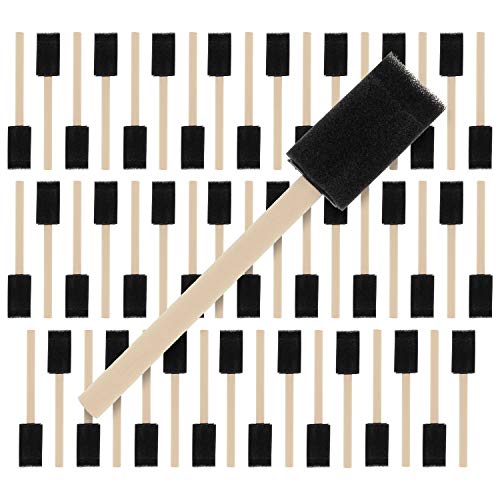
The flat, beveled foam tip makes this set the clearest match for straight edges and narrow areas. Each brush has a 1-inch foam head on a lightweight wood handle, and the 50-count pack provides a consistent width across a project. The maker says the foam absorbs paint and reduces drips until application; listed uses include paint, varnish, stain, polyurethane and chalk. This is a focused choice for repeated lines, but the single head width is limiting when you need broad strokes or multiple line widths.
Bottom line: Pick this set for repeated, narrow edges when a consistent 1-inch flat tip fits.
Auvressa Mixed Foam and Round Brush Set

The Auvressa assortment is the only option here that pairs flat foam heads with small round applicators. It includes 26 round brushes measuring 0.6 inch and 15 flat brushes split between 1-inch and 2-inch widths. The maker describes the flat heads for edges and backgrounds, while the round heads are for dots, stenciling and stamping. That combination is useful when straight edges are only one part of a craft project. Most pieces are round, however, so it is less suited to producing many uniform straight lines than a pack of identical flat tips.
Bottom line: Choose it when you need line work plus round tools for details and stamping.
WAFJAMF 40-Piece Round Sponge Brush Set

The WAFJAMF set varies round-head diameter rather than offering flat brushes, making it a better fit for circular marks and stenciling than long straight lines. The 40 pieces come in four diameters: 0.5, 0.75, 1.15 and 1.5 inches, with 2.5-inch wooden handles. The maker says the high-density foam is washable and reusable, and recommends soap and water for cleaning. Multiple diameters can help with dots or repeated round motifs, but the rounded shape is a limitation when you want a crisp, continuous line along a straight edge.
Bottom line: Pick it for varied round stencils, not for long, straight edge work.
Hapeper 28-Piece Round Sponge Brush Set
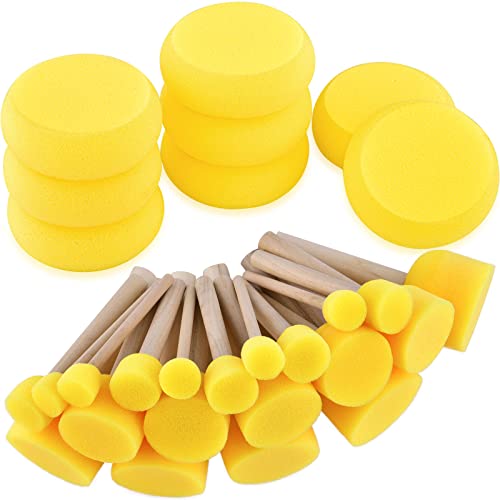
The Hapeper set focuses on round painting tools, with 20 handled brushes in four head diameters and eight additional round sponges. The handled heads measure 15, 20, 30 and 40 mm, making this set relevant for dots, circles and other rounded craft marks rather than straight lines. The maker says the wood-and-sponge pieces can be washed and reused. Its range of head sizes supports varied round effects, but the round profile is less suitable than a flat foam tip for drawing a consistent edge or line.
Bottom line: Choose it for several sizes of round marks and craft painting.
Choosing a sponge brush for straight edges
A flat foam head is the practical choice for straight edges because its broad face can travel along a ruler or taped boundary. For a narrow line, start with a 1-inch or smaller flat head; wider heads cover more area but leave a broader stroke. Foam applicators hold paint in their cells, so load lightly and press excess onto scrap material before touching the finished surface. Move the brush in one continuous pass when possible, keeping the flat face aligned to the edge. Round sponge heads make dots and stamped shapes; they do not provide the same continuous flat edge for long lines.
Flat and round sponge heads compared
Head shape is the key difference: flat foam supports edges and broad strokes, while round foam produces dots or circular stamps. Use this quick guide to match the head to the mark before choosing a set.
| Need | Head shape | Useful size cue |
|---|---|---|
| Straight edge or narrow band | Flat, beveled | About 1 inch or narrower |
| Broad coverage | Flat | 2 inches or wider |
| Dots and circular stamps | Round | Choose diameter by mark size |
For lines shorter than a few inches, a round sponge can dab a mark, but repeated dabs may show joins. A flat head is a better starting point for a continuous stroke.
Getting a cleaner line with foam
A light paint load and steady contact help reduce ragged edges. Press the foam into paint only shallowly, then remove excess on scrap; saturated foam can release too much paint at the start or end of a stroke. When a ruler or straightedge is used as a guide, keep paint from pooling against its edge by applying a thin coat and moving away from the guide. On porous surfaces such as unfinished wood, a first pass may absorb unevenly; a second light coat after the first dries can even coverage. For a crisp border, use painter’s tape suited to the surface and remove it before the coating fully hardens.
Cleaning and reusing foam brushes
Water-based acrylic paint should be rinsed from foam promptly, before it dries inside the cells; dried acrylic is difficult to remove from a small foam head. Soap and water are a cleaning option for washable foam, while solvent-based varnishes and stains may require the cleaner specified for that coating rather than water. Some foam heads are intended for disposable use, so assess whether washing deforms or tears the tip before reusing it. Store a cleaned brush only after it is dry, and avoid pulling or twisting the foam against its handle, which can loosen the head or change its edge.
Frequently Asked Questions
Can a round sponge brush make straight lines?
A round sponge can make a short line by dabbing overlapping marks, but the joins may be visible. For a continuous edge, choose a flat foam head around 1 inch wide or narrower.
What size sponge brush works for narrow trim?
A flat head around 1 inch wide is a useful starting point for narrow trim, with a smaller head helpful for tighter spaces. Match the width to the trim so the foam does not spill beyond the edge.
How do I keep paint from bleeding under tape?
Use tape suited to the surface and press its edge down firmly before painting. Apply a thin coat rather than loading the foam heavily, since excess paint can pool at the tape boundary.
Should I wet a foam brush before painting?
For water-based paint, a barely damp foam head can reduce immediate absorption, but excess water can thin the coating and soften the line. For stain or varnish, use a clean, dry foam head unless the coating directions say otherwise.
Can foam brushes be reused after painting?
Washable foam brushes can often be cleaned after water-based paint if rinsed before the coating dries. Solvent-based products may need a compatible cleaner, and damaged or hardened foam will not produce a consistent edge.