
Best Stretch Rings for Arthritic Fingers: 5 Options Compared

Finger Stretcher Rings, Set of 2 is the closest match for most people seeking stretch rings for arthritic fingers because it is a simple two-ring set rather than a multi-tool kit. Choose a different option if you want adjustable resistance or several levels to progress through.
Finger stretchers work the muscles that open the fingers against resistance; they are not a treatment for arthritis. Keep movement gentle, and ask a clinician or hand therapist whether resisted exercise suits your symptoms.
We earn a commission if you buy through links on this page. As an Amazon Associate I earn from qualifying purchases. Products are compared on manufacturer specifications, not hands-on testing.
- Best overall: Finger Stretcher Rings, Set of 2 – A straightforward set of two finger stretcher rings, without extra training tools.
- Best for graduated levels: FMELAH Three-Level Silicone Stretcher – Includes three silicone resistance pieces rated at 6.6, 8.8, and 11 pounds.
- Best for adjustable resistance: Kiauiky Adjustable Finger Stretcher – Its maker gives six resistance settings spanning 6.6 to 21 pounds.
| Product | Best for | Resistance | Pieces | Design | Shop |
|---|---|---|---|---|---|
| Finger Stretcher Rings, Set of 2 | Simple ring set | — | 2 | Rings | Check Price on Amazon |
| FMELAH Three-Level Silicone Stretcher | Three resistance steps | 6.6, 8.8, 11 lb | 3 | Silicone pieces | Check Price on Amazon |
| Kiauiky Adjustable Finger Stretcher | Adjustable resistance | 6.6–21 lb | 2 | Adjustable bands | Check Price on Amazon |
| Four-Level Finger Extensor Bands | Four resistance levels | Light to heavy | 4 | Extensor bands | Check Price on Amazon |
| IMENSEAS Seven-Piece Grip Kit | Mixed hand-training kit | 6.6–11 lb bands; 4 lb exerciser; 50 lb ring | 7 | Mixed tools | Check Price on Amazon |
Stretch Rings for Arthritic Fingers
Compare the styles and resistance options, then favor comfortable, controlled movement over a harder workout.
Finger Stretcher Rings, Set of 2

Finger Stretcher Rings, Set of 2 is the most direct ring-style choice here: the set contains two finger stretcher rings and does not bundle other training tools. Its compact dimensions are 1.4 inches long and 0.8 inches wide, which may matter if storage space is limited. The maker does not give a resistance level, so this set suits shoppers who prioritize a simple format over selecting a precise load. For arthritic fingers, resistance should not force painful movement; check whether the ring feels comfortable before continuing with repeated exercises.
Bottom line: Choose this if you want a simple ring-style finger stretcher without a multi-tool kit.
FMELAH Three-Level Silicone Stretcher

FMELAH Three-Level Silicone Stretcher stands out for its three labeled resistance levels: 6.6, 8.8, and 11 pounds. The set uses silicone pieces, and its maker says the material is washable, latex-free, and designed for repeated use. It may suit someone who has already been advised to use resistance and can move comfortably at the lightest level.
Bottom line: Pick this if three clearly labeled resistance steps matter more than a simple ring format.
Kiauiky Adjustable Finger Stretcher

Kiauiky Adjustable Finger Stretcher differs from fixed-level stretch rings with six adjustable settings spanning 6.6 to 21 pounds, according to its maker. The two-piece black-and-gray set is intended to work finger flexors and extensors, so it is a broader hand-training format than a basic ring. The maker also names dexterity, flexibility, and endurance as intended goals; those are product claims, not a promise of arthritis relief. Its upper settings may be too demanding for someone seeking very gentle finger movement, so start at the lowest setting and avoid increasing resistance when movement hurts.
Bottom line: Choose this for adjustable settings if you can keep exercise comfortably gentle.
Four-Level Finger Extensor Bands

Four-Level Finger Extensor Bands is an extensor-band set with four resistance levels, making it a choice for buyers who want several steps rather than a ring-only format. Its maker positions the bands for finger extension training and says they target extensors. That matters when choosing a particularly light starting point: do not assume the lightest band is gentle enough for an arthritic hand. Choose it only if you can test the resistance without provoking discomfort.
Bottom line: Consider this if you want four levels and can confirm the lightest one feels manageable.
IMENSEAS Seven-Piece Grip Kit
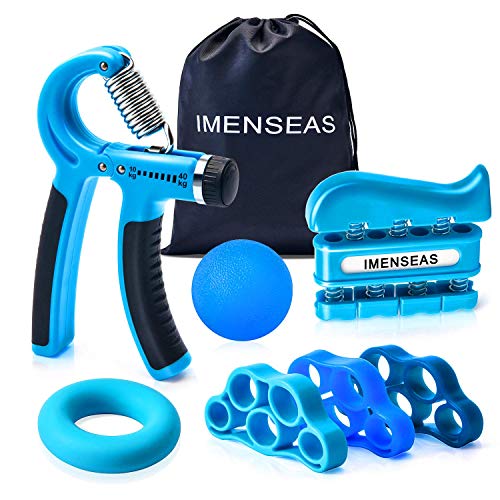
IMENSEAS Seven-Piece Grip Kit is the broadest kit, pairing finger stretchers with a grip ring, stress ball, finger exerciser, and adjustable hand gripper. Its maker gives resistance figures for several pieces, including 6.6 to 11 pounds for the stretchers and 50 pounds for the grip ring. That variety suits someone seeking several kinds of hand training, but it is less focused than a simple finger-stretching ring. Some included tools have much higher stated resistance than the stretcher bands, so someone managing arthritic finger discomfort should not treat every piece as interchangeable or appropriate for the same exercise.
Bottom line: Pick this for multiple hand-training tools, not for a ring-only purchase.
How to Choose Stretch Rings for Arthritic Fingers
Choose the lightest resistance that allows smooth finger opening without pain, forcing, or lingering soreness. Hand exercises for arthritis generally emphasize comfortable range of motion before resisted strengthening; a heavier band is not automatically a better choice. The products here range from a simple ring set with no resistance figure to bands with labeled loads, so compare format and measurable resistance separately. If you have a flare, recent hand surgery, or new swelling, ask a clinician or hand therapist before adding resistance. A useful decision rule is to stop the set if discomfort rises during the movement or remains worse afterward; do not advance to a stronger level until the current motion is comfortable.
Ring and Band Styles Compared
Ring-style stretchers offer a compact, single-purpose format, while extensor bands and kits can add adjustable loads or other grip tools. Finger extensors open the hand against resistance; grippers mainly train closing strength, so the two movements are not interchangeable. Use the comparison below to match the format to the job rather than assuming a larger kit is better for stiff fingers.
| Style | Useful distinction | Choose when |
|---|---|---|
| Stretcher ring | Simple, focused format | You want finger-opening resistance only |
| Extensor bands | May offer multiple levels | You want a labeled progression |
| Mixed kit | Combines opening and grip tools | You need several exercise types |
When hand opening is the goal, favor an extensor tool over a gripper as the primary exercise device. A ring or band should sit comfortably and let the fingers move without being forced apart.
How to Start Gentle Finger Exercises
Start with a few slow, comfortable repetitions and keep the wrist relaxed; for general hand mobility, a common starting range is 5 to 10 repetitions, adjusted to comfort. Move through the range you can control rather than pushing to the end of a stretch. A warm room or comfortably warm water may make a hand feel easier to move, but avoid hot water if sensation is reduced. Resistance exercise is different from unresisted mobility work, so begin at the lowest available setting and use short sets. Stop for sharp pain, increasing swelling, numbness, or a noticeable lasting symptom increase, and get professional advice before resuming.
Resistance, Fit, and Safety Checks
Resistance labels make comparisons easier, but the force a finger experiences also depends on how far the band stretches and how it fits the hand. The lightest rated option is the sensible starting point when you have been cleared for resistance work; do not skip to a stronger setting because it feels easy once. Check that the device does not pinch skin or force fingers into an uncomfortable position, and keep the movement slow enough to release it in control. Arthritis symptoms differ by joint and day, so a comfortable range can change. Confirm with a hand therapist whether resisted extension is appropriate for your specific condition, especially after an injury or procedure.
Frequently Asked Questions
Can finger stretchers help with stiff arthritic fingers?
Finger stretchers provide resisted finger-opening exercise, but they are not an arthritis treatment. Gentle range-of-motion movement is a better starting point than adding resistance when fingers are painful or swollen.
How many repetitions should I start with?
A cautious general starting range for hand mobility is 5 to 10 slow repetitions, stopping sooner if discomfort increases. Use fewer repetitions with resistance and seek a clinician’s guidance if symptoms worsen afterward.
Should I use a finger stretcher during a flare?
Avoid resisted exercise when it increases pain or swelling, and ask a clinician or hand therapist about safe movement during a flare. Gentle, unforced motion may be more appropriate than stretching against a band.
Are finger stretchers the same as grip strengtheners?
No: finger stretchers resist opening the fingers, while grippers resist closing the hand. They train different movements, so select the tool that matches the exercise you intend to do.
When should I stop a finger-stretching exercise?
Stop if you feel sharp pain, increasing swelling, numbness, or discomfort that stays worse after the set. Do not move to a stronger resistance until the current movement is comfortable.