
Best Swing Away Hitch Adapter: 5 Options Compared

The Mockins swing away hitch adapter suits most buyers who want a wide opening angle and a high stated capacity: it pivots 120 degrees and supports up to 500 pounds, according to the maker. Choose a different model if you need a 180-degree swing or a lower-profile setup.
A swing away adapter pivots a hitch-mounted rack or carrier sideways to make rear access easier, but the vehicle, hitch, adapter, and rack ratings all constrain the usable load.
We earn a commission if you buy through links on this page. As an Amazon Associate I earn from qualifying purchases. Products are compared on manufacturer specifications, not hands-on testing.
- Best overall: Mockins 500 lb Swing Away Adapter – Its maker states a 500-pound capacity, and the 120-degree swing provides broad rear access.
- Best for maximum swing: 180° Passenger-Side Swing Adapter – The maker specifies a 180-degree passenger-side swing and a 320-pound maximum capacity.
- Best for two-sided mounting: 2.0 Swing Away Adapter, 105° – It can be mounted on either the driver or passenger-side and swings up to 105 degrees.
| Product | Best for | Swing angle | Capacity | Swing side | Shop |
|---|---|---|---|---|---|
| Mockins 500 lb Swing Away Adapter | High stated capacity | 120° | 500 lb | Passenger | Check Price on Amazon |
| 180° Passenger-Side Swing Adapter | Maximum opening angle | 180° | 320 lb | Passenger | Check Price on Amazon |
| 2.0 Swing Away Adapter, 105° | Either-side mounting | 0°–105° | 220 lb | Either side | Check Price on Amazon |
| 90° Swing Adapter, 400 lb | 400 lb capacity | 90° | 400 lb | — | Check Price on Amazon |
| 90° Swing Adapter with Hitch Tightener | Anti-rattle hardware | 90° | 320 lb | — | Check Price on Amazon |
Swing Away Hitch Adapters Compared
Compare the pivot range, stated capacity, and swing direction before choosing an adapter for your rack or carrier.
Mockins 500 lb Swing Away Adapter

The Mockins adapter combines the highest capacity in this group with a 120-degree passenger-side pivot. The maker says it supports up to 500 pounds and describes its construction as solid steel with an anti-rust coating. Its dimensions are 30.5 by 16.7 by 5.5 inches, and it weighs 41 pounds. That makes it a fit for buyers prioritizing the load rating and a wide opening angle. The limitation is its 120-degree swing: buyers who need a full 180-degree opening should compare another option.
Bottom line: Choose this if its 120-degree pivot clears your rear access needs and all connected load ratings allow the load.
180° Passenger-Side Swing Adapter

The 180-degree pivot distinguishes this adapter from the other options, and its maker gives it a 320-pound maximum capacity. It fits standard 2-inch receiver hitches and swings to the passenger-side, which can provide more clearance for a rear door or hatch than a shorter pivot. Its dimensions are 29 by 22.5 by 4.7 inches. The tradeoff is fixed swing direction: buyers whose parking setup or rear access requires a driver-side pivot should choose a model offering that side instead.
Bottom line: Pick this when a passenger-side, full 180-degree swing matters more than the highest load rating.
2.0 Swing Away Adapter, 105°
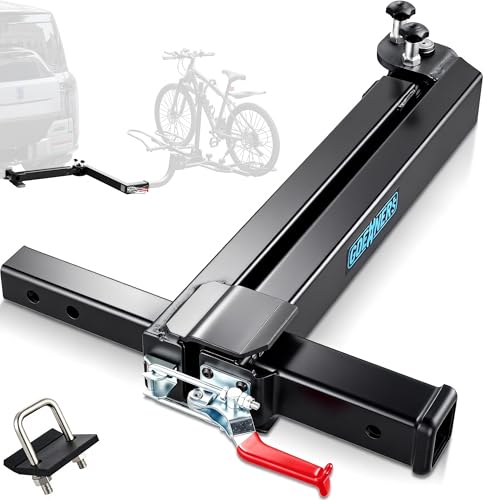
Unlike the passenger-side-only models, this adapter can be mounted on either side of the vehicle. The maker specifies a 0-to-105-degree swing and a 220-pound capacity, with a self-locking position at 105 degrees. Its 2-inch receiver fit makes it relevant for compatible bike racks and cargo carriers. This is the choice for buyers who need to select the swing direction to suit their setup. The 220-pound capacity is lower than the other options, so it may not suit heavier rack-and-cargo combinations.
Bottom line: Choose this when mounting on either side is useful and 105 degrees of swing is enough.
90° Swing Adapter, 400 lb

The 400-pound stated capacity sets this adapter apart from models rated at 320 pounds or less, while its pivot is limited to 90 degrees. The maker describes reinforced steel construction and a positive locking pin, and says installation is tool-free. It is intended for 2-inch receivers and for use with bike racks or cargo carriers. This can suit a buyer who values the capacity and a straightforward pivot. The 90-degree opening is the limitation for vehicles whose tailgate needs more room to clear a loaded rack.
Bottom line: Pick this if a 90-degree opening clears your tailgate and the connected components support the planned load.
90° Swing Adapter with Hitch Tightener

This adapter includes a hitch tightener, unlike the other options described here, and has a 90-degree swing. The maker specifies a 320-pound capacity, cold-rolled steel construction, and compatibility with 2-inch receivers. It is intended to extend the use of a receiver with a bike rack or luggage rack. The tightener may be a useful feature for buyers concerned about movement at the receiver connection. Its 90-degree pivot offers less opening range than the 120- and 180-degree alternatives, which matters when rear-door clearance is tight.
Bottom line: Choose this if the included hitch tightener is useful and a 90-degree pivot provides enough clearance.
How to Choose a Swing Away Hitch Adapter
Choose by matching the adapter’s receiver size, swing range, and allowed load to the vehicle and rack. A 2-inch receiver is common on many Class III and Class IV hitches, but the receiver’s class alone does not establish a safe load for a particular vehicle. Compare the vehicle’s maximum tongue weight with the hitch, adapter, and rack limits; use the lowest applicable rating. Count the adapter, rack, bikes, and cargo in the load where the rating is defined as total supported weight. A longer swing arm also moves the load farther behind the vehicle, so do not treat the adapter’s largest printed capacity as a guarantee that the vehicle can carry that much.
Use this decision rule: if a loaded rack blocks the hatch at 90 degrees, select an angle that clears it, while confirming that the open rack will not strike a wall or nearby vehicle.
Receiver Fit and Load Ratings
A 2-inch receiver must match the adapter’s receiver shank, and the rack must fit the adapter’s outward-facing receiver opening. Receiver size is only one part of compatibility: pin-hole placement, rack clearance, and the vehicle’s tongue-weight limit also matter. Hitch adapters add distance between the vehicle and the load, increasing leverage on the hitch; a load rating printed for the adapter does not override a lower vehicle or hitch rating.
Before driving, confirm the maximum tongue weight in the vehicle and hitch manuals, and check whether the adapter’s capacity includes the rack itself or cargo alone. When that basis is unclear, verify the rating before ordering. Secure the pin and any locking mechanism, distribute cargo evenly, and recheck hardware after the first short drive.
Pivot Angle and Rear-Door Clearance
A 90-degree swing may clear a hatch that opens upward but can be insufficient for a wide door, a side-opening tailgate, or a rack that sits close to the vehicle. A 120-degree or 180-degree pivot moves the load farther aside, though more swing requires more clear space beside the vehicle. Measure from the receiver to the hatch edge and account for the rack’s width, the bicycles or cargo, and the direction the door opens.
Test the intended path while parked before loading for travel, and keep people clear of the swing arm as it moves. Never assume the advertised angle guarantees access on every vehicle; vehicle body shape and rack geometry determine the actual clearance.
Safe Loading and Hitch Adapter Use
Hitch-mounted loads should stay within the lowest relevant rating: vehicle tongue weight, hitch, adapter, rack, and any carrier. Keep heavy items close to the vehicle and secure them against movement; cargo shifting outward can increase leverage even when the total weight stays the same. A swing away assembly adds a pivot and connection points, so inspect pins, fasteners, and the pivot before each trip for looseness or visible damage.
Do not open the swing arm while driving, and use the locking mechanism intended to hold it in the travel position. If the rack blocks lights or a license plate when closed, check local requirements and arrange compliant visibility rather than assuming the adapter solves it. Stop and reassess if the assembly moves, rattles excessively, or shows bending.
Frequently Asked Questions
How much weight can a swing away hitch adapter carry?
The capacities among these options range from 220 to 500 pounds. The usable load is limited by the lowest applicable rating for the vehicle, hitch, adapter, and rack, and you should clarify whether the figure includes the rack itself.
Will a swing away adapter fit any hitch receiver?
These options are designed for 2-inch receivers, not every receiver size. Confirm the vehicle has a matching receiver and that the rack fits the adapter’s outward-facing opening and pin arrangement.
Does a swing away adapter reduce tongue weight?
An adapter moves a load farther from the hitch, increasing leverage, so the vehicle or hitch may allow less load than the adapter’s own capacity. Check the vehicle and hitch limits rather than relying on the adapter rating alone.
What swing angle do I need for a tailgate?
The needed angle depends on the tailgate’s width, opening direction, and distance from the receiver. Measure the clearance with the rack and cargo in place; a 90-degree model may be enough for some setups, while a wider door can require more swing.
Can I open the swing arm while the vehicle is moving?
No, open or reposition the arm only while parked. Before travel, engage its travel lock or pin and check that the rack and cargo are secure.