
Best Swing Speed Golf Radar: 5 Models Compared

Swing Speed Radar, 20–200 mph is the best swing speed golf radar for most golfers because its 20–200 mph range starts lower than the other options and it works without a ball. Choose Swing Speed Radar with Tempo Timer if tempo feedback matters more, or Swing Speed Radar with Bluetooth App or TheStack Radar if you want connected app features.
A golf swing radar measures club speed during a swing, giving you feedback without requiring a full shot when the device supports no-ball use.
We earn a commission if you buy through links on this page. As an Amazon Associate I earn from qualifying purchases. Products are compared on manufacturer specifications, not hands-on testing.
- Best overall: Swing Speed Radar, 20–200 mph – Its 20–200 mph range and no-ball use suit a broad range of practice swings.
- Best for tempo practice: Swing Speed Radar with Tempo Timer – It combines speed readings with a tempo timer.
- Best for phone tracking: Swing Speed Radar with Bluetooth App – Bluetooth app support enables club-by-club goals and tracking.
- Best for ball-speed data: TheStack Radar – It measures swing and ball speed and estimates carry distance.
| Product | Best for | Speed range | Ball needed | App or data features | Shop |
|---|---|---|---|---|---|
| Swing Speed Radar, 20–200 mph | Simple speed practice | 20–200+ mph | No | — | Check Price on Amazon |
| RYP Golf Radar | Saved swing results | — | No | Last 10 swings; optional voice | Check Price on Amazon |
| Swing Speed Radar with Tempo Timer | Tempo training | 40–200+ mph | No | Tempo timer | Check Price on Amazon |
| Swing Speed Radar with Bluetooth App | Phone-based tracking | 40–220 mph | No | Bluetooth app; voice readout | Check Price on Amazon |
| TheStack Radar | Speed and wedge data | — | — | Bluetooth app; carry estimate | Check Price on Amazon |
Swing Speed Golf Radar Options
Compare the speed range and practice features that shape each radar’s best use.
Swing Speed Radar, 20–200 mph

Swing Speed Radar, 20–200 mph stands apart with a measurement range beginning at 20 mph, lower than the other radars here. It reads swing speed without requiring a ball, though the maker also says golfers can use a real ball or a practice substitute such as a wiffle ball. Its one-button, turn-on-and-swing approach suits golfers who want a straightforward speed check rather than app-based tracking. The limitation is its lack of listed connected tracking features, so it is a less suitable choice for anyone who wants to save session data on a phone.
Bottom line: Choose this for direct swing speed feedback without a ball or app workflow.
RYP Golf Radar

RYP Golf Radar is the option here that explicitly saves results from the last 10 swings and offers optional spoken feedback. The maker says it can measure swings with a Rypstick, driver, or iron without a ball, and the display reports speed in either mph or kph. That makes it useful for comparing a short run of swings or training with different clubs. It runs on five AA batteries, which are not included, so keep spares available for practice.
Bottom line: Pick this if reviewing your last 10 swings and optional voice feedback matter.
Swing Speed Radar with Tempo Timer

Swing Speed Radar with Tempo Timer adds a tempo timer to speed measurement, unlike the simpler speed-only choices. Its 40–200+ mph range is suited to golfers who want to pair swing speed feedback with a tempo routine; the maker says no ball is needed and suggests practice balls as an option. The timer is the deciding feature for golfers working on repeatable rhythm as well as speed. Its lower measurement limit is 40 mph, however, so golfers seeking a radar with a range beginning at 20 mph should consider a different model.
Bottom line: Choose this when a tempo timer is as important as the speed reading.
Swing Speed Radar with Bluetooth App

Swing Speed Radar with Bluetooth App has the widest upper measurement limit among the radars with a range, reaching 220 mph, and adds Bluetooth connection to an iPhone or Android phone. The maker says the app supports goals and club-by-club progress tracking, with spoken speed feedback through the phone or earbuds. No ball is required according to the maker. This setup suits golfers who want to keep training records without looking at the radar display. Its range begins at 40 mph, so the lower limit is higher than Swing Speed Radar, 20–200 mph’s.
Bottom line: Pick this for phone-based goals, club tracking and spoken speed feedback.
TheStack Radar
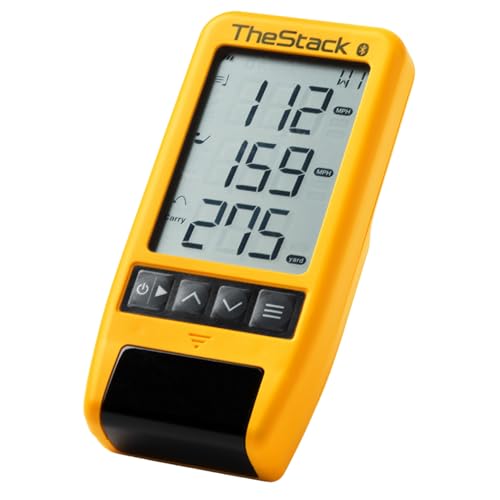
TheStack Radar extends beyond swing speed readings by measuring ball speed and estimating carry distance and smash factor. The maker says it connects to TheStack app over Bluetooth and automatically transfers training-speed data, while its included wedge app offers gamified, skill-specific practice. This makes it the most data-oriented option for golfers who want speed work alongside wedge sessions.
Bottom line: Choose this for combined swing speed, ball-speed and wedge-practice app features.
How to Choose a Swing Speed Golf Radar
Choose by the feedback you will use: basic speed, saved swings, tempo, or broader ball data. A radar’s speed number is useful for comparing swings only when you keep the club, swing intent, and setup consistent. Club speed and ball speed are different measurements; ball speed is affected by contact as well as club speed. For a speed-only practice session, no-ball operation removes the need to hit shots, while app-connected models can add records or voice feedback. If tempo is a specific goal, choose the model with a timer rather than assuming a speed display tracks rhythm. Decide whether you need readings below 40 mph before selecting a model with that lower bound.
How Radar Speed Readings Work
Golf radar units use reflected radar signals to measure motion, and their readings depend on how the device is positioned relative to the swing path. Keep the radar in the same position and orientation between sessions; moving it can make comparisons less meaningful. A reading labeled swing speed refers to the club’s motion, while ball speed describes the ball after impact. Carry distance estimates and smash factor are additional calculations, not the same as a direct swing speed reading. For repeatable practice, compare swings with the same club and avoid mixing full swings with partial swings in one speed set. Follow the device’s placement guidance because the specifications do not provide a universal distance or angle.
When to Choose a Timer, App or Ball Tracker
A tempo timer is most relevant when the practice goal includes rhythm, while phone tracking helps organize sessions by club or preserve recent swings. A ball tracker is useful when you want a broader view that includes ball speed or estimated carry, but it adds measurements beyond club speed. Use this quick choice guide to match the feature to the practice task.
| Practice need | Feature to prioritize | Why it matters |
|---|---|---|
| Quick speed check | Direct display | Minimizes setup and session overhead |
| Rhythm work | Tempo timer | Pairs speed feedback with timing practice |
| Session review | Saved swings or app | Retains results for comparison |
| Shot outcome context | Ball speed and carry estimate | Adds ball-flight-related data to speed |
How to Compare Practice Sessions
For a useful comparison, keep the club and swing type constant and change only one training factor at a time. A set of 5 to 10 swings can reveal whether readings are consistent, but do not treat a single fastest swing as a stable baseline. Separate speed sessions from ball-striking sessions: no-ball swings can support speed practice, while ball-speed data requires impact. If recording results, note the club and whether the swing was full or partial; a driver swing and an iron swing should not be treated as directly interchangeable. Stop if a swing causes pain, and build speed gradually rather than forcing maximal effort on every repetition.
Frequently Asked Questions
What is the difference between club speed and ball speed?
Club speed measures the club’s motion, while ball speed measures the ball after impact. Ball speed also reflects contact quality, so an estimate of carry distance or smash factor is not interchangeable with a club-speed reading.
Why should I keep the radar in one position?
A consistent position and orientation make session-to-session readings easier to compare. Radar readings depend on how the device relates to the swing path, so follow its placement guidance rather than changing location between swings.
How many swings should I compare in practice?
Compare a repeatable set of about 5 to 10 swings with the same club and swing type. That gives more context than relying on one unusually fast reading, though it is a practice comparison rather than a formal measurement protocol.
Does a higher swing speed guarantee more distance?
No; club speed alone does not determine a shot’s distance. Ball speed depends on contact as well as club speed, and carry estimates add another calculated measure rather than a guarantee of actual distance.